The Question Every Curious Kid Asks That Textbooks Never Answer
A child stands in an airport watching a 400,000-pound plane lift off the runway and asks: "How does the air actually hold it up?" The parent does not know. The textbook, checked later, says the curved wing makes air move faster on top. That answer is wrong. And a child who thinks carefully about it will figure that out before their parent does.

- Children aged 8 to 12 are wired for mechanistic reasoning. They want to know how things work step by step, not just what happens
- The textbook industry strips mechanisms out of science to meet reading-level algorithms and avoid political friction from state adoption boards
- Research confirms that children as young as 7 can grasp complex biological mechanisms like genetic inheritance when explanations are clear and accurate
- A satisfying explanation does not remove complexity. It translates it while keeping the causal chain intact
Why the Textbook Cannot Answer the Question
There are two reasons, and they work together.
The first is the reading-level algorithm problem. Publishers use frameworks like the Lexile score to define age-appropriateness. That score measures word frequency and sentence length. To hit the target, authors shorten sentences and use simpler words. In science writing, shorter sentences often mean removing dependent clauses. Dependent clauses are where caveats and mechanisms live. Strip those out and what remains is technically readable but scientifically hollow.
The second reason is less often discussed: the state adoption board.
The American textbook industry is valued at around $4.3 billion. It does not operate on the principle of scientific accuracy. It operates on mass institutional adoption. Textbooks are accepted or rejected by state boards, and the boards of large-market states, primarily Texas and California, effectively determine what publishers are willing to print. During the 2023 to 2024 Texas adoption cycle, board requirements included presenting "positive aspects" of the state's natural resources. In practice, that meant publishers softened explanations touching on fossil fuel chemistry and climate systems. When a politically sensitive mechanism gets replaced by an approved summary, the child is left with the conclusion but no chain of reasoning to support it.
One former editor described the process plainly: modern textbooks are "processed into existence using the pulp of what already exists," scrubbed of anything possibly objectionable before being fed into the adoption system. The result is a book that answers "what" and avoids "how."
A curious child does not want "what." They want "how."
What Children This Age Are Actually Asking For
The cognitive research on this is consistent. Children aged 8 to 12 are in a developmental window characterised by strong mechanistic reasoning. Mechanistic reasoning means understanding the step-by-step causal chain that connects individual parts of a system to produce a result. It is not enough to know that gravity keeps the atmosphere in place. The child wants to know the sequence of events that makes that true.
Research from Dr. Henry Wellman at the University of Michigan and Dr. Tania Lombrozo at UC Berkeley shows that children apply something like Occam's razor when evaluating explanations. They prefer answers with fewer moving parts, but they are highly sensitive to logical consistency. If the answer contains a step that does not follow from the previous one, they notice. If it relies on a rule that does not apply anywhere else, they push back.
Studies confirm that when children receive circular or metaphorical answers, they express visible dissatisfaction and retain the information poorly. When they receive a true mechanistic explanation, their recall is substantially higher and their engagement continues past the original question. The research framing: "Explanations seem designed to facilitate learning. Causal explanatory knowledge is central to human reasoning."
A 2025 study at Boston University tested whether second-graders could understand the biological mechanism of genetic trait inheritance, a topic normally withheld until high school. Using a structured storybook featuring a fictional species, the researchers found that seven- and eight-year-olds could develop a genuinely mechanistic understanding of how physical traits are inherited, and could generalise that understanding across species. As the lead researcher noted: "We're still astonished by what we found. It shows that kids are a lot smarter than we ever give them credit for. They're not these empty vessels; they are theory-builders."
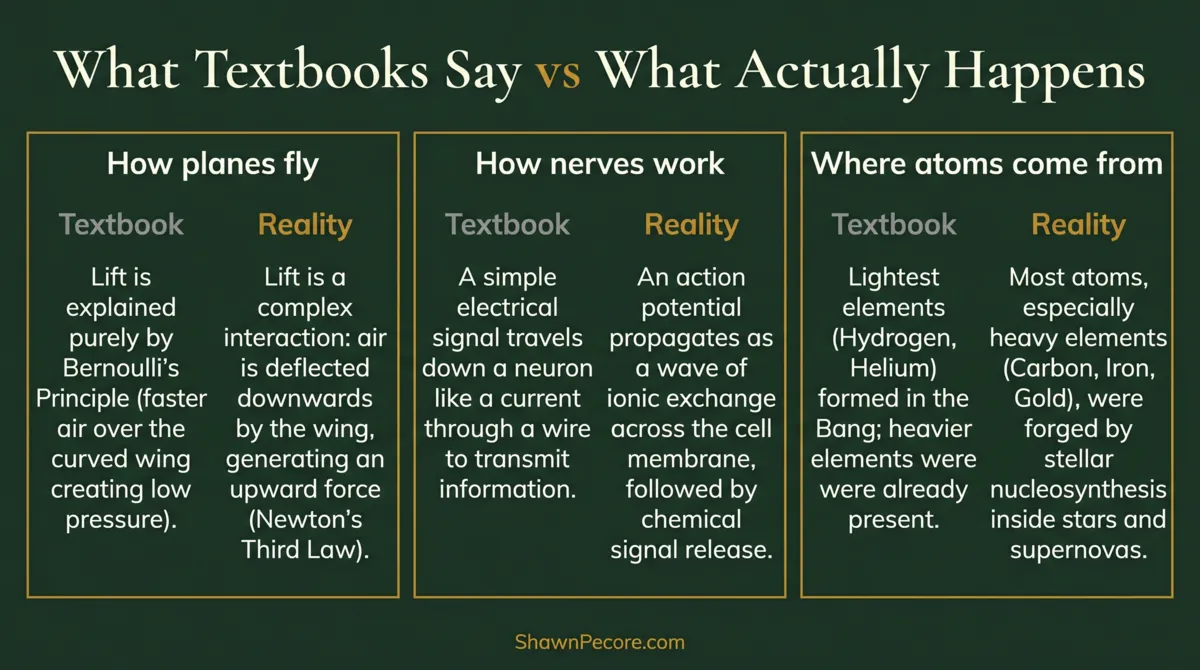
How Airplanes Actually Fly (And Why the Textbook Version Is Wrong)
The standard explanation in most elementary and middle school textbooks goes like this: an airplane wing is curved on top and flat on the bottom. Air splits at the front of the wing and must rejoin at the back at the same time. Because the top surface is longer, the air on top must travel faster. Faster air creates lower pressure, per Bernoulli's principle. Lower pressure above the wing creates lift.
This is called the equal transit time theory. It is wrong.
Dr. Holger Babinsky, Professor of Aerodynamics at the University of Cambridge, put it directly: "I don't know when the explanation first surfaced but it's been around for decades. You find it taught in textbooks, explained on television and even described in aircraft manuals for pilots. In the worst case, it can lead to a fundamental misunderstanding of some of the most important principles of aerodynamics."
High-speed smoke tests in aerodynamic wind tunnels show that air on top of the wing arrives at the trailing edge significantly before the air on the bottom. There is no rule requiring them to meet. An eleven-year-old applying basic logic will ask the obvious question: who decided the air has to arrive at the same time? And if the flat part has to face down, how do stunt planes fly inverted?
The accurate explanation works like this. The wing introduces a shape into the airflow. Its shape and angle of attack influence the airflow and pressure around it, including lower pressure over much of the upper surface. More directly, the wing deflects a large mass of air downward. By Newton's Third Law, the air pushes back up with equal force. That upward force is lift. Stunt planes flying inverted simply reverse the angle of attack to redirect the deflection.
The mechanism fits. The equal transit time theory does not. And a curious child will tell you so.
The annual value of the American textbook industry. It operates on state adoption contracts, not scientific accuracy. Publishers who lose a major state contract lose millions in guaranteed revenue. That financial pressure shapes what mechanisms get explained and which ones get replaced with approved summaries.
How the Brain Tells the Hand to Move (And Why "Electrical Wire" Is Wrong)
The textbook version: the brain sends electricity down the nerves like signals through a copper wire.
The wire comparison is useful in one respect: nerve signals are electrical. But neurons are living cells, not metal conductors. Their membranes and ion channels control where the electrical change happens. The signal does not simply leak away into surrounding tissue.
The accurate explanation uses a different image: a row of dominoes.
A neuron maintains different concentrations of charged ions inside and outside its membrane. When a signal begins, sodium channels open in one small region of its axon. Sodium ions enter, changing the local voltage. That electrical change triggers neighbouring channels farther along the same axon, producing a travelling action potential. Potassium channels help each region return toward its resting state. When the signal reaches the axon ending, chemical messengers can carry the message across a synapse to the next neuron or to a muscle.
Electrical currents do flow locally through the membrane and inside the axon, but the signal is regenerated along the nerve rather than carried like current through a copper wire.
Think of the axon as a row of dominoes: each falling domino triggers the next, much as a patch of membrane triggers the adjacent patch. Unlike dominoes, each patch recovers as ions move and channels reset. At a synapse, a separate step passes the message to another cell. Damage to an axon or synapse can interrupt that carefully controlled pathway.
Two explanations for the same phenomenon. One is how textbooks describe it. One is how it actually works. Can you tell which is which?
Where the Carbon in Your Hand Actually Came From
The standard textbook explanation: the Big Bang created the universe and everything in it.
A child who asks "where did the carbon in my actual hand come from before the Earth was here?" has asked something that sentence cannot answer. The Big Bang produced mostly hydrogen and helium, with tiny traces of lithium. It did not produce significant quantities of carbon or oxygen. Carbon, oxygen, and iron did not yet exist.
The accurate chain starts with those hydrogen clouds. Gravity compressed them into dense concentrations until the pressure and heat reached the threshold for nuclear fusion. The first stars ignited. Inside those stellar cores, hydrogen atoms were fused together under conditions of extreme pressure and temperature, forging progressively heavier elements: helium, then carbon, then oxygen, then iron. Each step required more energy, more pressure, more heat.
Some massive stars eventually exploded as supernovae, dispersing newly formed elements. Other stars released carbon-rich material more gently through stellar winds. Both processes enriched the gas and dust from which later generations of stars and planets formed.
Gravity gathered those clouds again. Some of that matter collapsed into new stars. Some of it formed planetary systems. The carbon, oxygen, nitrogen, and iron in the cloud that became our solar system ended up in the Earth, in the oceans, in every organism that has ever lived.
The carbon in a human hand was forged in earlier generations of stars and released into space long before Earth formed. Saying "we are made of stardust" is not a poetic flourish. It is a description of stellar nucleosynthesis. One parent on a science forum described explaining this to their child and reported the child's response: "You and I and rocks and trees are made out of stardust." The child understood immediately. The mechanism is not too complex. It is just rarely offered.
What to Do When the Question Comes
Most parents who have experienced the dinner table paralysis describe the same feeling: a combination of pride that the child is asking and anxiety about getting the answer wrong. The anxiety is understandable. The good news is that "I don't know" followed by finding the real answer together is not a failure. Research on children's explanatory preferences consistently shows that a genuine mechanistic answer, even a delayed one, produces far better retention and satisfaction than a simplified placeholder.
The dinner table is not a test. A child who sees a parent track down the real answer and return with it has learned something more transferable than any single fact: that questions worth asking are worth pursuing past the first available answer.
The three mechanisms above (how lift really works, how nerve signals actually travel, where the atoms in your body came from) are real science at the level children can follow. None of them required removing the mechanism. They required translating it.
That is the principle behind the MEYE Science Series: accurate science for children aged 8 to 12, written by a classroom teacher with science and engineering experience, structured to explain how things work rather than just what happens. All titles are coming soon. See the full series
If this is the kind of science you want your child reading, the Shawn Pecore Substack is where I write it first. Free.
Frequently Asked Questions
Most textbooks use the equal transit time theory to explain lift, which has been shown to be incorrect by aerodynamics researchers. The theory persists because it is easy to write in simple language. The accurate explanation involves air being deflected downward by the wing's angle of attack, creating a pressure drop above the wing. Textbooks avoid this because it requires more mechanistic explanation than their reading-level targets allow.
The equal transit time myth states that air splits at the front of a wing and must meet at the back at the same time. Because the curved top is a longer path, the air must move faster, creating lower pressure. This has been proven false by wind tunnel tests. Air on top arrives at the trailing edge significantly before the air on the bottom. The actual mechanism of lift involves the wing deflecting air downward and Newton's Third Law.
Yes. The domino analogy works well for this age range. Ion concentration differences across a neuron’s membrane create a resting voltage. Sodium enters a small part of the axon when channels open, triggering adjacent channels along that same cell. Signals pass to other neurons across synapses. Children aged 8 to 12 can follow this explanation when it is presented clearly. It is more satisfying than the wire analogy because it answers the obvious follow-up question: how does electricity travel safely through a wet body?
The Big Bang produced mostly hydrogen and helium, plus traces of lithium. Stars subsequently forged carbon and many other heavier elements; stellar winds and some supernova explosions returned them to space. That matter eventually clumped back together under gravity to form Earth and everything on it, including the human body. This is why "we are made of stardust" is scientifically accurate rather than just poetic.
Children aged 8 to 12 are in a developmental window characterised by strong mechanistic reasoning. They want to know how things work at a causal level, not just what happens. Research shows they are not satisfied by circular or metaphorical explanations and stop retaining information that does not match their logical expectations. The questions feel hard to adults because the textbook version of the answer was never correct to begin with.
Say you don't know, and then find the real answer together. Research on children's explanatory preferences shows that a genuine mechanistic answer, even a delayed one, produces far better retention and satisfaction than a simplified placeholder. The dinner table is not a test. A child who sees a parent track down the real answer learns something more lasting than the science itself.
Children's mechanistic reasoning, ResearchGate (ResearchGate) · Young children prefer and remember satisfying explanations (PMC) · Cats, Bats, and People: children's understanding of genes and trait inheritance (Boston University) · Mechanistic reasoning in biology among elementary school children (Taylor and Francis) · How wings really work, University of Cambridge (Cambridge University) · What is aerodynamics, grades 5 to 8 (NASA) · Neuron action potentials: the creation of a brain signal (Khan Academy) · A textbook example of what's wrong with education (Edutopia) · Science group finds middle school textbooks inadequate (Education Week) · Children's surprising capacity for scientific literacy (ScienceDaily) · New study on children's flexible thinking across rules and meaning (Harrisburg University) · Where did everything come from, r/Parenting 2026 (Reddit)
Back to: The Question Every Curious Kid Asks That Textbooks Never Answer