How AP Students Think vs How Textbooks Assume Kids Think
May, end of the school year, advanced physics class. The thousand-page textbook is a doorstop. Every student in the room is watching a twelve-minute video that explains torque through animation. The publisher assumed children learn by reading sequential disconnected facts. The students figured out years ago that they do not.
The Doorstop
Standard AP textbooks run to 1,000 pages or more. The page count is not incidental. It reflects a deliberate design philosophy. Cover as many topics as possible across as many state standards as possible, and do each one briefly enough that no district can object to what was omitted.
The result is a book that spreads thin across everything and goes deep on nothing. Students who need to genuinely understand how a physical system behaves find it useless. So they find something else.
Alternative instructional YouTube channels covering physics and advanced science have accumulated over a million subscribers each. The market is not rejecting difficult content. It is rejecting content that does not teach. One advanced history and science student described it directly. Textbooks distract him because reading them feels passive, while dynamic videos feel like a conversation and allow better retention. One teacher in an r/Teachers discussion put it differently. Textbooks are written to the lowest common denominator, watered down to be marketable across every level of rigor.
The pattern that produces this outcome does not start in high school. It starts when a child is handed their first illustrated science encyclopedia and learns, without anyone saying so, that science is a collection of facts to receive rather than a set of processes to understand. This connects to what AP physics and young learners reveals about the source of the problem. The textbook model is the end of a chain that starts in elementary school.
What AP Physics 1 Actually Demands in 2026
The College Board revised the AP Physics 1 framework effective fall 2024. The emphasis on explaining mechanisms matters for parents of children who are currently seven or eight years old.
The 2024 framework emphasises more than algorithmic memorisation, including three connected science practices: Conceptual evaluation, experimental design, and the creation of multiple representations. Students must construct free-body diagrams and energy bar charts. They must explain physical systems through visual heuristics, not just numerical answers. The exam tests whether a student can reason about an unfamiliar situation from physical principles, not whether they can retrieve a formula.
Some teachers report supplementing static textbooks with conceptual workbooks, discussions, and practical tasks. These examples show alternative approaches, not a representative national trend.
A study involving 1,000 high school students found that answer-giving algorithmic tools reduced learning while conceptual tools improved it. The students who had access to tools that required them to reason through the physics, rather than tools that provided the answer, retained more and performed better. That result holds at every age. Algorithmic shortcuts do not build understanding. They replace it.
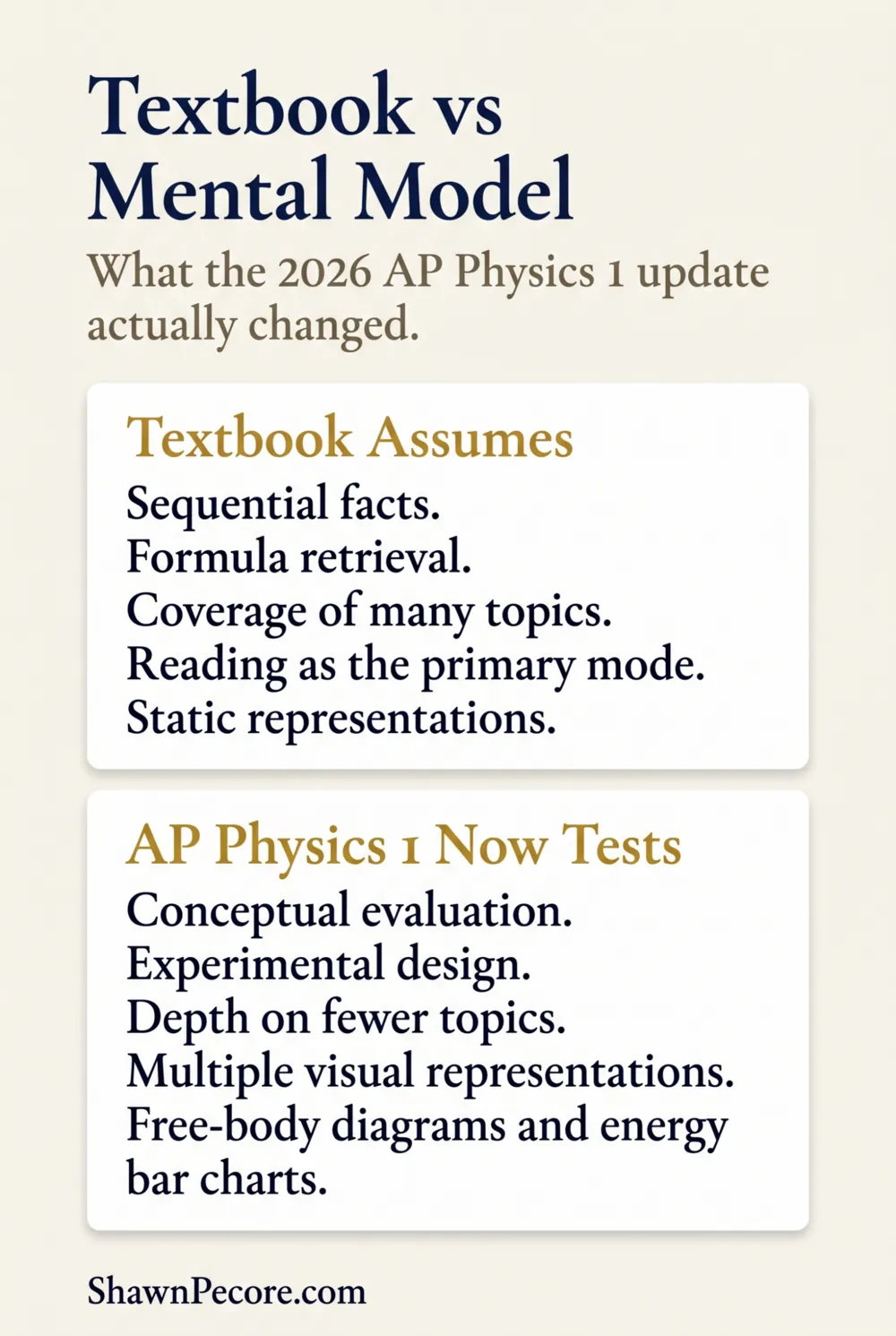
The textbook assumes children learn by reading sequential facts. Advanced students demonstrate, consistently, that they do not.
The Atomic Model Problem
Textbooks for elementary and middle school students routinely present the Bohr model of the atom. Electrons orbiting a nucleus like planets orbiting the sun, in fixed circular paths, at discrete distances. It is clean. It is visualisable. It is wrong in ways that matter.
Quantum mechanics describes electrons as existing in probability clouds, not fixed orbits. The concept of a definite electron path is not a simplification of the truth. It is a contradiction of it. A student who has the solar-system atom as their mental model must unlearn it entirely before they can engage with quantum mechanics. That unlearning takes weeks in an advanced classroom. It requires a teacher to actively dismantle a belief the student holds with confidence because they learned it in a book and it was never challenged.
Research into physics education confirms that textbook visual representations frequently fail to align with how students actually construct mental models. The static, two-dimensional Bohr diagram leaves students without any concept of quantum probability or the three-dimensional shape of electron orbitals. The AP Physics 1 course framework effective fall 2024 includes working with representations and understanding the limits of physical models. The textbook that planted the Bohr model as fact makes that demand significantly harder to meet.
Seth French, co-author of the National Council of Teachers of English media statement, argued that the time has come to teach media literacy alongside reading, and to include texts that feel conceptually deep rather than simply sequential. Maryanne Wolf, a cognitive neuroscientist at UCLA, adds the important counterpoint. Deep reading remains essential for building the critical thinking circuits in the brain, but only when the text demands depth. A static encyclopedic textbook demands very little.
What Dynamic Mental Models Look Like
The students who do well in AP Physics are not, on the whole, the students who memorised the most.
They are the students who retained something from earlier in their education. The ability to visualise a physical problem before picking up a calculator. They can picture what happens to the energy in a system when one variable changes. They can reason about direction and magnitude without a formula as the entry point. The formula is the last step. The model comes first.
A Pew Research Center report published in January 2025 found that 26% of surveyed US teenagers had used ChatGPT for schoolwork. It did not determine that all those students were using AI to cheat or bypass learning. The survey does not tell us whether a student used AI responsibly, dishonestly, or simply as a search and explanation tool. Students who use AI to retrieve an algorithm for a homework problem and then cannot apply any reasoning to an unfamiliar exam question are not the villains of that story. They are the predictable output of a system that taught them to retrieve rather than reason.
Teachers who moved away from textbook-constrained instruction report saving an average of 5.9 hours per week on preparation, per Gallup in 2025. That time was spent on instruction that actually produced understanding. The textbook was not making anyone more efficient. It was creating work that did not transfer.
What Parents Can Do About It
The practical implication is specific. Reject encyclopedic fact books. A book that covers 500 topics at two sentences each is not building a mental model of anything. It is providing a list.
Look for books that take one phenomenon and go deep. One question, followed by the actual mechanism, explained clearly enough that a curious child can build an internal picture of what is happening. That picture is what survives into advanced coursework. The list does not.
Encourage children to draw what they think is happening. Not what a diagram in a book shows. What they believe the process looks like, in their own spatial language. That act mirrors the use of representations built into the AP Physics 1 course framework effective fall 2024. A child who has been doing it since age nine is not starting from scratch at sixteen.
Ask for the mechanism, not the name. When a child tells you what something is called, ask how it works. The name is the address. The mechanism is what lives there.
The MEYE Science Series is built on this principle throughout. One phenomenon per book, explained at the level a curious reader can follow, with no simplification that plants a misconception for a future teacher to dismantle. See the full MEYE Science Series for current and upcoming titles.
Frequently Asked Questions
Because textbooks prioritise coverage over cognitive depth. Well-produced educational videos take one concept and explain it through dynamic visual models, demonstrating how physical systems behave rather than listing facts. Students who need to understand torque or quantum superposition find a strong twelve-minute video teaches the mental model far more efficiently than forty pages of sequential text. The audience is voting with their attention, and they are not wrong.
Students who rely on memorisation alone may struggle. The AP Physics 1 framework effective fall 2024 emphasises conceptual reasoning and experimental design alongside appropriate mathematical work. A student who memorised every equation but never built a mental model of how energy flows through a system will fail the conceptual questions that now make up a substantial portion of the exam. The students who consistently do well can visualise a physical system before picking up a pencil.
A mental model is an internal, visualisable representation of how a physical system works. Rather than recalling a formula, a student with a strong mental model can picture energy moving through a system, predict the direction of a force, and reason about what happens when a variable changes. Research finds that mental models form independently of mathematical formalisms. A student who has the model can apply the formula meaningfully. Without the model, the formula is a tool with no context.
Start with a phenomenon, not a topic. Find something observable and ask the child what they think is happening and why. Let their prediction be wrong. Ask what they would need to change about their model to account for what actually happened. That sequence, observe, predict, test, revise, is scientific inquiry and it requires no textbook. When the child needs to go deeper, books that take one phenomenon seriously and explain the full mechanism are far more useful than encyclopedic references.
The conceptual and science-practice emphasis is part of the AP Physics 1 framework effective fall 2024; the 2026 clarifications changed exam details, not this central teaching philosophy. Students must construct free-body diagrams and energy bar charts rather than primarily writing equations. The exam tests whether a student can explain a physical phenomenon from first principles, not whether they can retrieve the correct formula. The update formalises what good physics teachers have known for years. Understanding the mechanism matters more than knowing the equation.
College Board AP Physics 1 Course and Exam Description, effective fall 2024, with fall 2026 exam clarifications (College Board)
ScotScoop, from textbooks to TikTok, how teens are rewriting AP prep, 2024 (ScotScoop)
David Cutler via Medium, beyond down with textbooks, rethinking resources for today's students, 2024 (Medium)
r/Teachers, do you use textbook to teach, community discussion, 2024 (Reddit)
r/ScienceTeachers, how do you teach science, community discussion, 2024 (Reddit)
ERIC, mental models in AP physics versus elementary science textbooks, atom representation study, 2024 (ERIC)
Seth French, NCTE media statement on decenting textbook reading, via AP News, 2024 (AP News)
Maryanne Wolf, deep reading and critical thinking, via AP News, 2024 (AP News)
Pew Research Center, teens using ChatGPT for schoolwork, January 2025 (Pew Research)
Gallup Poll, teachers using dynamic digital resources, time savings data, 2025 (Gallup)
NSTA Blog, seven essential tips for modern science instruction, Rachael Toy, 2025 (NSTA)
Part of the series: What I Learned Teaching AP Physics That Changed How I Write for Kids