What I Learned Teaching AP Physics That Changed How I Write for Kids
I teach AP Physics. Every year. And after a decade of it, I can tell you exactly when a student's conceptual understanding of physics died. Not in high school. In fourth grade, when someone handed them a vocabulary list and called it science. The problem with how we approach AP physics for kids is not that we start too early. It is that we start too late. With the wrong thing entirely.
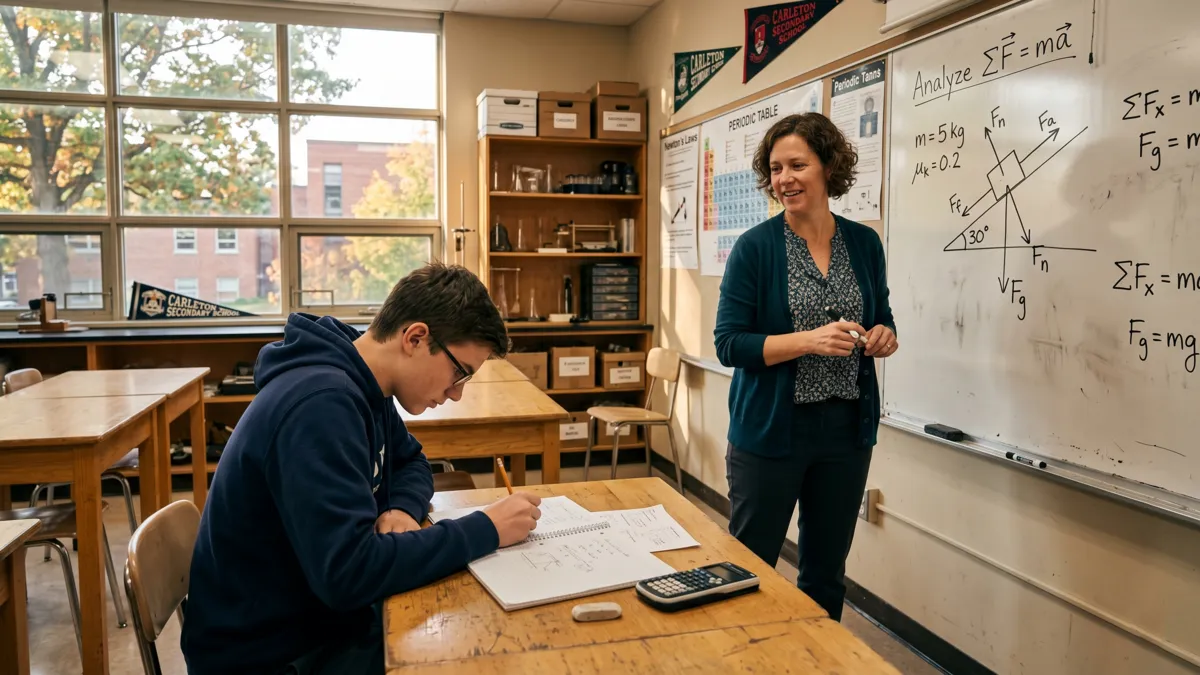
The students who do well in AP Physics are not the ones who memorised the most. They are the ones who kept their eight-year-old instinct to visualise before calculating.
- Some chemistry students who solve quantitative problems successfully still struggle with related conceptual questions. The formula does not transfer to understanding.
- Elementary students receive an average of 18 minutes of science instruction per day compared to 89 minutes of ELA. The conceptual gap starts here.
- Research from Frontiers in Psychology in 2026 found an effect size of 1.18 on abstract reasoning tasks for children aged 8 to 12 given structured logic work. They can handle far more than the curriculum offers.
- The AP Physics 1 framework effective fall 2024 emphasises conceptual reasoning and experimental design alongside mathematical work. That contrast offers useful lessons for elementary teaching.
- Children who arrive at advanced physics with strong mental models consistently outperform those who memorised more equations. The model comes first. Always.
The Ramp Problem
Here is something I see every year without fail.
I give an AP Physics class a conceptual question about a block sliding down a ramp. No numbers. No formula needed. What is happening to the energy, and why? Half the class immediately flips to the formula sheet. They scan it looking for something involving mass, acceleration, kinetic friction. The physical reality of the block on the ramp is irrelevant to them. They are looking for an equation that fits the shape of the problem.
Now ask a nine-year-old the same question, framed as a skateboard on a hill. No formula sheet. No prior instruction. What do you think is happening? A child may reason about speed, hills, and friction using everyday observations, even without algebra. Both students can learn physics, but a formula search alone is not a mechanistic explanation.
That gap is not natural. It is manufactured by a decade of science education that rewarded finding the right answer over understanding the right process.
The National Academies of Sciences, Engineering, and Medicine confirmed the pattern in 2024. Some chemistry students who solve quantitative problems successfully still struggle with related conceptual questions. High grades in formula-based science do not transfer to conceptual understanding. They never did. The curriculum just never asked anyone to notice.
What AP Physics 1 Actually Tests
The College Board revised the AP Physics 1 course framework effective fall 2024. Its emphasis on reasoning is worth understanding even if your child is eight years old.
The update moves the course away from algorithmic memorisation and toward three things. Deep conceptual evaluation, experimental design, and the creation of multiple representations. Free-body diagrams. Energy bar charts. Visual heuristics that require a student to construct a picture of a physical system before writing a single number. The exam is now explicitly testing the mental model, not the formula retrieval.
What the research says, confirmed by the College Board's own documentation, is that introducing these visual practices in elementary school prevents the cognitive dissonance that shows up at the advanced level. A child who has been drawing energy flow diagrams since age nine does not freeze when an AP exam asks them to represent a system visually. It is already how they think.
Steve Heimler, a prominent advanced physics educator, described the problem he sees consistently. Students buried in thousand-page textbooks who cannot believe they can actually learn this material. The textbook did not prepare them to think. It prepared them to find things in a textbook. Those are not the same skill.
The gap between performing an algorithm and explaining a physical mechanism remains an important challenge for science instruction. The exam changed. The pipeline feeding into it largely has not.
Why the Mental Model Breaks Down Before High School
Research into physics education is clear on one point that elementary curricula almost universally ignore. Mental models form independently of mathematical formalisms.
In practice this means a child does not need to understand algebra to build an accurate mental model of how gravity works. The model comes first. The algebra, when it arrives, gives the model precision. But if the algebra arrives before the model exists, the student has nowhere to put it. They memorise the formula in isolation and it sits there, disconnected from any physical understanding of what it represents.
The atom-as-solar-system error is the cleanest example. Children learn that electrons orbit the nucleus like planets orbit the sun. It is intuitive, it is visually clean, and it is wrong in a way that actively damages what comes next. Quantum mechanics requires unlearning it entirely. Every AP Physics teacher I know has had this conversation. The mental model was planted in the fifth grade. The unlearning happens at sixteen.
In the 2019 NAEP science assessment, 36% of US fourth-graders reached NAEP Proficient or above. 30% never or rarely engage in scientific inquiry activities at all. The elementary cognitive capacity is there. The curriculum is not meeting it.
The Statistics No One Talks About
18 minutes.
That is the average daily science instruction time for children in grades K through 3, per the National Survey of Science and Mathematics Education. They receive 89 minutes of ELA instruction in the same day. Nobody made a deliberate decision that reading matters more than understanding the physical world. It accumulated. Testing pressure, resource allocation, instructional minutes. All of it pushed science to the edge of the day.
What can you do with 18 minutes? A worksheet. A short video. A vocabulary exercise. There is no time for prediction, no time for observation, no time for a child to construct a mental model from something they actually watched happen.
That is where the gap starts. Not in high school physics. At age seven, in the 18-minute slot between reading and lunch.
The materials filling those 18 minutes are their own problem. Many contain early science misconceptions dressed as simplifications, planted so early that neither the child nor the parent notices until a high school teacher has to dismantle them.
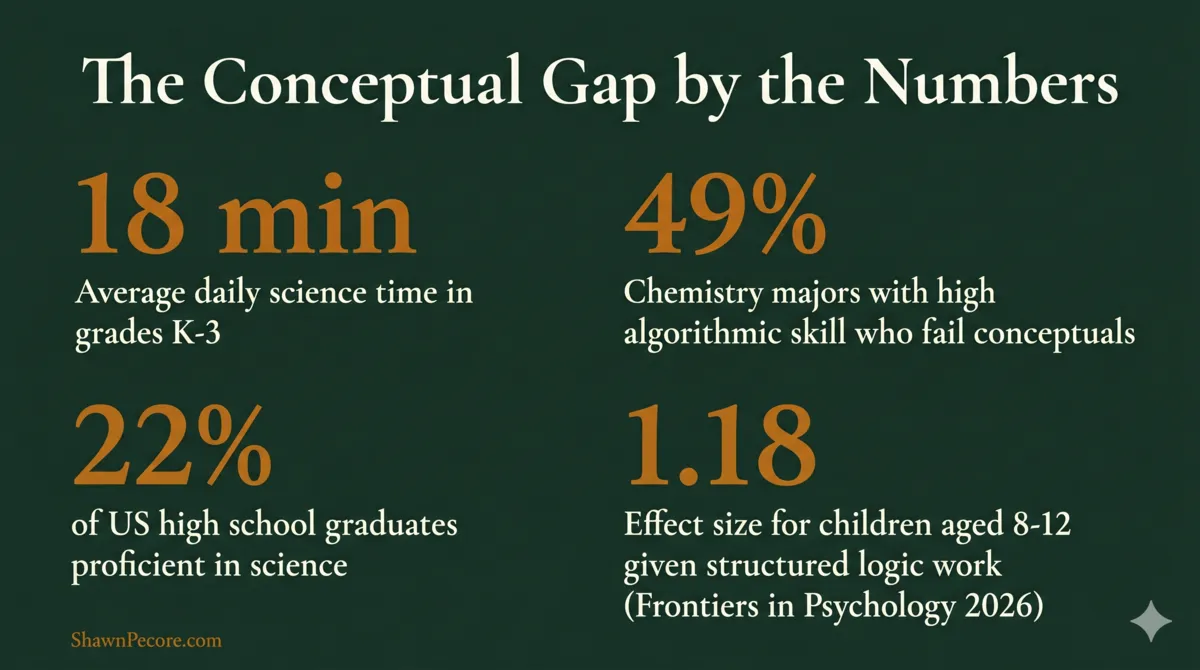
The conceptual gap that shows up in AP Physics was not created in high school. The 18-minute daily science slot in early primary school is where it starts.
What an 8-Year-Old Gets Right That a 16-Year-Old Gets Wrong
The research finding that stopped me in my tracks came from PMC in 2024. Younger children show cognitive advantages in probabilistic evaluation and causal detection when algebraic requirements are removed. Younger children can sometimes approach unfamiliar problems without the habits developed through years of formula-focused teaching; that does not establish that they generally outperform older students in physics.
That finding is counterintuitive enough to be worth sitting with for a moment. The child who has not been formally taught physics is reasoning about physical causation more accurately than the student who has been trained in physics formulas for four years. The training, when it goes wrong, is making things worse.
The Frontiers in Psychology study from 2026 put numbers on what happens when you give children aged 8 to 12 the right kind of challenge instead. After a structured coding and logic intervention, the effect size on decomposition tasks was 1.18. That is large. Pre-test computational thinking scores of 20.4 became post-test scores of 30.6. These were not exceptional children. They were ordinary primary-school students given work that actually matched their cognitive capacity.
Daniel Willingham, writing in the American Federation of Teachers journal in 2026, addressed the attention span debate directly. Children's ability to control attention has not been compromised, he found. They have simply become faster at identifying when they are bored. The behavioural disruption in a science class with worksheets is not attention deficit. It is a child recognising, accurately, that the cognitive floor is below them.
This is not an argument for acceleration. It is an argument against deceleration. Children are ready for real conceptual science between 8 and 12. The window is there. Most curricula do not use it.
What This Means for Science Books
I started writing the MEYE Science Series because of what I see in my AP classroom every May.
The students who are doing well are not the ones who read the most science encyclopaedias as children. They are the ones who had books, or adults, that took one physical phenomenon seriously and explained how it actually worked. One thing, completely. Not five hundred things at two sentences each.
Maryanne Wolf, a cognitive neuroscientist at UCLA, makes the point plainly. Deep reading strengthens the circuits in the brain tied to critical thinking, but only when the text demands it. A book that delivers a fact and moves on is not building those circuits. It is providing storage. Storage is not the same as understanding.
Understanding how AP students actually learn makes the implication clear. A child who has spent years reading books that go deep on one thing, that require visualisation, that do not flinch at giving the real mechanism, arrives at advanced physics with something no formula sheet can provide. A working internal model of how physical systems behave.
That is what the MEYE Science Series is built to give them. See the full MEYE Science Series for current and upcoming titles.
This is what I write about every week on Substack. The science behind how children learn science. Follow along for free.
A 14-minute overview of Newtonian mechanics, energy, and thermodynamics. Watch it alongside your child. The goal is not to master every detail. It is to show what a conceptual map of physics looks like before the algebra takes over.
Try It: Conceptual Readiness Check
Seven scenarios. For each one, decide whether the response described builds a mental model or trains fact retrieval. Parents, you can do this with any science book your child currently owns. The results sort into three tiers.
Frequently Asked Questions
AP Physics 1 is a college-level introductory physics course taken in high school. The AP Physics 1 framework effective fall 2024 emphasises conceptual reasoning, experimental design, and multiple representations; fall 2026 clarifications adjusted exam details. What this reveals about younger kids is significant. The skills that distinguish high-performing AP students are not mathematical. They are conceptual. Children who arrive with a strong mental model of how physical systems work consistently outperform those who memorised more formulas. That foundation is built, or not, between ages 8 and 12.
Yes. Research in Frontiers in Psychology in 2026 found an effect size of 1.18 on decomposition tasks for children aged 8 to 12 after structured logic work. A separate PMC study found that younger children show cognitive advantages in causal detection when algebraic requirements are removed. The barrier to physics at this age is almost never cognitive. It is curricular.
A mental model is an internal visualisation of how a physical system works. Rather than retrieving a memorised formula, a student with a strong mental model can picture energy moving through a system, predict what happens when a variable changes, and construct an explanation from first principles. Research confirms that mental models form independently of mathematical formalisms. A student who never builds the model but memorises the equations will succeed on formula-based tests and fail on conceptual ones. The AP Physics 1 course framework effective fall 2024 tests conceptual reasoning alongside mathematical modelling.
Because school science and advanced physics test different things. School science rewards memorisation, correct labelling, and following a procedure to a known result. Advanced physics rewards constructing a mental model of an unfamiliar system and explaining a phenomenon even when a reference sheet is available. A student who excelled at the first has been well trained for something that does not transfer to the second. A single national proficiency rate for all high school graduates cannot be inferred from NCLB or ESSA without a clearly defined assessment and population. The gap is not intelligence. It is the wrong kind of preparation.
It should take one phenomenon and go deep. Not 500 topics at 100 pages. One question, the actual mechanism, explained at the level a curious child can follow without the explanation being false. The text should demand something from the reader. A prediction, a process to follow in their head, a question to carry away. Maryanne Wolf at UCLA notes that deep reading strengthens critical thinking circuits, but only when the text demands that depth. A book that delivers a fact and moves on does not meet that bar.
The current average is around 18 minutes per day in grades K through 3, compared to 89 minutes of ELA. That ratio is a significant contributor to the conceptual gap that shows up in high school physics. Research does not specify a single number, but Dr. Pam Goodner notes that dedicated science instructional time leverages innate curiosity and builds critical thinking competencies. At minimum, the 18-minute average needs to be treated as an acknowledged problem, not a normal baseline.
National Research Council, Science Teaching Reconsidered, misconceptions in science education, 1997 (National Academies)
NAEP Nation's Report Card, fourth-grade science proficiency data, 2019 (nationsreportcard.gov)
College Board AP Physics 1 Course and Exam Description, effective fall 2024; 2026 exam clarifications (College Board)
PMC, cognitive development and children's advantage in causal detection, 2024 (PMC)
Frontiers in Psychology, enhancing computational thinking through coding interventions for ages 8-12, effect size data, 2026 (Frontiers in Psychology)
Daniel Willingham, cognitive science and attention spans in children, American Federation of Teachers, 2026 (American Educator)
ERIC, mental models in AP physics versus elementary science textbooks, 2024 (ERIC)
Steve Heimler via ScotScoop, from textbooks to TikTok, AP prep, 2024 (ScotScoop)
Maryanne Wolf, deep reading and critical thinking circuits, via AP News, 2024 (AP News)
NSSME, average daily science instruction time in grades K-3, 18 minutes versus 89 minutes ELA, via Edutopia 2024 (Edutopia)
Dr. Pam Goodner, dedicated science instructional time and student competencies, via Edutopia 2024 (Edutopia)