Why Age-Appropriate Science Is Often Just Dumbed-Down Science
A ten-year-old can hold a question in mind, test it against what they already know, and update their thinking when the evidence does not fit. That is not a description of a gifted child. Decades of cognitive research show it is a description of most children in this age range. The science books they are handed do not reflect this.
- Children aged 8 to 12 can reason about abstract scientific systems, a fact well-established in neuroscience but largely ignored by publishers
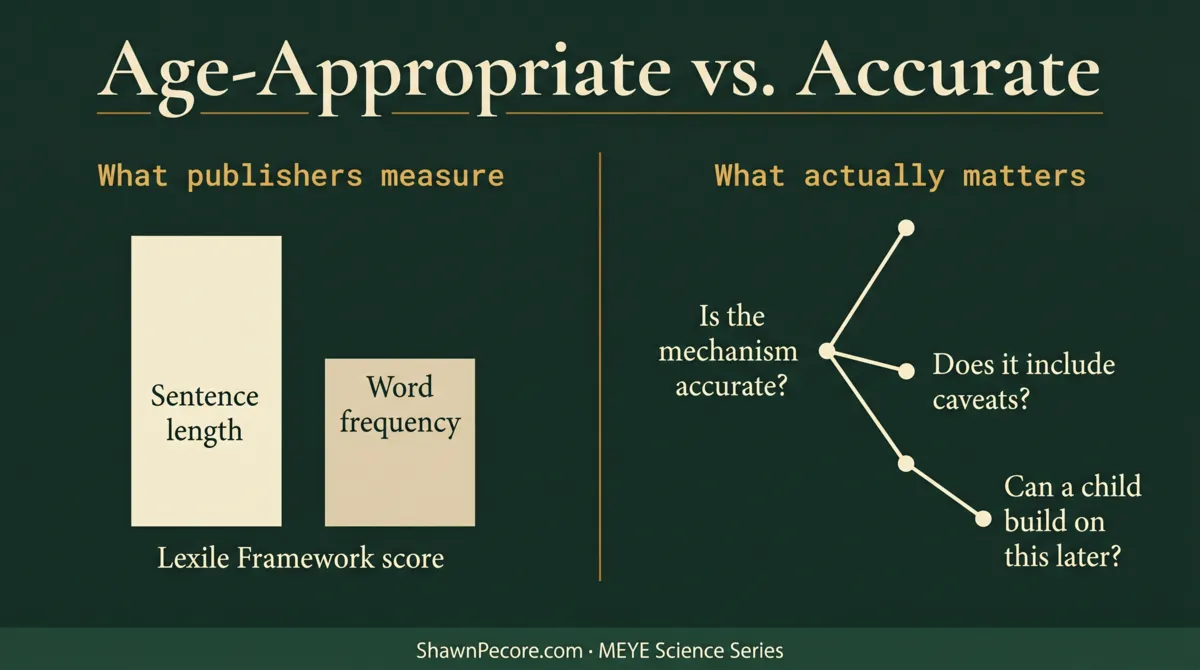
- Reading-level algorithms measure vocabulary frequency and sentence length, not the accuracy or depth of the science being explained
- A review reported in 2001 estimated that around 80 percent of US middle-school pupils then used science textbooks containing documented errors
- Repeated exposure to oversimplified science creates a false sense of mastery that leaves students unprepared when they encounter rigorous material later
Why the standard for age-appropriate science leaves curious kids underserved.
What "Age-Appropriate" Actually Means to a Publisher
When a publisher labels a science book as appropriate for ages 8 to 12, they are usually referring to a score produced by an algorithm. The most widely used is the Lexile Framework for Reading, which evaluates text complexity based on two variables: how frequently each word appears in general written language, and how long the sentences are.
That is it. The algorithm says nothing about whether the science is correct.
The stratification of children's books by age and reading level is a relatively recent development, taking hold during the market shifts of the 1980s and 1990s. Before that period, science writing for young readers was less constrained by graded vocabulary restrictions. The contemporary system pushed authors and editors toward shorter sentences and more common words. In most kinds of writing, that produces clarity. In science writing, it produces a different problem.
Accurate scientific explanations depend on dependent clauses. On caveats. On the specific conditions under which something is true. "Lightning never strikes the same place twice" is short and uses simple words. "Lightning preferentially strikes tall, conductive objects and will repeatedly strike the same location if the same physical conditions are present" is accurate. A readability score alone cannot judge which explanation is scientifically accurate; the first statement is a common misconception.
Major publishing programs still lag years behind developments in educational research, because they require evidence of broad market acceptance before investing in new approaches. The typical adoption cycle for instructional materials in public school systems can stretch seven years. The books children read today are often built on pedagogical assumptions from a decade ago.
What Children This Age Can Actually Handle
The publishing industry's justification for aggressive simplification has leaned heavily on Jean Piaget's stages of cognitive development, specifically the assumption that children between seven and eleven are locked in a "concrete operational" stage and cannot reason abstractly. That model is now substantially revised by the research that followed it.
Modern neuroscience shows the period from 8 to 12 years old is marked by rapid structural changes in the prefrontal cortex, particularly in the region associated with self-generated abstract thought and relational reasoning. Children in this window are not just becoming capable of abstract thinking. They are actively developing it.
The behavioural data confirms this. A 1999 study by Chen and Klahr found that children as young as seven could be explicitly taught the Control-of-Variables Strategy, a core component of scientific reasoning that requires isolating independent variables and holding other factors constant. What matters more: the children transferred this skill to new domains they had not encountered during training. They were not just following a procedure. They understood the principle.
There is a counterintuitive finding worth knowing. Because preadolescents have less developed selective attention filters, they distribute their attention more broadly than adults. Adult scientists tend to focus on data that confirms what they already think. Children are often better at detecting novel causal patterns and anomalous information, precisely because they have not yet developed the same confirmational habits. In some pattern-recognition tasks, the 8-to-12-year-old brain has a measurable advantage over adult cognition.
The failure, as the research consistently frames it, lies not in the child's capacity to grasp the science. It lies in presenting science as a list of unconnected facts rather than as a system of interconnected mechanisms that actually explain how things work.
What Gets Lost When Science Gets Simplified
A review of twelve widely used US middle-school science textbooks, reported in 2001, estimated that around 80 percent of pupils at the time used these titles and documented factual errors in them. The researchers specifically looked for errors that would disrupt a student's understanding of physical laws, not minor editorial oversights.
The examples they documented are not subtle. One book labelled a photograph of the singer Linda Ronstadt as a silicon crystal. Another presented an incorrect formula for calculating the volume of a sphere. A third asked students to find the volume of an object while providing only depth and width, omitting the height entirely.
A separate analysis of Earth science textbooks used in secondary schools in England and Wales found over 500 instances of scientific misconceptions across 51 texts, with an average of one substantive error per page. Forty percent of the errors related to rock-forming processes, including a recurring confusion between weathering and erosion. The most common error was the claim that the Earth's mantle is entirely liquid or composed exclusively of magma, a misrepresentation the researchers traced directly to "overzealous attempts at oversimplification."
The Miller-Urey experiment is another routine casualty. Books regularly tell children that Stanley Miller created the building blocks of life by sparking a mixture of methane and ammonia. Most omit the critical detail that Miller intentionally excluded oxygen from the chamber. That omission is not a minor footnote. It is the entire point of the experiment. Without it, the student has a story, not an understanding.
Children are routinely taught there are three states of matter: solid, liquid, and gas. Plasma, the most abundant state in the observable universe, is left out. Bose-Einstein condensates, documented since 1995, do not appear in most elementary curricula. These are not advanced topics reserved for graduate study. They are part of the basic picture of how matter behaves.
Each statement below appears in a children's science book. Is it a useful simplification, or does it get the science wrong?
The Difference Between Simplifying for Clarity and Getting It Wrong
Terry Pratchett, mathematician Ian Stewart, and biologist Jack Cohen introduced the concept of "Lies to Children" in their work on science communication. A Lie to Children is a statement that is technically incomplete, but acts as a structured stepping-stone toward a more accurate understanding. Newtonian physics is the classic example. It is not the ultimate description of the universe, but it is mathematically consistent, functionally accurate at everyday scales, and a necessary foundation before quantum mechanics or general relativity make sense.
The model sets a clear limit on when this kind of simplification is acceptable. Lies of omission, leaving out tangential advanced variables, are acceptable. Lies of commission, stating things that are outright false, are not. And the most important test: if a teacher at the next level has to spend time actively unteaching the simplified version before they can build the accurate one, the simplification was a failure.
By that standard, telling a child the Earth's mantle is liquid magma is a failure. It is not a stepping-stone toward understanding mantle dynamics and seismic wave propagation. It is a wall that has to come down before the real explanation can go up.
True simplification for clarity belongs to the domain of language, not science. It means using precise words that are widely understood, cutting unnecessary qualifiers, and writing shorter sentences without removing the causal mechanism those sentences describe. The revision from "these approaches use different kinds of methodology" to "these approaches use different methods" improves readability without changing what is true. That is what simplification is supposed to do.
What Happens to the Child Who Gets the Watered-Down Version
When science is consistently presented to children as a static list of facts to memorise, something specific happens to their relationship with the subject. The child reads a simplified explanation of genetics and comes away believing they understand DNA replication. The explanation was smooth, the vocabulary was accessible, and there were no loose ends. It felt like understanding.
Then, in high school, they encounter epigenetics, RNA transcription, and the actual biochemical complexity of the process. The gap between what they were told and what they are now seeing is not gradual. It is a cliff. Many students interpret that gap as a personal failure. They were good at science when it was simple. Now that it is hard, they assume they are not good at science anymore.
Researchers have described this as the "easiness effect." Oversimplified content produces a false sense of mastery, which holds until the student encounters the real thing. The result is that students who were curious and capable abandon STEM fields not because the material exceeded their ability, but because the distance between their foundational knowledge and the rigorous version was larger than it needed to be.
Paleontologist Neil Shubin described his own schooling this way: "When I look back on the science I had in high school, I remember it being taught as a body of facts and laws you had to memorize. Not only does this approach whip the joy of doing science right out of most people, but it gives everyone a false view of science." The students he is describing were not poorly taught in terms of effort. They were taught science without the scientific method. Facts without mechanisms. Answers without questions.
What to Look for Instead
Good science books for this age range do exist. Within the homeschooling and gifted education communities, a few titles come up repeatedly. Building Foundations of Scientific Understanding by Dr. Bernard Nebel is often cited. It focuses on the interconnectivity of scientific disciplines and requires the student to use logical deduction and systemic observation. Parents describe it as demanding to teach and entirely worth it.
The markers that show up consistently in books parents return to:
The book explains why, not just what. A book that tells a child the Earth's tectonic plates move is a fact. A book that explains what drives that movement, what happens at the boundaries, and how we know what we know about the deep interior is science.
Real terminology is used and defined on first use. Avoiding the word "subduction" does not make plate tectonics more accessible. It makes it less accurate and leaves the child without the vocabulary to read further on their own.
Caveats and exceptions are included. "Newtonian mechanics works extremely well for everyday objects, but breaks down at very high speeds" is honest. It prepares the child for what comes next, rather than setting them up for a collision with it.
The book says when something is not fully understood. Real science has open questions. A book that presents everything as settled is not describing science.
The MEYE Science Series was built on these principles. Each title is written by a classroom teacher with science and engineering experience and decades in the field and in front of students. The science is accurate. The terminology is real. The books treat children aged 8 to 12 as capable of understanding how the world actually works. All titles are coming soon. See the full series
If this is the kind of science you want your child reading, the Shawn Pecore Substack is where I write it first. Free.
Frequently Asked Questions
Publishers use reading-level algorithms like the Lexile Framework that measure vocabulary frequency and sentence length, not the accuracy or depth of the science. To hit an age-appropriate score, authors shorten sentences and replace technical terms with common words. In science writing, those dependent clauses and precise terms are often where the accuracy lives.
Yes. Modern neuroscience research shows that children aged 8 to 12 are capable of abstract reasoning, hypothesis testing, and complex systems thinking. A 1999 study found that children as young as seven could learn and transfer the Control-of-Variables Strategy, a core component of the scientific method. The limiting factor is usually the books, not the child.
A science book is dumbed down when simplification changes what is true, not just how it is expressed. Useful simplification removes jargon and unnecessary qualifiers. Harmful simplification removes the causal mechanism, strips out caveats that determine when something is true, or replaces the actual explanation with an analogy that contradicts what a student will later learn.
Look for books written by working scientists rather than generalist authors. Check whether the book explains how things work, not just what happens. See whether it uses real scientific terminology and defines it on first use. Books that acknowledge uncertainty and open questions are a positive sign. The homeschooling and gifted education communities often surface the strongest titles.
Not reliably. A study reported in 2001 reviewed twelve popular US middle-school science textbooks and documented errors in the titles, which were estimated to reach about 80 percent of middle-school pupils at the time. A separate analysis of Earth science textbooks in England and Wales found an average of one substantive error per page across 51 texts.
Reading level is the wrong question. A curious 10 year old may read several years above grade level, but the more relevant question is whether the science in the book is accurate and whether the explanation respects the child's capacity for genuine curiosity. A book can score well on a Lexile algorithm and still get the science wrong.
Children's developing abilities make them better learners than adults in some tasks (PMC) · Development of abstract thinking during childhood (PMC) · Cognitive Development (NIH StatPearls) · Children's Scientific Reasoning Skills (Cambridge University Press) · Middle School Science Texts Full of Errors (Education Week) · Misconceptions in Earth Science Textbooks (ResearchGate) · Common Science Textbook Errors (The Sparrow's Home) · Lies to Children ( Vector BSFA) · Telling Lies to Children (SERC Carleton) · Reading Levels and the Stratification of Children's Books (Science Meets Fiction) · Dissemination Does Not Equal Public Engagement (PMC) · Dumbing Down: Why? What Are the Signs? (The Creativity Post)
Back to: Why Age-Appropriate Science Is Often Just Dumbed-Down Science