The Misconception About "Age-Appropriate" Science Content
Age-appropriate is one of the most well-meaning phrases in science education. It is also one of the most destructive when it gets applied to facts rather than language. A simplified explanation that is mechanistically false is not a stepping stone. It is a wall the child will hit six years later, when a teacher has to spend a month dismantling what a picture book constructed.

Simplifying the language is fine. Simplifying the facts is not. The distinction matters more than most children's science publishers acknowledge.
The Sponge Cloud
A parent buys a highly-rated illustrated STEM book. Seven-year-old, great reviews, nice illustrations. The book explains clouds this way. Clouds hold water like a sponge, and when they get too heavy, the water falls as rain.
The child believes it. Why wouldn't they? It is in a book. It makes intuitive sense. Nobody corrects it.
Six years later in earth science class, the teacher introduces atmospheric pressure, condensation nuclei, thermodynamics. The sponge is sitting there in the way. The teacher will spend weeks on it. A well-meaning picture book planted a false model so deeply that it takes a professional weeks to dig it out. That is the actual cost of getting this wrong.
Here is what clouds actually are. Tiny water droplets or ice crystals suspended in the atmosphere, formed when water vapour cools to the dew point around microscopic particles called condensation nuclei. That explanation is accessible at age seven. It requires a few more words than the sponge version. It does not require unlearning at fourteen.
This is one thread in a larger pattern. If you want to understand where the damage starts, AP physics and young learners traces it from elementary school all the way into the advanced classroom.
Three Examples of Scientific Misconceptions
A 1997 science-education guide published by the National Research Council describes five categories of misconception: preconceived notions, nonscientific beliefs, conceptual misunderstandings, vernacular misconceptions, and factual misconceptions. Here are three of those categories that are especially useful to recognise in children’s science books.
Preconceived notions come from observation. The sun appears to move across the sky, so the child concludes the sun is moving. They are observing something real and drawing the wrong causal conclusion from it. You cannot correct this by stating the truth. You have to show the child that two different mechanisms can produce the same observable result, and then give them evidence for which one is actually happening.
Vernacular misconceptions are trickier because they feel like understanding. Work in physics means force applied over distance, not effort. Theory means a rigorously tested explanatory framework, not a guess. Weight and mass are not the same thing. A child who uses these words the way everyone around them uses them has learned a language that will actively mislead them in a science class.
Factual misconceptions are just false. Lightning never strikes the same place twice. Objects sink if they are heavy. The Great Wall of China is visible from space. None of these are true. All of them are widely repeated. And you cannot fix them by telling a student they are wrong. The National Academies are explicit on this. Telling a student to dismiss a misconception does not work. The false model has to be actively dismantled through evidence that contradicts it directly.
Most children's science publishing produces all three types. Not through carelessness. Through the assumption that simpler is always safer. Sometimes it is not.
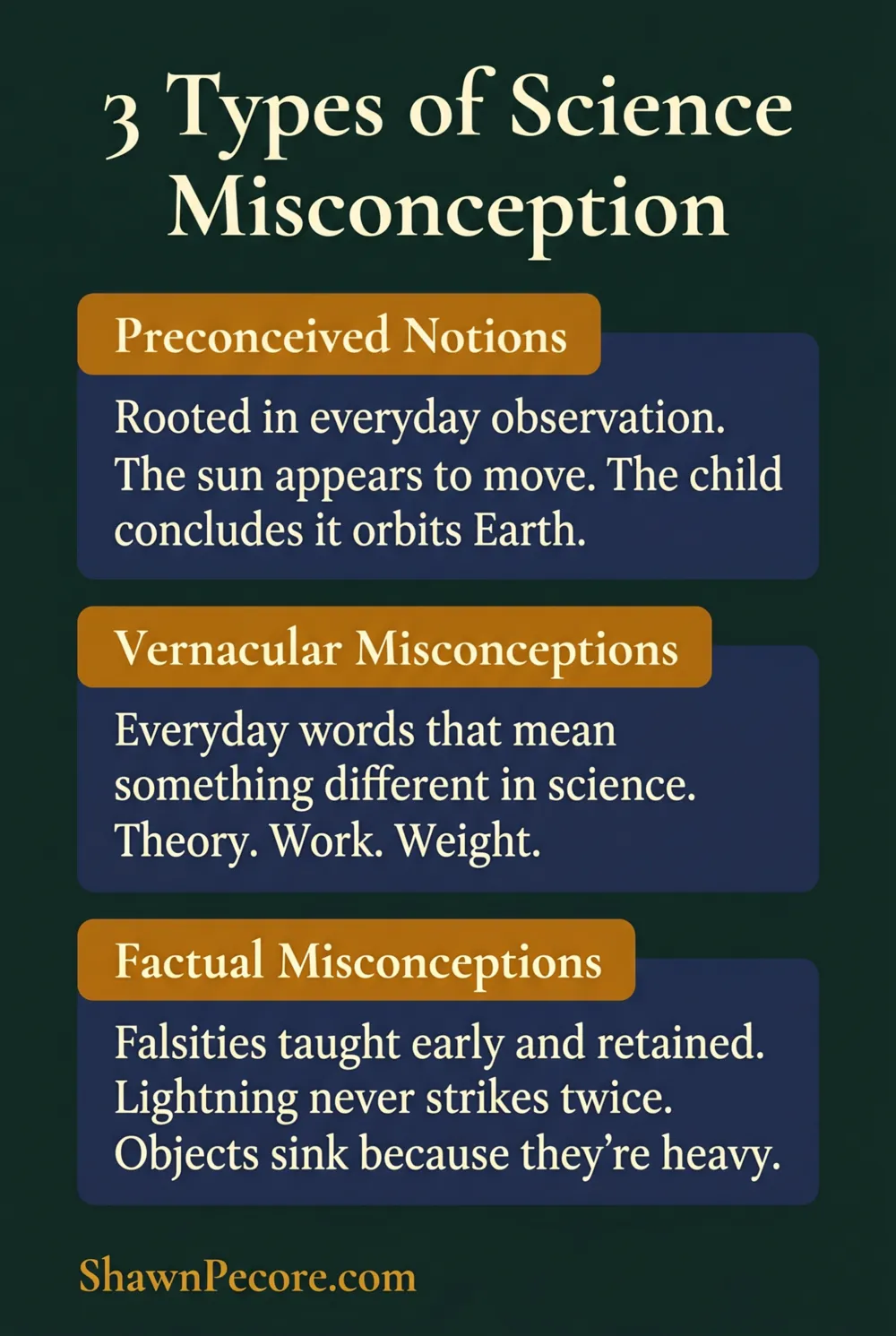
Three examples from a broader five-category framework. Each calls for careful diagnosis; a simplified explanation can sometimes reinforce a mistaken idea.
The Volcano Problem
The baking soda and vinegar volcano. You have seen it. Every school science fair. Every "fun STEM activity" list. It is everywhere and it is not science.
NAEYC put it plainly in 2024. When a child sees a dramatic reaction without understanding the chemistry behind it, they are watching a magic trick. The activity cements something specific in how the child thinks about science. That the visual result is the point. That the mechanism does not need to be understood. That the foam is the science.
Those children arrive in chemistry class years later expecting impressive reactions. When the teacher asks them to explain the ionic dissociation happening in the foam, they have nothing. They enjoyed it. Nobody gave them the mechanism.
It is not an isolated problem. Tasmania reported reviewing 235 identified literacy resources for alignment with evidence-based reading instruction and beginning to discontinue materials that did not align. The report does not say that 235 resources were removed, or that they were science resources. 30% of teachers are using AI weekly specifically to work around inadequate simplified curriculum materials, per Gallup in 2025. The teachers are aware. The curriculum market has been slow.
And the format is part of the problem. A static book cannot facilitate the kind of dynamic, corrective explanation that catching a misconception actually requires. That is the argument behind how textbooks reinforce those errors at every level of education.
What Accurate Early Science Actually Looks Like
NAEYC is clear on the distinction. Simplifying language is fine. Simplifying facts is not. Those are two different things and most children's science publishing treats them as one.
Put a cold glass on a table on a warm humid day. Ask the child where the water on the outside came from. They will look at it, think about it, and usually say something about the cold. That is the beginning of condensation. No false metaphor needed. The phenomenon is right there. You just have to ask the question instead of handing them an answer.
The same approach works for equilibrium, gravity, density, phase change. Show the thing. Ask what they notice. Ask what they think is happening. Ask what would change if one thing were different. None of those steps require dumbing the concept down. They require grounding it in something observable rather than something stated.
A 2025 Tigerville Elementary School report recorded 86% meeting or exceeding science standards; its 25.2-point advantage over the district average applied to mathematics. The school results do not establish the causal effect of a particular science programme. The size and transferability of changes in cognitive performance depend on the particular intervention and measure; no general annual IQ gain should be inferred from one programme. Accurate is not harder to teach. It is harder to find in the materials.
The MEYE Science Series starts from that premise. Real terminology, explained in context, grounded in observable phenomena, no simplification that requires a teacher to spend three weeks on the correction. See the full MEYE Science Series for current and upcoming titles.
Try It: Misconception Detector
Ten statements. Some accurate. Some vernacular misconceptions. Some factual misconceptions. For each one, decide whether you would be comfortable telling it to a child as science fact. The feedback after each answer names the type of misconception if one exists and explains why.
Frequently Asked Questions
A factual misconception is a falsity taught early and retained unchallenged into adulthood. The National Academies define it as something a teacher cannot correct by simply telling the student the correct answer. The misconception has to be actively dismantled through evidence. Common examples include the belief that lightning never strikes twice, that objects sink because they are heavy, and that the Earth is closer to the sun in summer.
Simplifying language is fine. Simplifying facts is not. The NAEYC framework makes this distinction clearly. Early childhood educators can use age-appropriate language without sacrificing accuracy. A child can learn what condensation means if you explain it simply alongside an observable example. What they should not receive is a metaphor that is mechanistically false, because the false model will be harder to correct later than it was to install.
Not on its own. NAEYC describes it as a magic trick rather than a science activity when the child does not understand the chemistry. A dramatic result without a mechanism teaches that science is spectacle. If the child can explain why the reaction produces gas, what acid-base chemistry means, and how to vary the outcome by changing proportions or temperature, it becomes science. Without that understanding, it is just foam.
Do not simply tell them the correct answer. The National Academies are explicit on this point. Telling a student to dismiss a misconception is not effective. Ask the child how they came to believe what they believe. Then set up an observation that produces a result their current model cannot explain. The goal is genuine cognitive dissonance, where the child's existing model fails to predict what they observe. That failure opens the space for the correct model.
A vernacular misconception occurs when an everyday word has a different technical meaning in science. "Theory" means a well-tested explanatory framework, not a guess. "Work" means force applied over distance, not effort. A factual misconception is a straightforwardly false belief, like lightning never striking twice. Vernacular misconceptions are corrected by clarifying the technical definition. Factual misconceptions require evidence that contradicts the existing belief.
National Research Council, Science Teaching Reconsidered, misconceptions in science education, 1997 (National Academies)
NAEYC, debunking seven myths about STEM in early childhood, 2024 (NAEYC)
Moss Valley Primary Academy, common misconceptions in science document, 2024 (Moss Valley Academy)
Tasmanian Government Department of Education, lifting literacy implementation plan, 235 resources de-implemented, 2024 (Tasmania Dept of Education)
Greenville County Schools, elementary science outcomes with rigorous frameworks, 2025 (Greenville County Schools)
Generation Next Research, IQ gains from rigorous educational instruction, 2026 (Generation Next)
Gallup Poll, teachers using AI to bypass inadequate curriculum materials, 2025 (Gallup)
ERIC, exploration of common student misconceptions in science, 2024 (ERIC)
Part of the series: What I Learned Teaching AP Physics That Changed How I Write for Kids