Engagement vs Accuracy in Science Education: The False Choice
The pitch for most children's science content goes something like this: we have simplified the complex concepts so children can actually enjoy learning them. The implication is that accuracy and engagement are on opposite ends of a dial: turn up the engagement and you have to turn down the accuracy. This is wrong, and there is now enough research to say so clearly.

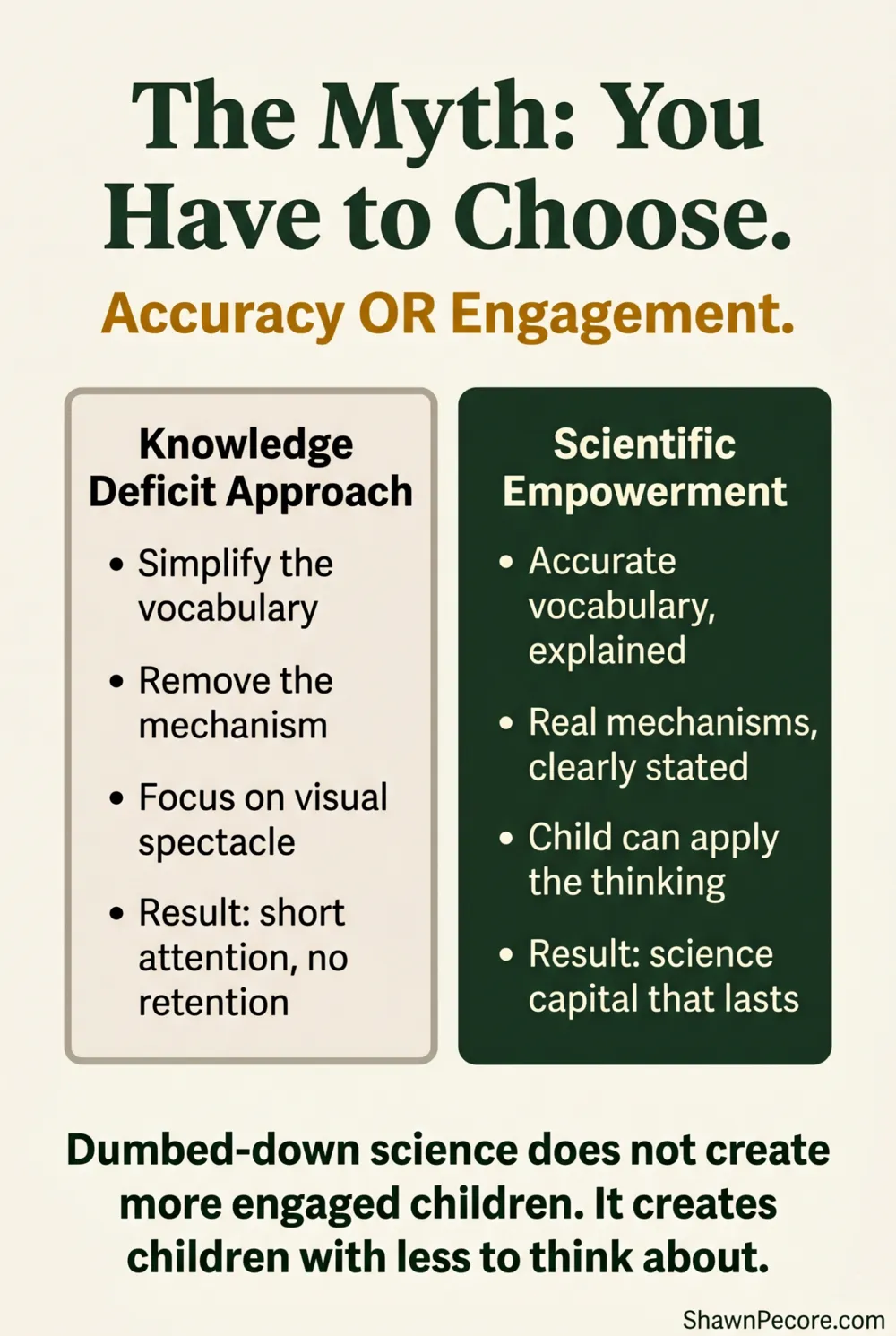
- 2026 research on science communication definitively dismantles the "knowledge deficit" model: simplifying scientific facts does not increase engagement or trust in science
- 93% of educators agree student engagement is a critical metric, but engagement and actual learning are not the same measurement (Discovery Education/Hanover, 2025/2026)
- What builds long-term engagement is "scientific empowerment": giving children the tools to think scientifically about their own lives, including accurate vocabulary and real mechanisms
- A short, accurate media literacy intervention improved discernment between real and false news by 26.5% in a PNAS study. Accuracy, taught correctly, creates durable capability
- Deep, accurate problem framing is precisely the skill that cannot be replicated by AI, and it cannot be built by content that strips out the depth
The False Premise
Watch a group of pre-teens with a gamified science app. Tap the screen to earn points. Levels unlock. Cartoon avatars cheer. The room is quiet, the students appear focused, and the teacher has a moment to breathe. When the app comes off and a written question about the same content appears on paper, the results are often poor.
The app engaged their dopamine system. It did not engage their scientific reasoning. Those are different systems, and conflating them is the error at the centre of most modern children's science content.
Louis Deslauriers at Harvard put the research clearly: "Deep learning is hard work. The effort involved in active learning can be misinterpreted as a sign of poor learning. On the other hand, a superstar lecturer can explain things in such a way as to make students feel like they are learning more than they actually are."
The smooth, simplified, visually stimulating experience feels easy and accessible. The accurate, rigorous explanation feels harder. The harder one produces durable knowledge. The smooth one produces a pleasant hour and forgotten content.
What Engagement Actually Means
Engagement is one of those words that has been hollowed out by overuse. A 2025/2026 Discovery Education survey found that 93% of educators believe engagement is a critical metric for understanding achievement, and 99% of superintendents consider it one of the top predictors of school success. Everyone agrees engagement matters. Almost no one is measuring the same thing.
Behavioural engagement means the child is present, attentive, and participating. Cognitive engagement means the child is actively reasoning, evaluating, and connecting new information to prior knowledge. A child can have 100% behavioural engagement and 0% cognitive engagement. The app produces the first. Science education requires the second.
Research from Education Week, published in April 2026, documents this gap precisely in mathematics, but the principle applies directly to science. A classroom where 100% of students call out an answer simultaneously looks engaged. As the researcher reflected afterwards: "What were they thinking?" The surface engagement was complete. The cognitive engagement was unverifiable and, in follow-up assessment, largely absent.
True engagement in science looks like a child who is confused by a result, wants to understand why, and pursues that understanding past the point where the activity ended. That kind of engagement is built by giving the child something real to be confused about. Not by removing the confusion in advance.
Scientific Empowerment vs Dumbed-Down Science
Research published in the Journal of Science Communication in 2026 draws a clear distinction between two approaches. The traditional model, called the "knowledge deficit" approach, assumed that public disengagement from science was caused by ignorance and that broadcasting simplified information would fix it. Decades of this approach later, the data shows it has not worked.
The emerging model is called "scientific empowerment." Researchers Anne Toomey and Kevin C. Elliott define it as focusing on "the individual and collective science-related choices, agency, and capital made available to people," highlighting equitable access to the benefits of science as a basic human right.
Science capital, the individual's accumulated scientific knowledge and confidence, is not built by simplification. It is built by genuine engagement with real mechanisms, real vocabulary, and the experience of actually using scientific thinking to evaluate something in the real world. A child who learns the term "non-Newtonian fluid" and understands what it means has gained science capital. A child who learns that "it acts like liquid and solid at the same time" has gained an interesting description that connects to nothing else.
A PNAS study found that a short, scalable media literacy intervention improved participants' ability to distinguish between real and false news by 26.5%. Accuracy, when taught as a skill with real tools, creates capability. The lesson extends directly to science: giving children the real vocabulary, the real mechanisms, and the habit of asking for evidence produces learners who can evaluate science throughout their lives.
The Vocabulary Question
One specific argument for simplification is that scientific terminology intimidates children. The evidence does not support this.
Children aged 8 to 12 are in a developmental window characterised by strong mechanistic reasoning. They want to know how things actually work at a causal level. Research from Boston University found that second-graders could develop genuine mechanistic understanding of genetic inheritance when the explanation was accurate and clear. The terminology was not the barrier. The quality of the explanation was.
The MEYE Science Series is built on this observation. The books use real scientific vocabulary, introduced and explained on first use, because treating a curious child's intellect with respect means giving them the actual words. A child who finishes MEYE Plate Tectonics knowing what subduction means has something they can build on. A child who finishes a simplified version knowing that "the plates push against each other" has a description that goes nowhere.
The vocabulary does not replace the explanation. It is part of the explanation. A good definition gives the child a label for something they have now understood mechanistically. That label is a hook everything else can hang on.
What This Looks Like in Practice
When your child is doing a science activity, resist the temptation to replace the scientific term with a description. If they are making slime, tell them they are making a non-Newtonian fluid, and then explain what that means. If they are observing rust, tell them they are watching an oxidation reaction, and then explain what iron and oxygen are doing to each other.
The explanation does not need to be complete. A partial but accurate explanation is better than a complete but incorrect one. "The iron is combining with oxygen from the air to form iron oxide, which is rust" is accurate, partial, and gives the child a framework for the next question. "The metal gets old and breaks down" is inaccurate and connects to nothing useful.
When the child asks a follow-up question you cannot answer accurately, say so. Look it up together. That act teaches something more durable than any single piece of content: that science is a process of finding out, not a fixed set of simplified answers.
This post is part of a series on science activities that actually teach. My main blog post, The Problem With 'Making Science Fun', covers the full framework. A related post, Inquiry-Based Learning Without Rigor: Why It Fails, addresses the specific problem of applying exploration before building a foundation.
Frequently Asked Questions
No. Research from 2026 on science communication shows that simplifying scientific content to the point of removing accuracy does not increase engagement or trust in science. What does increase long-term engagement is scientific empowerment: giving children the actual tools to think scientifically about their own lives. Dumbed-down science produces short-term attention and long-term disengagement.
Yes. Using correct scientific terminology, explained on first use, does not reduce engagement. It treats the child's intellect with respect. A child who hears "non-Newtonian fluid" after making cornstarch slime has learned a category that connects to a wide range of phenomena they will encounter. Replacing the term with a description strips the child of a conceptual tool they could use.
Scientific empowerment focuses on giving individuals the agency to use accurate scientific methods to understand and influence their own lives. For children, this means building science capital: a sense that science belongs to them and is relevant to their experience. Science capital is built through accuracy, engagement with real mechanisms, and genuine inquiry, not by gamified apps that strip out vocabulary in favor of points and avatars.
Does science communication have its goals wrong, Toomey and Elliott, JCOM, 2026 (JCOM) · Student engagement research, Discovery Education/Hanover, 2025/2026 (Discovery Education) · Digital media literacy intervention, PNAS, 2024 (PNAS) · Deslauriers, L., active learning and perceived learning, Harvard 2025 (Harvard Gazette) · I Thought I Knew When Students Were Engaged, Education Week, April 2026 (EdWeek) · Transformative Experience Research, Seeing Science Project, PMC, 2024/2025 (PMC)
Back to: The Problem With 'Making Science Fun'