Inquiry-Based Learning Without Rigor: Why It Fails and What to Do Instead
Inquiry-based learning is the right idea applied wrong roughly half the time. The concept is sound: children learn better by doing science than by watching it described. The problem is the "doing" often happens before the child has any framework to make sense of what they are doing, and the result is not learning. It is confusion that looks like engagement.

- Cognitive Load Theory establishes that novice learners cannot simultaneously figure out task rules and learn underlying concepts. Unguided inquiry forces both at once
- The 2024 research consensus: direct instruction first, guided inquiry second. The sequence matters as much as the method
- A University of Groningen meta-analysis found an overall effect size of 0.66 for adequate guidance on learning activities in inquiry-based instruction, meaningful and consistent across studies
- 30% of fourth-grade teachers report conducting scientific inquiry-related activities never, or only once or twice a year (NAEP survey data, 2019/2025)
- Letting a child "discover" a concept they have no vocabulary for produces frustration, not curiosity
The Unguided Inquiry Problem
A common setup: a parent puts ramps, toy cars, and measuring tapes on the floor and tells a child to "explore how things move." The child crashes the cars into each other for twenty minutes. Everyone had fun. No physics was learned.
The problem is not the child and it is not the activity. It is that exploration without a question to answer produces play, not inquiry. Play is valuable. But it is not science.
The child in this scenario is experiencing momentum, friction, and gravity without any framework to recognise what they are experiencing. They have no vocabulary to attach to what they observe. They have no question that would let them notice whether their observations are consistent or surprising. The ramp and the car and the measuring tape are props in an unstructured activity.
Give the same child a question first: does changing the angle of the ramp change how far the car travels? Now they have something to test. Now the measuring tape is a tool rather than a toy. The inquiry is still happening. But it is guided by a question that requires an answer.
What Cognitive Load Theory Says
Cognitive Load Theory, developed by educational psychologist John Sweller and supported by decades of research, establishes that working memory is limited. When a learner is given a complex task with no prior knowledge, the cognitive system splits its limited capacity between figuring out what is happening and trying to learn the concept. Neither task gets the attention it needs. The concept does not transfer to long-term memory.
For novice learners, unguided inquiry is not just ineffective. According to the research, it can actively interfere with learning. The cognitive effort of managing an open-ended task crowds out the space needed for conceptual processing.
The car mechanic analogy is useful here. You do not learn to change oil by being handed an engine and told to figure it out. Someone shows you. They name the parts. They explain what each step does and why. After you have that foundation, you start doing it yourself. The inquiry comes after the instruction, not instead of it.
A University of Groningen meta-analysis of inquiry-based learning found an overall effect size of 0.66 for adequate guidance on learning activities. That is not a marginal difference. Guidance changes outcomes in ways that are measurable and consistent across studies.
The Research Consensus in 2024
The most cited debate in educational research over recent years has been direct instruction versus inquiry-based learning. Both sides produced strong arguments and real evidence. The resolution reached in 2024, based on accumulated research, is that the debate was asking the wrong question.
Educational researcher Ton de Jong summarised it directly: inquiry-based instruction produces better overall results for acquiring conceptual knowledge than direct instruction, but teachers should use both approaches. The key is sequence. Direct instruction builds the schema. Guided inquiry develops the deeper understanding that direct instruction cannot produce alone.
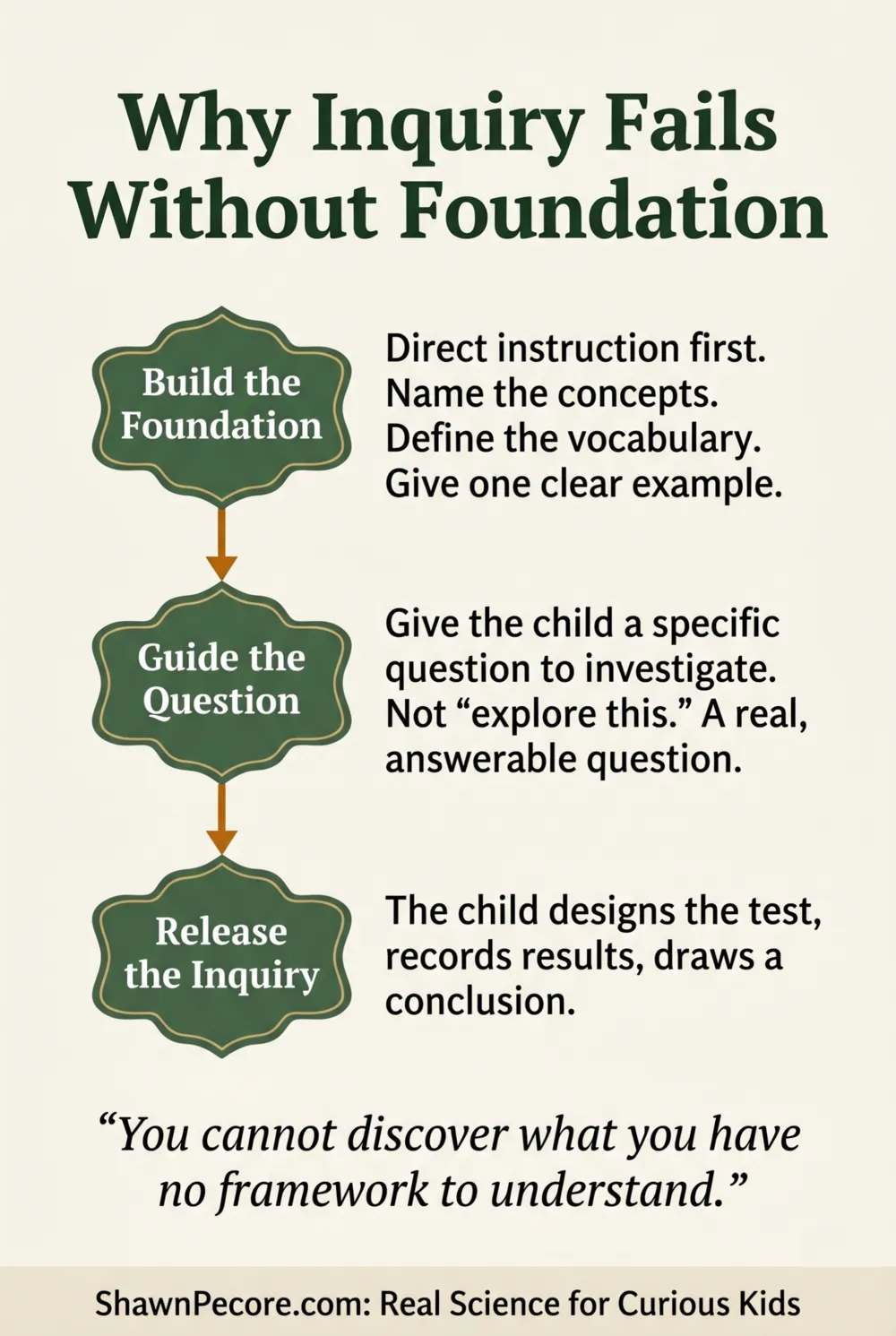
The practical implication: before asking a child to figure out why bridges hold weight, explicitly teach them what compression and tension are. Not a long lecture. Five minutes of clear explanation with an example they can visualise. Then ask the question. Then let them build and test.
The 50% replication rate of social science and educational research papers in the DARPA SCORE project is a reminder that widely adopted pedagogical theories deserve scrutiny. Inquiry-based learning applied without the preceding direct instruction is one of the more clearly documented examples of a method adopted at scale before the research on its preconditions was fully worked out.
What Guided Inquiry Actually Looks Like
The sequence is not complicated. Explain the concept first. Name the key terms. Give one example that makes the mechanism clear. Then ask a question that lets the child test the concept.
"A chemical reaction happens when two substances combine and create something new. Baking soda and vinegar react to produce carbon dioxide gas, which is what makes the bubbles. Now: do you think the amount of baking soda affects how much gas is produced? How would we test that?"
The child now has the vocabulary (chemical reaction, carbon dioxide, variable), the concept (reactions produce new substances), and a genuine question to investigate. The inquiry that follows is real scientific thinking, not supervised play.
Frustration is still possible and still valuable. If the child's prediction does not match the result, that is the experiment working correctly. What matters is that the child has enough foundation to reason about what might have gone wrong. Without that foundation, frustration has nowhere to go except away from science.
This post is part of a series on science activities that actually teach. My main blog, The Problem With 'Making Science Fun', covers the full framework for evaluating any science activity. A related post, Real Science Experiments vs Crafts: How to Tell the Difference, gives a practical rubric for evaluating any activity before committing to it.
Frequently Asked Questions
Inquiry-based learning fails when it is applied before the learner has a foundational understanding of the topic. Without prior knowledge, working memory is overloaded trying to figure out the rules of the task and learn the underlying concept simultaneously. Novice learners need direct instruction first to build a schema, and only then can meaningful inquiry begin.
Neither is universally better. The 2024 research consensus is that both are necessary and must be sequenced correctly. Direct instruction is mandatory for novice learners to build foundational knowledge. Once that foundation is secure, guided inquiry is superior for developing deep conceptual understanding. The combined, sequenced approach outperforms either method alone.
Guided inquiry means the learner explores within a structured framework. The teacher or parent has established the vocabulary, the core concept, and the question to investigate. The child then designs or conducts a test to find an answer. Unguided inquiry gives the learner materials and tells them to figure out what is happening without prior instruction. For novice learners, unguided inquiry produces confusion and frustration, not learning.
Meta-analysis of inquiry-based learning, Lazonder and Harmsen, University of Groningen (Pure.rug.nl) · Ton de Jong, inquiry vs direct instruction, Educational Research Review 2023/2024 (Hechinger Report) · NAEP science survey data, Nation's Report Card 2019/2025 (nationsreportcard.gov) · DARPA SCORE Project replication rate (DARPA) · Preservice teacher preferences in inquiry, Journal of Research in Science, Mathematics and Technology Education, 2025 (JRSMTE)
Back to: The Problem With 'Making Science Fun'