The Problem With 'Making Science Fun' (And What Works Instead)
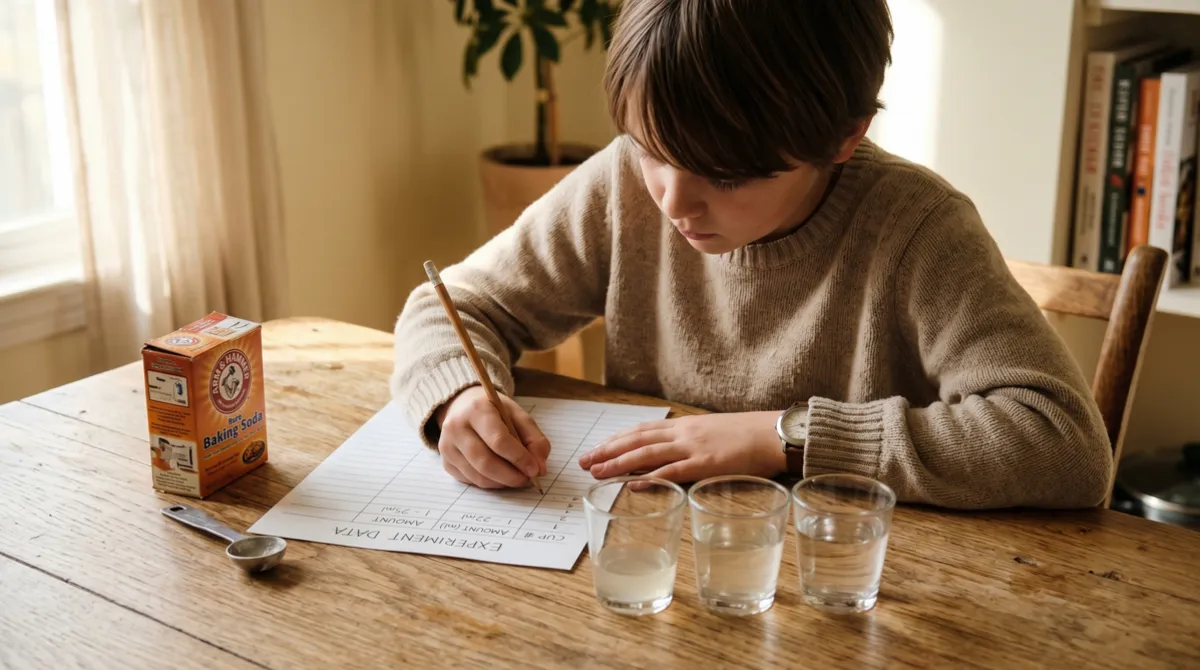
Every parent has watched it happen. A child mixes baking soda and vinegar, the foam erupts, the room cheers, and the activity is over. Ask the child what actually happened and they describe the bubbles. They cannot name the gas produced. They cannot explain why it happened. They have no idea what would change if you altered the ratio. A visually satisfying craft just happened, and it is being filed away in the child's memory as "science."
- 38% of eighth-graders scored below the basic proficiency level in science in 2024, despite decades of push for more engaging, activity-based learning (NAEP)
- A child can be fully hands-on in an activity and engage in zero scientific thinking. Educational researchers call this the hands-on versus minds-on gap
- Research from Cognitive Load Theory shows that unguided inquiry overwhelms novice learners and produces no durable learning. Guidance is not a crutch. It is a requirement
- Making science artificially easy does not increase engagement. Accurate, rigorous framing builds what researchers call "science capital," which produces greater long-term investment in science
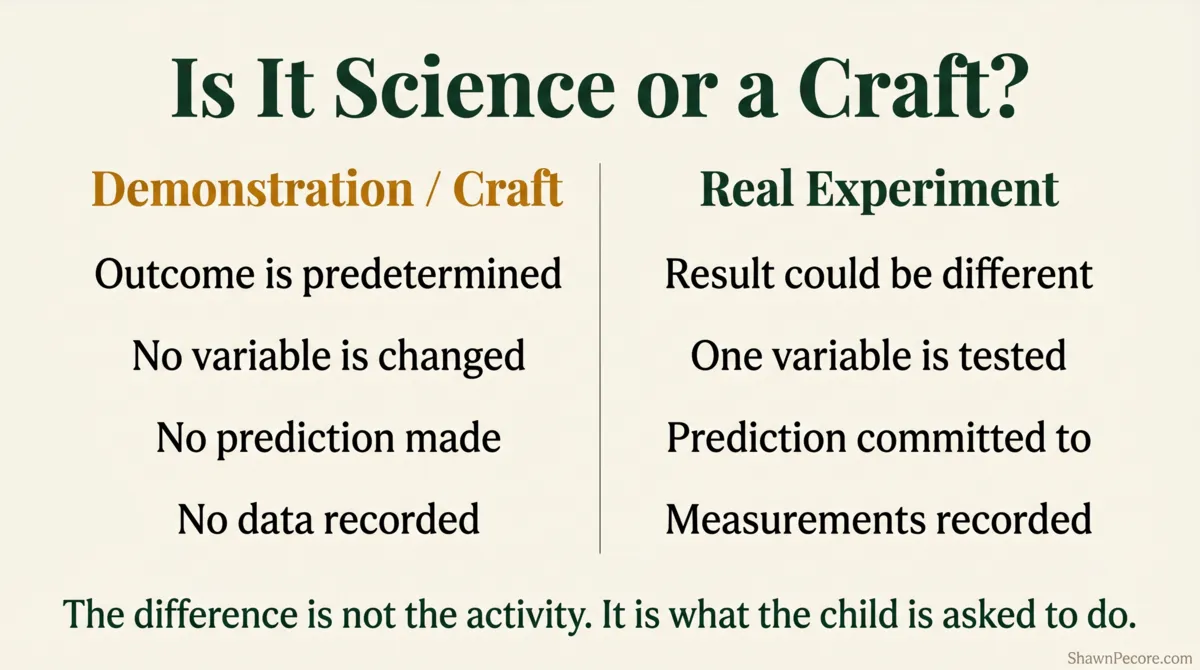
- A real science experiment requires a hypothesis, at least one variable, data collection, and a conclusion. If the outcome is predetermined and cannot be changed, it is a demonstration
The Baking Soda Volcano Problem
Walk into a kitchen where a child is doing a "science experiment" and the odds are good you will find one of a small set of activities: the vinegar volcano, the cornstarch non-Newtonian fluid, the cabbage pH indicator. All of these are in every children's science book. All of them involve real chemistry. And in most cases, none of them is teaching any chemistry.
The issue is not the activity. It is what the activity is asking the child to do.
In the standard version, the child mixes pre-set amounts of each ingredient, watches the reaction, and is congratulated for doing science. But nothing about that sequence required the child to think. They followed a recipe. The outcome was certain before they started. No question was asked. No prediction was made. No data was collected. The activity was structurally identical to following instructions to assemble furniture.
I have watched the same dynamic play out in classrooms. A well-designed activity collapses the moment we remove the cognitive requirement. Kids can be extremely busy, very engaged, and thoroughly entertained without their brain doing anything a science teacher would recognize as scientific thinking.
The vinegar volcano becomes a real experiment the moment the child is asked: what do you think happens if you double the vinegar? Write down your prediction. Now test it. Now measure. Now explain what you found. That version teaches variables. It teaches how to form and test a hypothesis. It teaches that science produces data, not just a cool reaction. It is also more interesting to the child, because now there is something to find out.
What the Data Actually Shows
Here is what decades of making science more fun and activity-based has produced.
The 2024 National Assessment of Educational Progress found that 38% of eighth-graders scored below the basic proficiency level in science. That score dropped 4 points from the 2019 cycle. Student-reported interest in science also dropped 10 points over the same period. Not stable. Down.
According to the same NAEP survey data, 25% of eighth-graders report persistently low levels of interest in science despite being in schools that have invested heavily in interactive, activity-based curricula. The activities are happening. The interest and the knowledge are not following.
The National Science Board's 2024 Science and Engineering Indicators found that only about 50% of American adults can correctly identify a scientific hypothesis when presented with a scenario. That is the adults, the product of all those years of science education.
None of this means science education is hopeless. It means the current approach is not working, and the approach has been optimising for the wrong thing.
Hands-On Is Not the Same as Minds-On
Educational psychologists have a useful distinction: hands-on learning versus minds-on learning.
Hands-on means the child is physically doing something. Mixing, building, measuring, pouring. Minds-on means the child is thinking while doing it. Predicting an outcome. Noticing when the result does not match the prediction. Adjusting a variable. Drawing a conclusion.
A child can be extremely hands-on while being completely minds-off. Elizabeth Bonawitz, Associate Professor at Harvard's Graduate School of Education, put it plainly in 2025: "Letting children think things through, giving them time to wonder and puzzle, shows how active learning can also happen through mental experimentation, not only hands-on activity."
What her research shows, and what classroom experience confirms, is that the physical component is not what drives the learning. The thinking is. A child given a ramp, a car, and a measuring tape and told to "explore how things move" will spend the time crashing the car into things. Entertaining. No physics learned. The same child, given the same equipment and asked to figure out whether the angle of the ramp or the weight of the car has a bigger effect on how far it travels, is now doing physics. The equipment did not change. The cognitive requirement did.
A meta-analysis of undergraduate STEM courses published in PNAS found that students in active learning courses were 1.5 times less likely to fail than those in traditional lecture-only formats. But that research defines active learning as cognitively demanding participation, not just movement or physical activity.
Why Difficulty Is Not the Enemy
The prevailing assumption in most children's science content is that difficulty is a barrier. If the child struggles, we have failed. So the activity gets simplified, the vocabulary gets replaced with descriptions, the steps get broken into smaller and smaller pieces until nothing can go wrong.
The research in cognitive psychology says the opposite.
Veronica X. Yan, a researcher at the University of Texas at Austin, has done significant work on what she calls the "difficulty-as-improvement" mindset. When learners interpret difficulty as a sign that they are growing rather than a sign that they are failing, their outcomes are measurably better. Conscientiousness goes up. Optimism goes up. Retention goes up. The same difficulty, framed differently, produces entirely different results.
Stripping difficulty out of science education does not help children. It removes the cognitive friction that produces actual learning. A child who has never had to work through a failed experiment has never experienced what science actually is. Science is mostly failure. Most experiments do not work the first time. Teaching a child that a good experiment always produces the expected result is teaching them something false about how science works.
When an experiment fails in my classroom, I say the same thing: this is data. A failed prediction is not a failed experiment. It is information. What changed? What did we learn? Where do we go from here? That reframe takes about thirty seconds and it shifts the entire experience. The child is no longer embarrassed by the failure. They are curious about it.
What Science Activities That Actually Teach Look Like
A real science experiment has four components. The absence of any one of them collapses the activity into a demonstration or a craft.
A question. Not "let's see what happens." A specific question: does the temperature of the water affect how fast sugar dissolves? Does the mass of a falling object affect how fast it falls? The question has to be answerable by the experiment. If you cannot design a test that could give you an answer, you do not have a scientific question yet.
A prediction. Before touching anything, the child commits to an answer. This is the hypothesis. It does not have to be correct. The entire point is to have something to test. A child who predicts that heavier objects fall faster has a stake in the outcome. They are now doing science, not watching science happen to them.
A variable. One thing that changes. Everything else stays the same. This is the hardest concept for young scientists to grasp and also the most important. If you change two things at once, you cannot know which change caused the result. Testing one variable at a time is not a rule scientists invented to be difficult. It is the only way to know what actually happened.
Data. Numbers, observations, measurements. Not memories of what the child thought happened. Written down. Recorded. Compared across multiple trials. Data is what separates science from storytelling about what we think we remember seeing.
A child who can consistently apply these four steps to any situation is doing science. The specific activity matters much less than whether those four elements are present.
How to Tell a Craft From an Experiment
Here is a quick test. Read the instructions for the activity. Then ask: if the child followed these instructions exactly, could they get a different result by changing something?
If the answer is no, because the instructions fully determine the outcome, it is a recipe or a demonstration. Nothing is being discovered. The child is performing steps someone else already worked out. That might be educational. It might be fun. It is not science.
If the answer is yes, because the child could alter a variable and potentially get a different outcome, you have a starting point for a real experiment. The question is whether the activity is set up to actually use that possibility.
The National Assessment Governing Board's 2028 NAEP Science Assessment Framework defines science achievement through three dimensions: Disciplinary Concepts (the content), Science and Engineering Practices (the methods), and Crosscutting Concepts (the overarching tools for applying knowledge). An activity that only touches the first dimension, by presenting a concept through a demonstration, is giving the child one third of science. The practices and the crosscutting concepts are where the thinking lives.
For more on applying a practical rubric to any activity, see the related post: Real Science Experiments vs Crafts: How to Tell the Difference.
Why Inquiry Without Foundation Backfires
The push for inquiry-based learning, where children discover scientific principles through exploration, has dominated educational reform for decades. It is well-intentioned. It is also frequently applied wrong.
Cognitive Load Theory, supported by decades of research in human cognitive architecture, establishes that working memory is limited. When a novice learner is placed in an unguided inquiry setting, they face two cognitive demands at once: figuring out the rules of the task and learning the underlying concept. For most novices, both tasks compete for the same limited cognitive space. The result is neither gets done properly.
Educational researcher Ton de Jong summarised the current scientific consensus: inquiry-based instruction produces better overall results for conceptual understanding than direct instruction, but only when students already have foundational knowledge. For novices, direct instruction has to come first. You cannot discover what you have no framework to understand.
This does not mean telling children everything. It means giving them enough to have a real question. "I'm going to tell you that the angle of a ramp affects how fast something slides down it. Now: does the weight of the object also matter? Design a test." That is guided inquiry. The child has a foundation and a genuine question. The exploration that follows is real scientific thinking.
The full argument is in the related post: Inquiry-Based Learning Without Rigor: Why It Fails and What to Do Instead.
The False Trade-Off Between Accuracy and Engagement
The argument for simplifying science usually goes: children are more engaged by accessible content. Accurate content is harder. Therefore, to keep children engaged, sacrifice some accuracy.
This argument has been tested. It does not hold up.
Research published in 2026 in the Journal of Science Communication found that the traditional "knowledge deficit" model (the idea that public disengagement from science is caused by a lack of simple facts) is wrong. Flooding people with simplified information does not increase their engagement or trust in science. What does work is what researchers call "scientific empowerment": giving people the actual tools to think scientifically about their own lives.
Louis Deslauriers, Director of Science Teaching and Learning at Harvard, documented this in work on student perception versus actual learning: "Deep learning is hard work. The effort involved in active learning can be misinterpreted as a sign of poor learning. On the other hand, a superstar lecturer can explain things in such a way as to make students feel like they are learning more than they actually are."
Using correct scientific terminology with a child is not a barrier to engagement. The term "non-Newtonian fluid" does not confuse children who have just made cornstarch slime. It names what they observed. It connects their experience to a category that explains many other things they will encounter. That connection is engagement. See: Engagement vs Accuracy in Science Education: The False Choice.
Practical Moves for Any Science Activity
You do not need to redesign the activity. You need to add the thinking layer on top of whatever you are already doing.
Before any science activity, ask three questions. First: what do you think is going to happen, and why? Make the child commit to an answer before touching anything. Second: what could we change to get a different result? This forces them to identify a variable. Third: how will we know what happened? This starts the conversation about measurement and data.
During the activity, resist the urge to explain the result as it unfolds. Wait. Let the child observe. Then ask: did that match your prediction? If not, why not? What would you have to change about your prediction to fit what actually happened?
After the activity, do not give the scientific explanation immediately. Ask for theirs first. A wrong explanation from the child that you then correct together is more valuable than a right explanation delivered by an adult before the child has tried. The cognitive struggle of forming and testing an explanation is where the learning happens.
When the experiment fails, and it will sometimes fail, say: this is data. Write down what happened. Ask: why didn't it work? That question, honestly pursued, is more scientifically valuable than a successful demonstration the child simply watched.
Is It Science? Quiz
Three activities. For each one, decide: real science experiment, or craft in disguise? The answer depends on what the child is being asked to do.
Frequently Asked Questions
A science activity that actually teaches requires the child to form a hypothesis before doing anything, identify at least one variable they can change, collect data during the activity, and explain what the result means. If the outcome is completely predetermined and the child cannot alter it by changing something, it is a demonstration or a craft, not an experiment.
As it is usually set up, no. The standard version asks the child to mix the ingredients and observe the reaction. No variable is tested. To turn it into a real experiment, the child needs to test different ratios of vinegar to baking soda, measure each time, record the results, and form a conclusion. That version teaches chemistry. The standard version teaches mixing.
Because most activities are designed for engagement first and learning second. The visual spectacle captures attention, but attention is not the same as cognitive engagement. A child can be fully attentive and physically active while their brain engages in zero scientific thinking. The activity needs to require the child to ask a question, predict an outcome, and evaluate whether the result matched the prediction.
Yes. Research from cognitive psychology shows that cognitive friction (the effortful thinking required to work through a challenging problem) is a prerequisite for durable knowledge. When activities are simplified to remove all difficulty, children are entertained but do not build the resilience or analytical skills that science requires. When learners interpret difficulty as a sign that they are growing, their outcomes are measurably better.
Check whether the kit allows your child to change something and see a different result. If the instructions say "pour A into B and observe," it is a demonstration. A real science activity leaves room for a different outcome. The child should be able to ask: what happens if I change this?
Hands-on learning means the child is physically doing something. Minds-on learning means the child is thinking, predicting, evaluating, and reasoning while doing it. A child can be extremely hands-on without engaging any minds-on thinking at all. Educational researchers distinguish between these two because hands-on activity without minds-on engagement produces no durable learning.
Earlier than most parents expect. Research from Boston University found that second-graders can develop genuine mechanistic understanding of biological inheritance when the explanation is clear and accurate. Children aged 8 to 12 are in a developmental window characterized by strong mechanistic reasoning. The limiting factor is not their intelligence; it is usually the quality of the explanation they receive.
The MEYE Science Series is built on the same principle: real science for curious kids aged 8-12, written at full strength. All titles are coming soon. See the full series →
If this is the kind of science you want your child thinking about, the Shawn Pecore Substack is where I write it first. Free.
NAEP 2024 Science Results, Nation's Report Card (nationsreportcard.gov) · Active learning increases student performance in science, engineering, and mathematics, PNAS (PNAS) · Difficulty-as-improvement framework, Yan, V.X., University of Texas at Austin, 2024 (Sage Journals) · Harvard GSED, mental experimentation and active learning, Bonawitz, E., 2025 (Harvard GSE) · Meta-analysis of inquiry-based learning, Lazonder and Harmsen, University of Groningen (University of Groningen) · Ton de Jong, inquiry vs direct instruction, Educational Research Review, 2023/2024 (Hechinger Report) · Does science communication have its goals wrong, Toomey and Elliott, JCOM, 2026 (JCOM) · Student engagement research, Discovery Education/Hanover, 2025/2026 (Discovery Education) · 2028 NAEP Science Assessment Framework, National Assessment Governing Board (NAGB) · Deslauriers, L., active learning and perceived learning, Harvard, 2025 (Harvard Gazette) · Inquiring in the Science Classroom by PBL, MDPI, 2025 (MDPI) · Science professors and Franklin Standards, The College Fix, 2025 (The College Fix)