How Geologists Teach Kids Earth Science (And Why It's Different)
I have watched a lot of rock cycle lessons. The diagram goes on the board, the students copy the arrows, the test is Friday. When I ask those same students what a geologist actually does all day, the answers cluster around the same word: rocks. They dig up rocks. They look at rocks. They name rocks. That is not wrong exactly. It is about as complete as describing a surgeon as someone who cuts people.
- In a 2025 study, 54.5% mentioned rocks, minerals, or resources in open-ended definitions of geology; 4% spontaneously mentioned environment or nature
- In the same study, 23% mentioned environment or nature when defining geoscience; the survey did not test which definitions were correct
- A 4% spontaneous mention of environment in an open-ended definition does not mean that 96% of students fail to understand geology’s connections to nature
- The 2025 geoscience communication consensus calls for connecting geology directly to the UN Sustainable Development Goals: clean water, renewable energy, and climate action
- Geologists use deep time and spatial reasoning as foundational cognitive tools. Neither is taught in most K-12 curricula
The Rock Cycle Cartoon Problem
Here is what the rock cycle diagram shows: igneous weathers to sediment, sediment becomes sedimentary rock, heat and pressure make metamorphic, enough heat melts it back to magma. Arrows. Colour coding. Labels. Students copy it and file it.
Here is what it does not show: time.
That granite exposed in a road cut near your house? It may have crystallised underground 300 million years ago, cooling slowly from magma at depths where the pressure is enough to change the properties of solid rock. Everything above it eroded away over the following 200 million years, slowly bringing it to the surface. The sedimentary layers beside it may have been mud on the floor of a shallow sea 400 million years ago, buried, compressed, cemented into rock, tilted by a tectonic event 150 million years ago, and then exposed again by erosion in the last few million years. None of that fits in a cartoon arrow.
A geologist reading that road cut is not identifying rock types. They are reconstructing events. The colour, texture, grain size, and orientation of each layer are data points in a timeline. That is four-dimensional thinking: three dimensions of space, one of time. It is not a special skill. It is a practiced question.
In one open-ended survey, 54.5% mentioned rocks, minerals, or resources when defining geology; 4% spontaneously mentioned the environment. The cartoon is partly responsible. Classification without time produces exactly that static impression.
What Deep Time Actually Means for a Child
Here is what 4.5 billion years actually feels like. Compress all of it into one calendar year. January 1st, the planet forms. You have to wait until late February for the first living cell. November before anything with a skeleton shows up. Dinosaurs get December 13th to December 26th and then they're gone. Us? 11:36 PM on New Year's Eve. Everything written down in all of human history fits in the last ten seconds before midnight.
I use this with kids in the classroom and the room goes quiet every time. Not because the numbers are impressive. Because they suddenly have somewhere to put things. The Rockies started forming about where the dinosaurs disappear on that calendar. The Grand Canyon is so recent it barely registers. A child who has that frame in their head looks at a hillside differently. The question stops being "what kind of rock is that" and starts being "when."
Deep time is not a supplementary geology concept. It is the prerequisite. Without it, every geological observation is just a thing you are looking at. With it, every geological observation is something that happened, at a specific moment in a very long story, for reasons that are still visible in the landscape if you know where to look.
How a Geologist Reads a Landscape
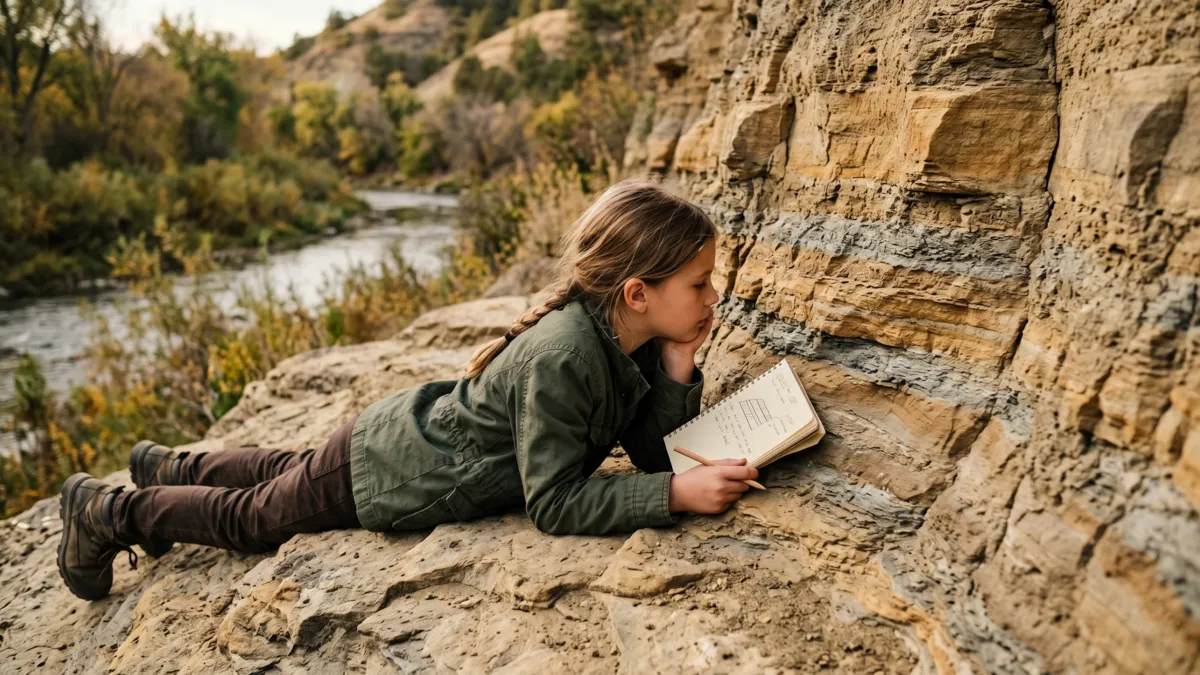
Point at a hill and ask a geologist what they see. They will probably answer with a question: what made that shape? Is it a drumlin, a smooth oval mound left by a retreating glacier? A block of harder rock that resisted erosion while everything around it wore down? A fault block that got pushed up when the crust stretched? The shape of the hill is a clue, not a label. The geologist is working backwards from the evidence to the event.
This is the cognitive move: noun to verb. The hill is a noun. The process that produced it is a verb. The pebble in a streambed is a noun. Its journey downstream, losing corners and weight with every kilometer, is a verb. The flat layering in a cliff face is a noun. The quiet shallow sea that deposited those layers, ten metres at a time over tens of thousands of years, is a verb. A geologist is always hunting the verb.
You can teach a child this habit in one afternoon. Not by explaining it, but by practicing it. Point at something outside. Ask: what made that look like that? What had to happen for this to be here? Let the child reach for an answer. A wrong answer is still a verb. It is still an attempt to explain a process rather than name a thing, and that is the shift.
Three Questions a Geologist Always Asks
These are not official protocol. They are the questions I find myself asking automatically at any new site, and I have started using them with kids because they work at any scale, anywhere, with no equipment.
What was here before this? Every landscape feature replaced something. The valley replaced solid rock. The soil replaced bare bedrock. The mountain replaced a flat plain or seafloor. Asking this forces a time orientation onto whatever the child is looking at. They are no longer cataloguing a thing. They are asking about a transition, which is a completely different cognitive posture.
What process is still running here? Erosion does not stop because you cannot see it happening. Tectonic stress does not pause. Sediment does not stop moving downstream. This question trains children to see the landscape as ongoing rather than finished, which is true, and which changes everything about how they relate to it.
What would this look like in a million years? This one is the hardest and the most interesting. The child has to apply what they know about the processes that are running to a timescale they cannot fully picture. The stream will have cut deeper. The hill will be shorter. The coastline will be somewhere else. That projection is not imagination. It is geology applied forward. Which is exactly what geologists do.
Three questions. Any location. No equipment.
What This Looks Like at Home
You do not need to know the geology. You need to be willing to not know it out loud, in front of the child, and then go find out together.
Start somewhere visible. A hill out the window, a gravel driveway, a garden with exposed soil after rain. Point at it and ask the first question: what is that made of and how did it get there? The child does not need to answer correctly. The goal is not the answer. It is the habit of reaching for a process instead of a category.
The deep time question is the one that tends to stop children cold in the best possible way. Before humans. Before mammals. Before any animal with a backbone. Most children have never been invited to think about the place they live in those terms. When they try, something shifts. The backyard becomes a location with a history rather than a backdrop for activities.
The process question is the one most parents skip because it seems too abstract. What is still changing here, right now, invisibly? But it is the one that matters most. The moment a child genuinely considers that the hill outside is getting slightly shorter every year, that the stream is carving something, that the ground is under stress, the landscape stops being background. It becomes something worth paying attention to.
This post is part of a series on real earth science education. The pillar post, What a Geologist Notices That Most Science Writers Miss, covers the full argument. The related cluster, Textbook Geology vs Real Fieldwork: What Your Child Is Missing, gives a practical guide for taking the questions outside.
Frequently Asked Questions
A geologist sees a landscape as a record of events rather than a static backdrop. The geologist's first question is not "what is this made of?" but "what sequence of events produced this?" That shift from classification to process is the cognitive move that defines geological thinking. It is learnable at any age and applicable to any landscape.
Social geology connects ancient earth processes directly to modern human history and the world children live in. Why did cities form where they did? Why do earthquakes happen in some places and not others? Why does fertile farmland exist where it does? Each of those questions has a geological answer, and teaching children to ask them changes geology from a historical curiosity into an explanation for the present.
The compressed calendar approach is most effective. If the entire history of Earth is one year, modern humans appear at 11:36 PM on December 31st. Dinosaurs disappeared on December 26th. The first animals with hard parts appeared in mid-November. That compression makes the numbers visceral. A child who can place events on that calendar has a working model of deep time they can apply to any geological observation.
In a 2025 open-ended survey of pre-college and early-college students, 54.5% mentioned rocks, minerals, or resources when defining geology, while 4% spontaneously mentioned environment or nature. These percentages cannot tell us what other connections pupils understood or whether particular teaching practices caused their answers.
A geologist starts with questions, not categories. The textbook presents definitions and asks the student to memorise them. A geologist working with a child starts with an observable feature and asks what process produced it, when it happened, and what it tells us about conditions that no longer exist. That sequence produces understanding rather than vocabulary.
Recruiting geoscience majors: student perceptions and a path forward, Journal of Geoscience Education, 2025 (Taylor and Francis) · Rethinking geoscience education for the 21st century, Silvia Occhipinti, European Federation of Geologists, 2025 (European Federation of Geologists) · Geoscience Communication, editorial, 2026 (Geoscience Communication) · Global Education Monitoring Report 2026, UNESCO (UNESCO) · Perceptions of geology from the United Kingdom, Lyell Collection, 2024 (Lyell Collection) · Making sense of the world through early geoscience education, Taylor and Francis, 2024 (Taylor and Francis) · Geoscience Experiences for Teachers, AGI Education (AGI)
Back to: What a Geologist Notices That Most Science Writers Miss

Social Geology: Connecting Ancient Earth to Modern Life
Ask a child why a city is where it is and they will probably say something about rivers, or harbours, or trade routes. Which is right. But push one level further and the answer is geology. Rivers run where they run because of the underlying rock. Harbours form where hard rock shelters soft bays. The fall line on the eastern seaboard, where hard crystalline bedrock meets soft coastal sediment, created the waterfalls that powered early American industry, and those mills became cities. Baltimore, Richmond, Raleigh. Geology explains the map.
Oil and gas exist where they do because of ancient marine basins. The fertile plains of the Midwest exist because glaciers deposited deep mineral-rich till over former lake beds. The locations of major earthquakes are predictable because plate boundaries are mappable. None of this is history. All of it is explanation for a world the child already inhabits.
Silvia Occhipinti at the European Federation of Geologists made the point plainly in 2025: geosciences are vital for addressing clean water, renewable energy, and climate response, but they remain underrecognised in education and public perception. A child who understands that geology is the science behind those problems is much harder to bore with a rock identification worksheet than a child who does not.