What a Geologist Notices That Most Science Writers Miss
Pick up a piece of granite and ask most adults what it is. "A rock." Ask a geologist and they will tell you that granite forms when magma cools slowly underground, under enormous pressure, at depths where the temperature is still several hundred degrees. They will tell you the minerals in it locked into that crystalline structure over millions of years. They will probably tell you something about the specific tectonic setting that produced it. Same rock. Completely different relationship with it. The gap between those two responses is what geology education is supposed to close, and mostly does not.
- Only 5% of U.S. high school science instruction is dedicated to Earth science, and 40% of science teachers have never completed a geoscience course (Journal of Geoscience Education, 2024)
- 30% decline in North American undergraduate geoscience enrolment in recent years, while demand for geoscientists in renewable energy sectors is projected to grow by 40% (European Federation of Geologists, 2025)
- 54.5% of students describe geology strictly as the "study of rocks and minerals." Only 4% associate it with environment and nature (Journal of Geoscience Education, 2025)
- The 2025 research consensus calls for replacing bottom-up geology education (start with rocks) with top-down geology (start with global systems and deep time)
- 337,511 working geoscientists are currently employed in the United States (U.S. Bureau of Labor Statistics and AGI, 2026)
What Every Geology Curriculum Gets Wrong
I have been in a lot of classrooms where geology is being taught. The setup is almost always the same. Rock cycle poster on the wall. Box of samples on the shelf. Worksheet asking students to identify igneous, sedimentary, and metamorphic. Test on Friday.
No reason, anywhere, why any of it matters.
The curriculum works through vocabulary before arriving at concepts. The logic is understandable. In practice, most students never arrive at the concepts. They learn what granite is. They do not learn that the granite under their school was pushed to the surface by a continent-scale collision hundreds of millions of years ago and has been eroding since. The first is a label. The second is geology.
A 2025 study by the European Federation of Geologists describes the traditional bottom-up approach as one that "appears dry and disconnected from the dynamic processes that make geosciences fascinating." The same report connects this directly to a 30% drop in North American undergraduate geoscience enrolment. The students are not uninterested in the Earth. They are bored by how it is being presented to them, and they opt out.
The Bottom-Up Trap
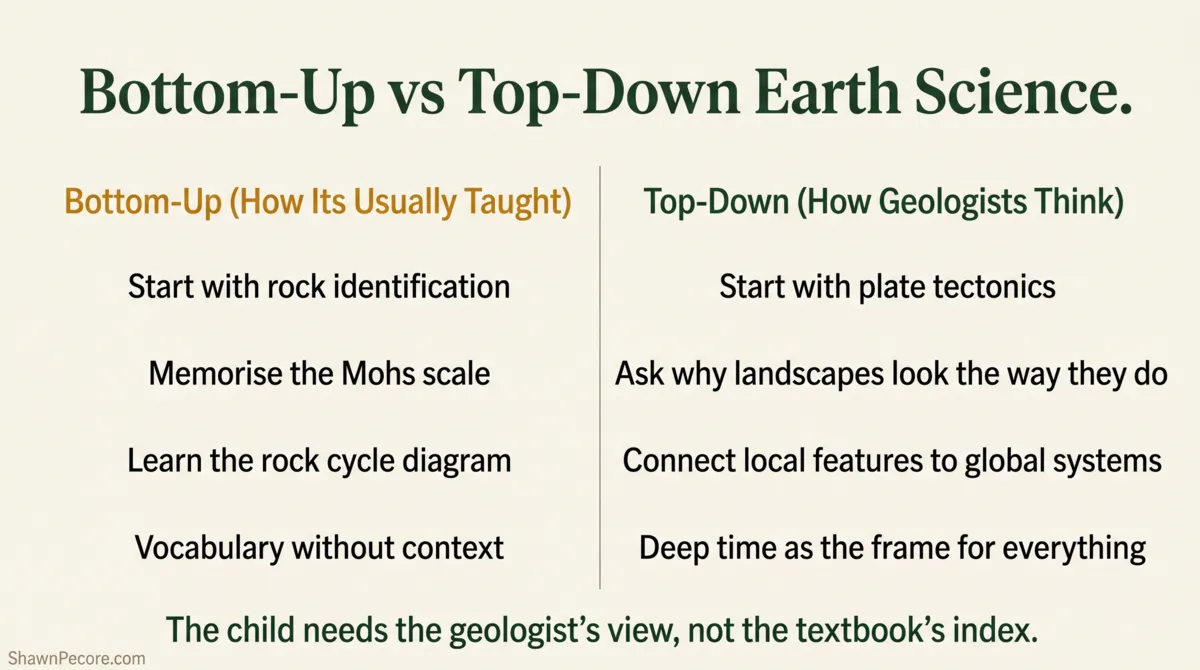
Start with minerals. Learn Mohs. Move to rock types. Memorise the rock cycle diagram. Plate tectonics, if there's time, near the end.
That is the sequence. And the problem with it is that it buries everything interesting at the back of the unit where most students never reach it. The ones who do encounter plate tectonics as a conclusion, which is exactly the wrong framing. Plate tectonics is not the payoff you earn after learning rock categories. It is the reason rock categories matter at all.
A child who understands that the crust is broken into moving plates can make immediate sense of mountains, earthquakes, volcanoes, and ocean trenches. They have a model. From that model, a sedimentary rock sample stops being a category on a chart and starts being a record of an ancient seabed, compressed over millions of years, now exposed in a road cut. The global system is the frame. Everything else hangs on it.
Top-down geology runs the sequence in reverse: global system first, local detail later, rock identification as vocabulary in service of the bigger picture. Silvia Occhipinti of the European Federation of Geologists described what the shift requires in 2025: an initial focus on basic concepts is what makes geoscience appear dry and disconnected. The fix is not a better rock kit. It is a different opening question.
What a Geologist Actually Sees When They Look at a Landscape
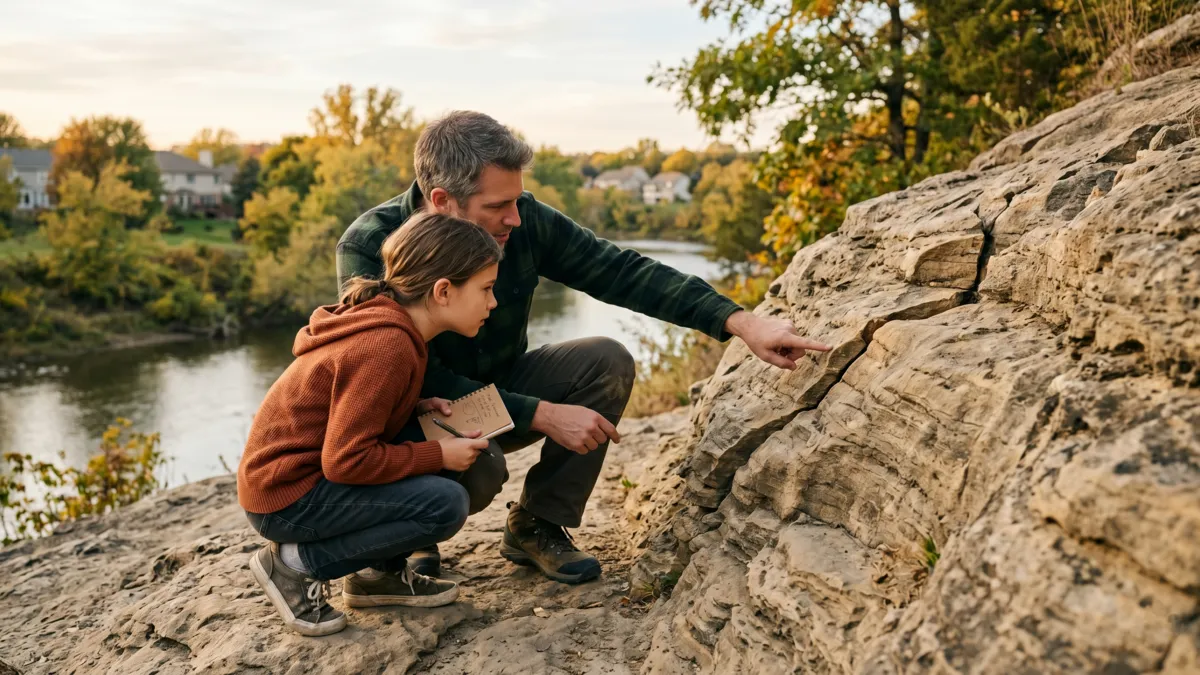
When I'm standing in front of a road cut, I'm not looking at dirt. I'm reading a sequence. The bottom layer came first. The colour change two-thirds of the way up means conditions shifted, maybe a river delta replaced a shallow sea. The tilt means something pushed those layers after they were already rock, long after. That read happens in a few seconds. It is not a special talent. It is a practiced question: what had to happen for this to look the way it does?
That question is learnable by a child. It does not require a geology degree or a field guide. It requires knowing to ask it at all.
The cognitive move is from noun to verb. Most people see a hillside and identify it: hill, dirt, trees. A geologist sees the same hillside and asks what made it that shape. Is it a drumlin left by a glacier? A resistant intrusion that the surrounding rock eroded away from? A fault block pushed up by extensional tectonics? Each answer implies a different history, a different timescale, a different set of forces. The noun is the same. The verb changes everything.
Take a child to a local river with that question in mind and watch what happens. The rounded pebbles on the streambed are not just rocks. They got that shape because water transported them, grinding their edges over a long distance. The fine sand collecting on the inside of a bend is there because the current slows on the inside of a curve, dropping its load. Both observations connect to processes operating at enormous scale. The child is watching the same mechanism that carved the Grand Canyon, at a speed slow enough to stand next to.
None of it requires a kit. It requires a question and a few minutes to look.
Deep Time: The Concept Nobody Teaches Kids
Earth is 4.5 billion years old. That sentence means almost nothing to a child. The number is too large. The fix is compression.
Here is what 4.5 billion years actually feels like. Compress all of it into one calendar year. January 1st, the planet forms. You have to wait until late February for the first living cell. November before anything with a skeleton shows up. Dinosaurs get December 13th to December 26th and then they're gone. Us? 11:36 PM on New Year's Eve. Everything written down in all of human history fits in the last ten seconds before midnight.
I use this with kids in the classroom and the room goes quiet every time. Not because the numbers are impressive. Because they suddenly have somewhere to put things. The Rockies started forming about where the dinosaurs disappear on that calendar. The Great Lakes are so recent they barely register. A child who has that frame in their head looks at a hillside differently. The question stops being "what kind of rock is that" and starts being "when."
Here is why this matters for how a child reads a landscape. Without deep time as a framework, geology is just rocks. With it, every landform has a history. The flat plain they drive across on the way to school was a shallow inland sea during the Paleozoic Era. The hill at the edge of the neighbourhood was pushed up by a collision that predates every animal with a backbone. The bedrock in the road cut was formed under pressure and temperature conditions that no longer exist on this planet's surface.
Geologists carry that framework automatically. Every observation gets placed in time. Teaching a child to do the same is one of the most durable things earth science education can produce, and it costs nothing beyond the compressed calendar and permission to take the question seriously.
The Teacher Gap
40% of high school science teachers in the United States have never completed a geoscience course. Not a geology major. Not even a single course. That number comes from research published in the Journal of Geoscience Education in 2024, and it explains a lot about why earth science looks the way it does in most classrooms.
Earth science gets about 5% of high school science instruction time. When teacher shortages hit and positions need to be filled, the subjects with the smallest footprint and the fewest specialist teachers get covered by whoever is available. A biology teacher covering an earth science unit will use the textbook. The textbook has rock identification and the rock cycle diagram. So that is what gets taught.
The Learning Policy Institute put the scale of the staffing problem at 411,549 unfilled or under-certified U.S. teaching positions as of 2025. One in eight nationally. In low-income schools, that proportion is higher, and earth science is consistently among the most affected subjects.
The parent filling this gap at home is not fighting a bad curriculum. They are doing something the formal system has openly acknowledged it cannot reliably do. A parent who understands that geology is about systems and time, not rock names, can deliver something the classroom frequently cannot get to.
For a closer look at how confusing science and engineering compounds this further, see the related post: Science vs Engineering in Education: Why the Difference Matters for Kids.
The Rock Tumbler Problem
A lot of children's first contact with geology is through rocks. Rock tumbler, crystal growing kit, fossil dig. Good starting points. The problem is they become the destination.
Here is the pattern I have seen many times. A child gets a rock tumbler. The stones come out shiny. The child identifies them by name with the card that came in the box. A few weeks later the tumbler sits in the corner and the parent concludes their kid just is not into science. But that is not what happened. What happened is the child was given vocabulary without syntax. They could name specimens. They had no reason to care about them.
Research from the Journal of Geoscience Education in 2025 found that 54.5% of students describe geology as the "study of rocks and minerals." Only 4% associate it with the broader environment or nature. That is the direct output of teaching geology as a classification exercise. The students learned exactly what they were shown.
The rock tumbler is not the problem. The missing piece is one question, asked the moment the stones come out: where did this rock come from, and what had to happen for it to end up here? That question, taken seriously, changes what the tumbler is for. Now it is the beginning of something, not the whole thing.
What Top-Down Earth Science Looks Like in Practice
The starting question is not "what is this rock made of?" It is "what was this place before it was what it is now?"
For most of North America, the answer to that question is genuinely staggering. The flat farmland of the American Midwest spent much of the Paleozoic Era as the bottom of a shallow inland sea. The Rocky Mountains were pushed up by the collision of the Pacific and North American plates around 80 million years ago. The Great Lakes are scour holes left by glaciers that retreated roughly 10,000 years back. Any of those stories can be picked up from a backyard, a nature walk, or a park with exposed rock. You do not need to travel to the site of the original event. You need to know that the event happened and that you are standing on its evidence.
A practical top-down session at home runs like this. Start with the global concept: the crust is in pieces that move. Connect it to something local: that is why earthquakes happen in California and why the Appalachians exist on the East Coast. Then go outside and ask what the local geology is actually doing. What pushed up the nearest hill? What is the nearest stream carving? Pick up a pebble and ask where it started and how far it has come.
This is what the Crash Course Geology video below is doing. Eight minutes on geology as a way of reading Earth history, not as a collection of specimen categories. Worth watching before the next nature walk.
For the parent who wants to take this outdoors, the related post on Textbook Geology vs Real Fieldwork: What Your Child Is Missing gives a practical guide for turning a neighbourhood walk into genuine geological observation.
How the MEYE Science Series Is Built Differently
The MEYE Science Series starts from one assumption: children aged 8 to 12 can handle real science. Not simplified science. Not science with the mechanisms swapped out for metaphors. The actual mechanisms, explained clearly, at the right level.
MEYE Plate Tectonics opens with the fact that the ground is moving right now, at roughly the speed a fingernail grows, and has been reshaping the planet for billions of years. Rock identification appears later, in the context of understanding what the plates are made of and why different boundary types produce different geological features. The vocabulary serves the concept. The global system comes first.
That is the top-down sequence in print form, written for a curious kid who does not need to be protected from how geology actually works.
MEYE Plate Tectonics is coming soon. See the full MEYE Science Series for all current and upcoming titles.
Three Questions to Ask Before Any Earth Science Activity
Before any geology activity with your child, ask these three questions. They take two minutes. They change what the activity teaches.
What is under our feet and how did it get there? You do not need to know the answer. Looking it up together is the actual activity. Most locations have a publicly accessible geological survey that will tell you what the bedrock is and when it formed. That one lookup transforms a rock sample from a labelled specimen into a piece of evidence with a specific history.
What is this place doing right now that we cannot see? The plates are moving. The rock is weathering. Sediment is washing into the nearest stream. None of it is visible at human speed, but all of it is happening. Asking a child to name what is changing, invisibly, right where they are standing trains them to see the landscape as active rather than finished. That is the core cognitive habit of a geologist, and it can be built at a kitchen table or a local park.
What did this place look like a million years ago? Or ten million. This one requires a reach the child cannot fully make, which is the point. The stretch into deep time is where the thinking happens. A landscape that was a seafloor, then a desert, then under a kilometre of ice, then a temperate forest has a history. The child standing in the present tense of that landscape is standing at the end of a very long story.
No equipment. No specialist knowledge. Just the questions and the willingness to say "I don't know yet" and mean it as an invitation rather than a stop sign.
For a practitioner's perspective on how professional geologists approach the gap between classroom knowledge and real field observation, see the related post: How Geologists Teach Kids Earth Science (And Why It's Different).
How Does a Geologist Think? Quiz
Three scenarios. For each one, choose whether the response shown is a bottom-up answer (vocabulary and classification) or a top-down answer (process and history). The goal is to recognise the difference, not to identify the geology perfectly.
Frequently Asked Questions
Start with global systems, not rocks. Explain plate tectonics first: the crust is broken into plates that move, collide, and pull apart over millions of years. That one concept explains earthquakes, volcanoes, mountain ranges, ocean trenches, and the distribution of continents. Then ask your child to connect something they can see to that system. Rock identification is vocabulary. System thinking is the subject.
Deep time is the concept that Earth is approximately 4.5 billion years old and that geological processes operate across timescales that are almost incomprehensible from a human perspective. Teaching a child to place local geology within that timeline changes how they read a landscape. The flat plain they walk across was once a seafloor. Deep time gives those observations meaning.
Rock identification is a useful vocabulary exercise, but it is not geology. A child who can name igneous, sedimentary, and metamorphic rocks has learned three categories. A child who understands how each type forms and what a local rock sample tells them about the history of the land they are standing on has started thinking like a geologist.
Because the rock phase is often where geology education ends rather than begins. The rock tumbler produces polished stones and then the curiosity runs out of runway. Nothing connected those rocks to the planet's history or to the landscape the child lives in every day. Top-down geology, starting with systems and dynamics instead of specimens, generates questions that do not run out.
Approximately 40% of high school science teachers in the United States have never completed a geoscience course, according to research published in the Journal of Geoscience Education in 2024. Earth science receives only about 5% of high school science instruction time. The result is that most students graduate without ever engaging with geology as a living, dynamic discipline.
Bottom-up geology starts with materials: minerals, rocks, and the rock cycle. Students memorise categories before progressing to global processes. Top-down geology inverts that sequence. It begins with plate tectonics, the water cycle, and atmospheric dynamics, then works down to the local and specific. Research from 2025 describes the bottom-up approach as dry and disconnected, and advocates for top-down as the framework that produces lasting engagement.
Start with three questions: What is under our feet and how did it get there? What is the ground doing right now that we cannot see? What did this place look like a million years ago? You do not need a geology degree to ask those questions. A child who learns to read a landscape by asking them is learning geology. A child memorising the Mohs hardness scale is doing something else.
Making sense of the world through early geoscience education, Taylor and Francis, 2024 (Taylor and Francis) · Rethinking geoscience education for the 21st century, Silvia Occhipinti, European Federation of Geologists, 2025 (European Federation of Geologists) · Geoscience Profession Data, U.S. Bureau of Labor Statistics and AGI, 2026 (AGI) · Recruiting geoscience majors: Student perceptions and a path forward, Journal of Geoscience Education, 2025 (Taylor and Francis) · Perceptions of geology from the United Kingdom, Lyell Collection, 2024 (Lyell Collection) · Frequent limits and advantages of conditions for geology education, peDOCS, 2024 (peDOCS) · An overview of teacher shortages 2025, Learning Policy Institute (Learning Policy Institute) · Geoscience Communication journal (Geoscience Communication) · Fieldwork in Physical Geography: A Quantitative Analysis, MDPI, 2024 (MDPI) · Intro to Geology: Crash Course Geology #1, YouTube (YouTube)