Textbook Geology vs Real Fieldwork: What Your Child Is Missing
Last spring a parent told me her daughter had just aced her geology test. Could name all three rock types, had the rock cycle memorized. Two weekends later they hiked through a state park that sits on a contact zone between granite bedrock and ancient marine sediment. The daughter walked straight over it. Didn't register. The test had been on categories, not on reading the ground you're standing on. Those are two entirely different skills, and most geology curricula only teach one of them.
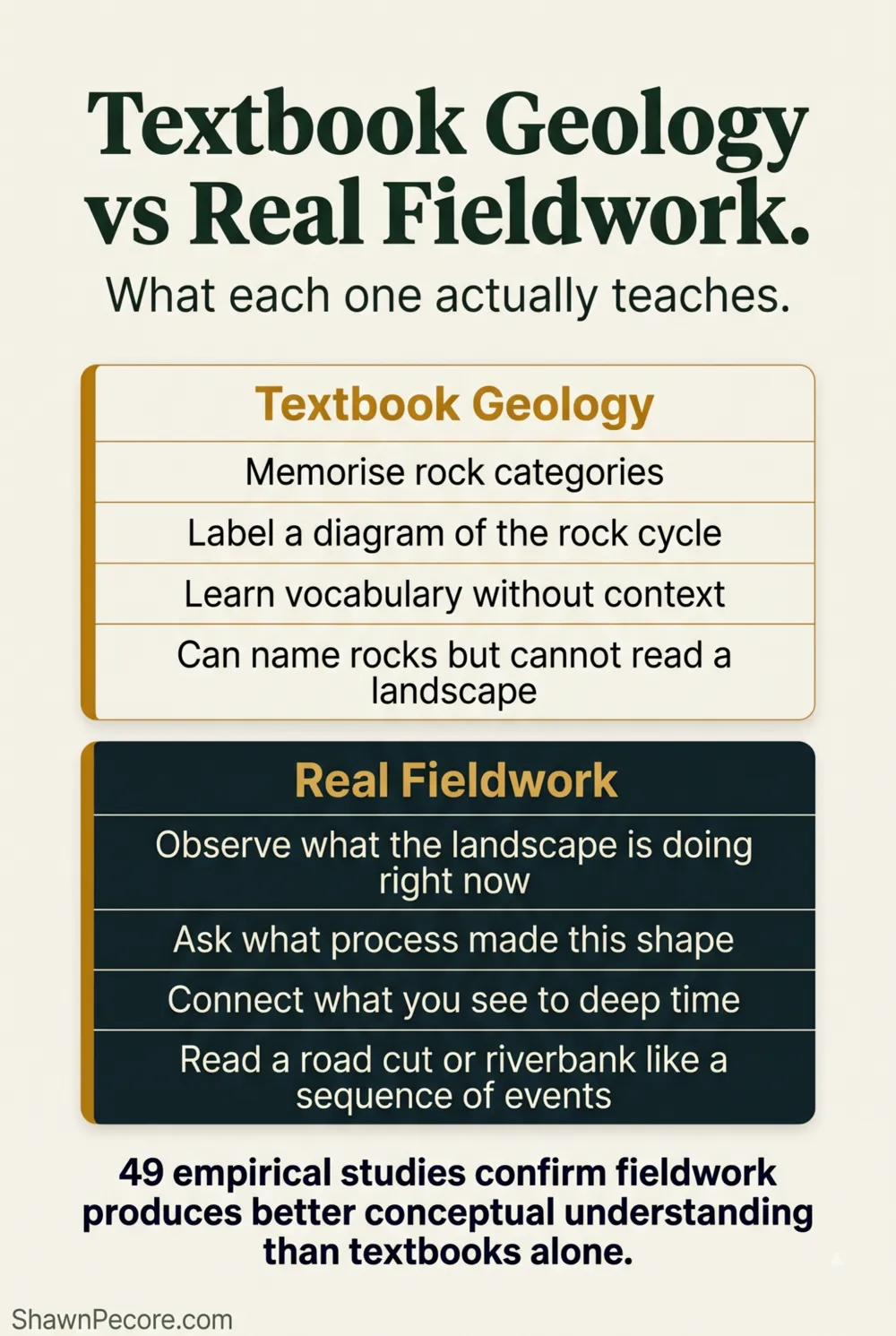
- A 2024 systematic review found 49 empirical studies confirming positive learning outcomes from Education Outside the Classroom. The evidence for fieldwork is not ambiguous (Sustainability Journal, 2024)
- 15% of courses in the lowest-performing U.S. schools are taught by out-of-field teachers, meaning the students who most need strong science instruction are most likely to receive textbook-only delivery (Florida Department of Education, 2024)
- Researchers warn that students who learn geology only through textbooks and virtual field experiences show significant difficulty with observation-to-inference reasoning when placed in real field settings
- The 2024 Czech and Slovak curriculum review found that national education standards practically ignore recommended field teaching methods, despite universal acknowledgement among geoscience professionals that fieldwork is foundational
- A child who learns to ask geological questions outdoors builds transferable reasoning skills that classroom instruction cannot replicate
The Saturday Hike Problem
Tuesday: a child copies definitions of igneous, sedimentary, and metamorphic onto index cards. Saturday: the family is on a trail through the same kinds of terrain those definitions described. Nobody makes the connection. Not even the parent who bought the rock identification kit last Christmas.
That is not the child's failure. The curriculum never asked them to make that connection. The vocabulary was presented as a destination, not as a tool. So the layered cliff face on the hike is just scenery. The rounded pebbles in the stream are just rocks. The hill at the trailhead has no history that the child has been given permission to ask about.
Fixing this does not require a geology degree or a field guide. Three questions, asked out loud, will do it. What is that hill made of? How do you think it got that shape? What was here before the hill? Those questions will not always have clean answers. That is fine. The point is asking them, not answering them correctly.
Tereza Jedličková of the Institute of Geology at Charles University put the research bluntly in 2024: the main drawbacks of geology education are the large volume of required knowledge, its thematic structure, and the absence of any link to real life. Better textbooks are not the fix she and her colleagues recommended. Direct engagement with outdoor environments is.
What the Research Says About Fieldwork vs Textbooks
Forty-nine empirical studies. That is what a 2024 systematic review published in the Sustainability Journal identified when researchers went looking for evidence on Education Outside the Classroom. All 49 confirmed positive learning outcomes. This is not a contested area of research. Fieldwork produces better conceptual understanding, stronger observation skills, and higher student interest than classroom-only instruction. The question is not whether it works. It is why so little of it happens.
Scott et al., reviewing fieldwork in physical geography in 2024, described what changes when a student actually leaves the building: the exploration in natural habitats introduces students to variety and unpredictability, and that unpredictability is what increases their interest in scientific inquiry. That last part matters. The unpredictability is not a nuisance to manage around. It is the mechanism.
A textbook diagram of erosion looks identical every time a child opens it. A real erosion channel after heavy rain is not the same twice. Water level different. Sediment load different. The bank undercut in a new place. A child who is standing there, watching it change, and asking why has nowhere to hide from the actual science. A child reading the diagram does.
The video below shows one instance of this: how fall lines in American geography, the geological boundary between hard crystalline rock and softer coastal sediment, determined where cities were built, where mills were placed, where industry concentrated. Geology as explanation for the human world, not just as a classification exercise.
Crash Course Geography. How geological features shaped where humans settled and built cities. A short example of top-down thinking connecting earth science to human history.
Why Virtual Field Experiences Are Not a Substitute
Since 2020, virtual field experiences (VFEs) have become the standard substitute when schools cannot get students outdoors. Digital tours of geological sites, interactive maps, video walkthroughs. They solve the logistics. Buses, permission slips, liability waivers, weather. None of that required.
But researchers studying the shift found a consistent problem: students who learned geology almost entirely through VFEs and textbooks showed significant difficulty with observation-to-inference reasoning when they eventually did end up in real field settings. They knew what to call things. They did not know how to look at them.
The gap is not about missing information. A good VFE can show accurate photographs of layered sedimentary rock with labels, scale bars, location data. What it cannot show is that same rock in afternoon light versus morning light, wet after rain versus dry in July, with the instability of the slope beneath your feet when you lean in to look at it closely. I have done enough fieldwork to know that those conditions are not incidental. They are what force you to actually observe rather than to recognise and label. A screen removes exactly the friction that builds the skill.
VFEs have a legitimate place as preparation, or as a bridge when access is genuinely not possible. What they cannot do is replace the experience of standing in front of something real and having to figure out what it means.
The Out-of-Field Teaching Problem
Florida Department of Education data from 2024 puts a number on something most parents have suspected: 9.06% of courses statewide are taught by teachers working outside their certified subject area. In urban and low-income schools, 10.97%. In schools rated F by state assessment, 15%.
Geology and earth science sit near the top of that out-of-field list. A biology-trained teacher covering an earth science unit under time pressure is going to use the textbook. Not because they do not care, but because planning fieldwork requires transport coordination, risk assessment, and the confidence to facilitate open-ended outdoor observation, none of which you can improvise the night before class. So the textbook becomes the lesson. The rock cycle diagram goes on the board. The test is Friday.
The students who end up with the most simplified, field-free version of geology are generally the ones in the lowest-performing schools. The ones who might benefit most from a different kind of relationship with the natural world. That is not a design choice anyone made. It is what happens when a stretched system runs out of options and defaults to what is feasible.
Which is why a parent who takes a child outside and asks what the ground is doing is not supplementing a lesson. They are providing something the formal system often cannot.
How to Turn a Neighbourhood Walk Into a Geological Survey
No geological map needed. No rock hammer, no field guide, no subscription to anything. What you need is the habit of stopping in front of things most people walk past.
Go out after heavy rain. Water does most of the work of making geology visible. Sediment washing off surfaces into gutters tells you something about what the soil upstream is made of. Puddles forming in the same spots every time tell you about permeability and drainage in the underlying ground. Erosion channels cutting into the base of a slope after every storm are showing you, in real time, how valleys form. Ask the child: where is the water going? What is it carrying? Where did that material start?
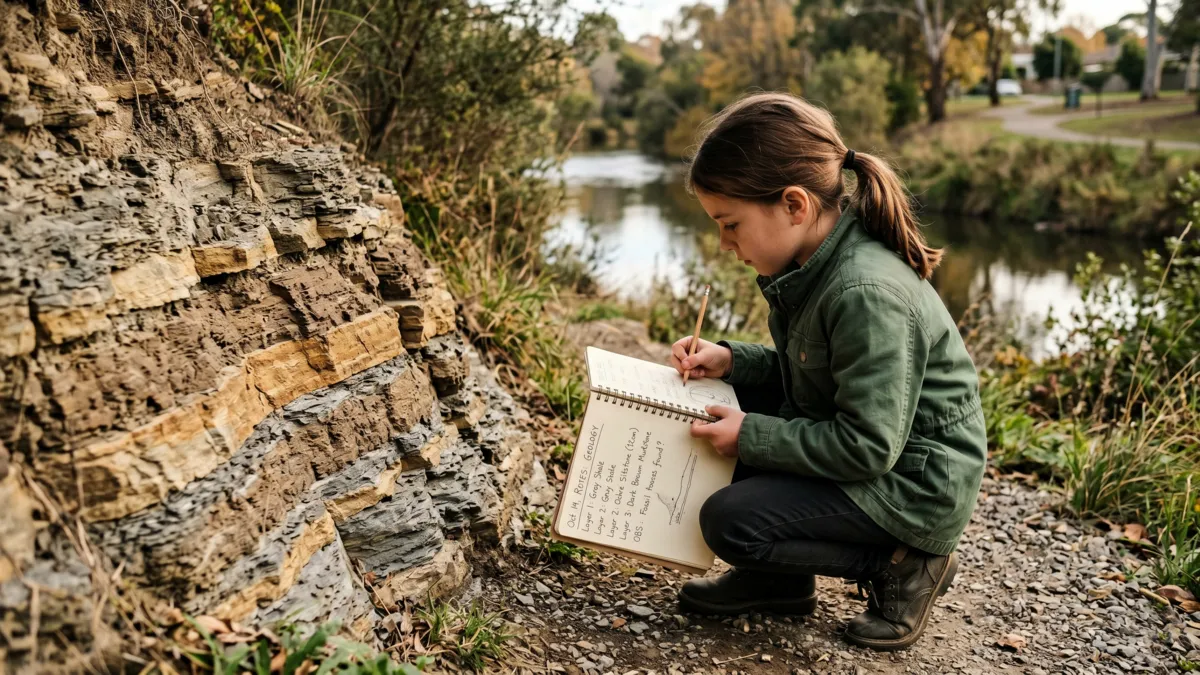
If your family drives anywhere regularly, you probably pass road cuts. These are the exposed rock faces left when engineers cut through a hill to lay a road, and they are some of the best free geology you can access. The layers visible in a road cut are a time sequence. Bottom layer, oldest. The layer above it, younger. Ask the child to count the layers. Ask why some are thick and some thin. Ask whether they are horizontal or whether they tilt, because a tilt means something moved them after they formed.
Streams and rivers are the most readable. The pebbles are rounded because water ground their edges down during transport over distance. The fine sand on the inside of a river bend settled there because the current slows on the inside of a curve. That is the same mechanism, at human scale, that carved the Grand Canyon over millions of years. The child standing at a local stream is watching the same process. Just slower than they can see.
What to Actually Look For
Three things. Teach a child to notice these and they can do basic fieldwork anywhere.
Layering. Anywhere rock or sediment is exposed in cross-section: road cuts, riverbanks, construction sites, even the sides of a garden bed after rain. The layers are a time sequence. Bottom first. What changed between layers? Why is that one thicker? Why does the colour shift there? The question to ask is always: what conditions produced this layer, and what conditions changed to produce the one above it?
Shape and edges. A smooth, rounded rock was moved by water over distance. An angular fragment broke recently and hasn't gone anywhere since. That distinction is visible immediately once you know to look for it. It connects to transport energy: faster, longer-moving water produces more rounded sediment. A beach is different from a rocky slope for exactly that reason. The child is not just looking at rocks. They are reading a map of how far things have travelled.
The thing that does not belong. A large boulder sitting alone in the middle of a flat field is a question. It was not formed there. Something moved it. Glacier, flood, landslide. Ask the child to figure out which one, and why. That question does not have an easy answer, and that is the point. The reach for a mechanism is the moment geological thinking begins. Everything before that is just looking at rocks.
This post is part of a series on real earth science education. The pillar post, What a Geologist Notices That Most Science Writers Miss, covers the case for top-down geology from a practitioner's perspective. The related cluster, Science vs Engineering in Education: Why the Difference Matters for Kids, addresses the distinction between scientific inquiry and engineering design that most STEM content blurs.
Frequently Asked Questions
Textbook geology teaches children what geological categories exist. Fieldwork teaches them to read those categories in the landscape they live in. A 2024 systematic review confirmed that fieldwork allowed students not only to reinforce their knowledge but also to acquire new skills and improve understanding of complex environmental systems. The textbook prepares vocabulary. Fieldwork makes it useful.
Yes. Fieldwork does not require a degree. It requires a set of questions: what is this made of and how did it get here? What process is still happening here right now? What was this place before it was this? Those questions do not require expert answers. A child who learns to ask them outdoors is doing real geology, regardless of how much either of you knows about rocks to start with.
No. Researchers found that students who learn geology only through virtual and textbook methods show significant difficulty with observation-to-inference reasoning when placed in real field settings. A VFE can show accurate information. It cannot produce the unpredictability and physical engagement that make fieldwork effective. VFEs are a useful supplement, not a substitute.
Action-based education means learning happens through direct engagement with real environments. For geology, this means going outside after rain to observe erosion, visiting a local river to look at sediment transport, or stopping at a road cut to examine exposed rock layers. Educational researchers following a 2024 curriculum review strongly recommended action-based education to close the gap between classroom knowledge and real-world understanding. The principle at home: let the observation come before the textbook, not after.
Frequent limits and advantages of conditions for geology education, Jedličková et al., Charles University, peDOCS, 2024 (peDOCS) · Fieldwork in Physical Geography: A Quantitative Analysis, Scott et al., MDPI, 2024 (MDPI) · Critical teacher shortage areas 2023-24, Florida Department of Education, 2024 (Florida DOE) · Making sense of the world through early geoscience education, Taylor and Francis, 2024 (Taylor and Francis) · AuScope National Seismic Monitoring Outreach (AuSIS) · Crash Course Geography, Fall Lines and Settlement Patterns, YouTube (YouTube)
Back to: What a Geologist Notices That Most Science Writers Miss