Why High School Physics Reveals How Much Elementary Students Can Handle
18 minutes. That was the average daily science instruction reported for grades K through 3 in a 2018 survey. Meanwhile they get 89 minutes of ELA. Nobody decided that reading matters more than understanding the physical world. It just accumulated that way. And it is costing children something they will not notice until they sit down in an AP Physics exam a decade later.
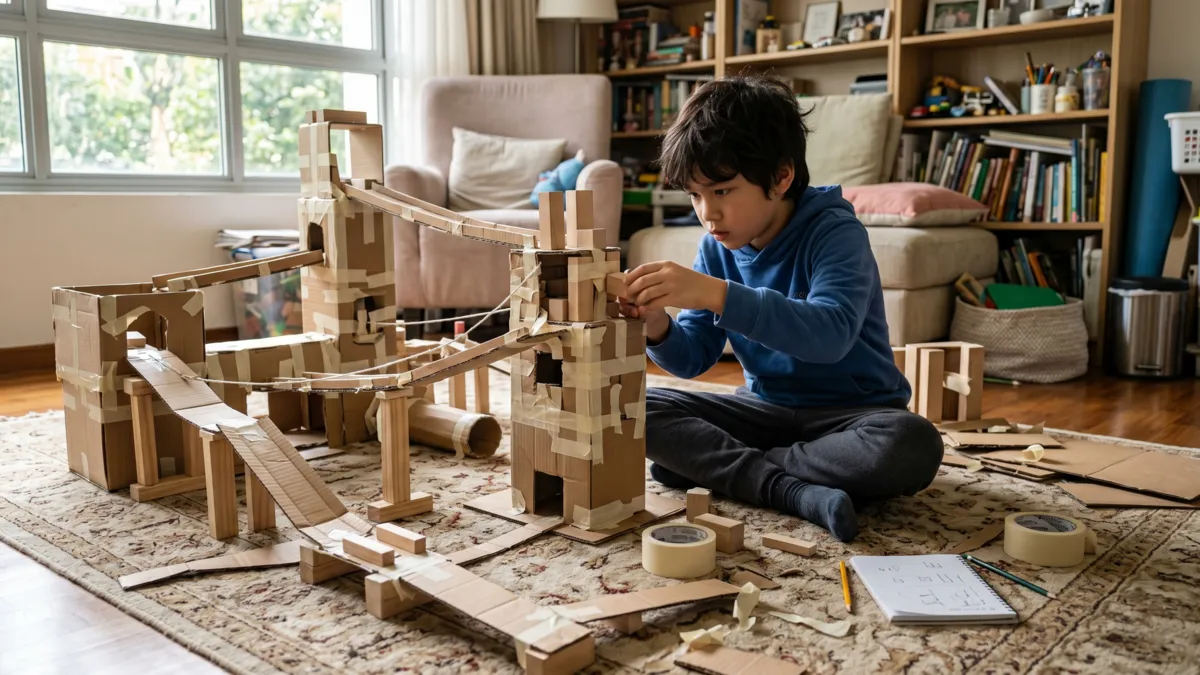
The cognitive gap that shows up at 16 was created at 7. Not by a lack of interest in science. By a lack of science.
18 Minutes
The 2018 National Survey of Science and Mathematics Education reported that grades K through 3 averaged approximately 18 minutes of science instruction per day. ELA gets 89 minutes. The ratio is not a reflection of which subject matters more. It reflects testing pressure, resource allocation, and instructional time decisions made without anyone explicitly choosing to deprioritise science.
The result is that a child in second grade spends roughly 90 seconds on science for every 8 minutes on reading. In those 90 seconds there is no time for prediction. No time to observe something and form a hypothesis. Certainly no time to test one. What fits into 18 minutes is a worksheet, a vocabulary exercise, or a short video. None of those build the kind of conceptual model that matters later.
This is where the gap starts. Not in a high school physics classroom. In the 18-minute slot between reading and lunch in second grade. This pattern connects directly to what AP physics and young learners reveals: the students who struggle most at the advanced level are almost never the ones who lacked intelligence. They are the ones who were given the least science, earliest.
What the Cognitive Science Actually Shows
The assumption embedded in most elementary curricula is that abstract reasoning is a high school skill. Recent research says otherwise. Consistently and by a significant margin.
Frontiers in Psychology published a study in 2026 on coding and logic interventions for children aged 8 to 12. The effect size on decomposition tasks after the intervention was 1.18. Pre-test computational thinking scores averaged 20.4. Post-test scores averaged 30.6. These were not exceptional students in gifted programmes. They were ordinary primary-school children given structured logical challenges.
The concrete operational stage, which spans roughly ages 8 to 12, is the developmental window when abstract algorithmic thinking becomes accessible. Papert's theory of constructionism adds a further layer. When children construct significant artefacts rather than receive instruction passively, they externalise their thinking. They can see their mental model, find where it breaks, and fix it. That process produces metacognition that direct instruction alone cannot replicate.
Daniel Willingham, writing in the American Educator in 2026, addressed the attention span debate directly. Children's capacity for attention has not been degraded by technology. What has changed is their speed at identifying when something is not worth their attention. The child who appears disengaged in a science lesson has made a reasonably accurate assessment. The cognitive floor of the activity is below them.
18 minutes versus 89. The ratio is where the gap starts. Not in a high school physics classroom.
The Minecraft Problem
A ten-year-old spends an evening building a conditional-logic redstone circuit in a video game. The circuit controls multiple moving components, requires sequencing, and only works if the logic is exactly right. The child debugs it over two hours without anyone asking them to persist.
The next morning the same child is handed a science worksheet asking them to colour-code the parts of a flower.
The disruption that sometimes follows is not a focus problem. It is an accurate response to a massive mismatch between what the child demonstrated the previous night and what the classroom is asking of them. Advanced students do not need more work. They need different work. One educator in an r/ScienceTeachers thread put it plainly. Advanced kids need less repetition and more depth, and when you reclaim the time from repetition, you use it to go further into the material, not to add more of the same.
The behavioural issue is the signal. It is telling you the cognitive floor is too low. That is a curriculum problem, not a child problem.
What Happens When You Give Kids Harder Work
A Tigerville Elementary School report for 2025 says 86% of students met or exceeded standards in science. A 25.2-point advantage over the district average was reported for mathematics, not science. The report does not isolate a teaching method as the cause of the school’s results.
Not gifted students. Not a special programme. Students whose teachers chose more demanding material.
The Frontiers in Psychology data adds the cognitive mechanism behind those results. The reported 1.18 effect size relates to a decomposition task in a coding intervention; it does not, by itself, establish a broad change in how children reason about every complex system. That change happens fast. The pre-to-post gap in the study emerged from a single targeted intervention, not years of remediation.
In the 2019 NAEP science assessment, 36% of US fourth-graders performed at or above NAEP Proficient; this is not a 2024 fourth-grade result. 30% never or rarely engage in scientific inquiry activities at all. Those numbers do not reflect what children are capable of. They reflect what they have been given.
The concern about underestimating capacity connects directly to age-appropriate science, where the same impulse to protect children from difficulty produces content that is not just limited but factually wrong.
The MEYE Science Series is built on the same premise: children aged 8 to 12 are ready for the real mechanism. See the full MEYE Science Series for current and upcoming titles.
Waves, motion, and fundamental forces with no algebra required. This is what conceptual physics looks like when the mathematical barrier is removed. A 10-year-old can follow this. Most 10-year-olds never get the chance.
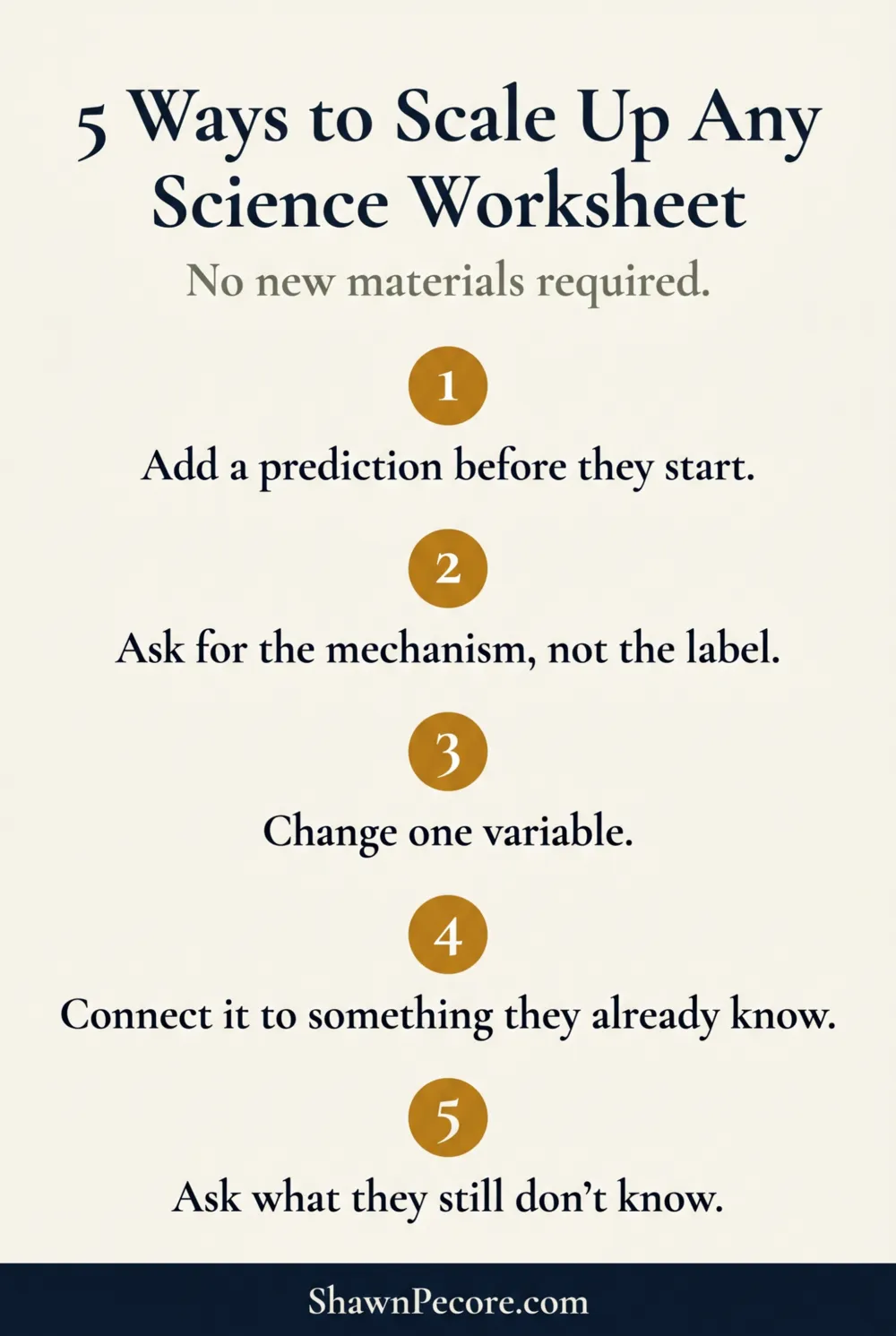
Try It: Scale Up Any Worksheet
Take any science worksheet your child has been given. Run it through these five steps. Each one adds a systems-thinking variable without requiring new materials, a new lesson plan, or any prior science knowledge on your part.
Work through each step with your child's actual worksheet in hand. Check each one off as you add it.
Frequently Asked Questions
The current average is around 18 minutes per day in grades K through 3, compared to 89 minutes of ELA. Most science education researchers consider this insufficient for building the conceptual foundation that supports advanced learning later. The 18-minute average is not a baseline to accept. It is a problem to name.
Yes. Research from Frontiers in Psychology in 2026 found an effect size of 1.18 on decomposition tasks for children aged 8 to 12 after structured logic work. A separate PMC study found cognitive advantages in causal detection for younger children when algebraic requirements are removed. Curricular demand is one possible barrier, alongside prior knowledge, teaching quality, and individual differences. It is the ceiling set by the curriculum.
One possible explanation is that the cognitive demand in the classroom is below what they are ready for. Daniel Willingham found in 2026 that children have not lost the ability to sustain attention. They have become faster at identifying when they are bored. A child who builds complex logic systems at home and is asked to colour a plant diagram the next morning is not struggling with attention. They are accurately reading a mismatch between their capacity and the worksheet.
Decomposition is the ability to break a complex problem into smaller, manageable components and reason through each systematically. It is foundational to both computational thinking and advanced scientific reasoning. Research from Frontiers in Psychology in 2026 found significant gains in decomposition ability for children aged 8 to 12 given structured logic work. Most elementary science curricula do not ask for decomposition at all.
Constructionism is Seymour Papert's theory that children learn most effectively when they construct significant artefacts rather than receive instruction. Building something externalises thinking, makes the mental model visible, and makes it debuggable. The child can see where their understanding breaks and correct it. Worksheets asking children to label or categorise do not produce the same process.
NSSME, average daily science instruction time in grades K-3, via Edutopia, 2024 (Edutopia)
Frontiers in Psychology, enhancing computational thinking through coding interventions for ages 8-12, 2026 (Frontiers in Psychology)
PMC, cognitive development and children's advantage in causal detection, 2024 (PMC)
Greenville County Schools, elementary science outcomes with rigorous frameworks, 2025 (Greenville County Schools)
Daniel Willingham, cognitive science and attention in children, American Educator, 2026 (American Educator)
NAEP Nation's Report Card, fourth-grade science proficiency and inquiry data, 2024 (nationsreportcard.gov)
r/ScienceTeachers, teaching advanced middle school science, community discussion, 2024 (Reddit)
Dr. Pam Goodner, dedicated science instructional time and student competencies, via Edutopia, 2024 (Edutopia)
Part of the series: What I Learned Teaching AP Physics That Changed How I Write for Kids