How to Turn a Child's "Why" into a Real Science Investigation
Socratic questioning at home does not require a philosophy degree or a lesson plan. It requires one habit: responding to a child's question with a question rather than an answer. That habit, applied consistently, produces something that most science curricula spend years trying and failing to build.
One targeted question at the right moment does more than a two-minute explanation. The child who reasons to a conclusion owns it in a way the child who receives one does not.
What the Socratic Method Is Not
The version most people picture is a law professor pacing at the front of a room, firing questions at a student who has nowhere to hide. That version is adversarial by design. It uses confusion as a tool. It is not what child development researchers mean when they describe Socratic dialogue as one of the most effective techniques available for building scientific reasoning in children.
The research version is decentered. The adult is not the arbiter of truth. The student is not trying to guess what the adult already knows. The goal is to explore what the child believes and why, and to use questions to help them find the gaps in their own model without anyone declaring the model wrong.
Rob Reich, at Stanford's Center for Teaching and Learning, describes it directly: Socratic inquiry is not teaching in the traditional sense. It does not include lectures. It is a concerted effort to explore the underlying beliefs that shape the student's views. That framing fits a kitchen table conversation as well as it fits a seminar room.
Rosemary Russ, Associate Professor of Science Education at the University of Wisconsin-Madison, made a related point in 2024: we have little understanding of how students' epistemologies shift as they navigate their courses. What a child believes it means to know and learn science is shaped by every interaction they have around science questions. A parent who responds to questions with questions is shaping that belief in a specific direction. So is a parent who responds with Google.
The broader context for why this matters is in why kids stop asking questions. The Socratic technique is one of the most direct counter-pressures available.
What It Actually Is in a Kitchen Conversation
A child asks why the ice cube in their glass is melting. The instinctive response is a short explanation: because the room is warmer than the ice, so the ice absorbs the heat and turns to water. That explanation is accurate. It is also a monologue. The child was the recipient of information, not a participant in reasoning.
The Socratic version starts with one question: is the water in your glass warmer or colder than the ice cube? The child looks, touches, thinks, and answers. Warmer. The next question: so what do you think is moving from the water to the ice, or from the ice to the water? The child reasons. The adult waits. The child arrives at something close to heat transfer, using their own language, through their own logic.
The shift is subtle in the moment. A child who reasons to a conclusion owns it in a way a child who receives one does not. That ownership is what makes the knowledge transferable. The child who talked their way to heat transfer can apply the same reasoning to a cold drink on a humid day, to why metal feels colder than wood at the same temperature, to how a refrigerator works. The child who was told the answer has a fact about ice cubes.
A 2024 meta-analysis across 86 comprehensive studies confirmed that Socratic questioning enhances evidence-based reasoning, with an overall effect size of 0.893 (Hedges' g) on higher-order thinking. That is not a small effect. It holds across age groups and subject areas.
The reason the technique works is directly connected to understanding what makes a good explanation. A child who has been guided through Socratic dialogue learns to distinguish a functional answer from a mechanistic one without ever having those terms defined.
The Wait Time Problem
Ask a child a question. Then stop talking.
That instruction sounds obvious. In practice, most adults wait less than one second before rephrasing the question, providing a hint, or answering it themselves. A 2024 systematic review published in PMC found that the optimal wait time after asking a child a question is 3 to 5 seconds. The gap between what research recommends and what adults actually do is significant.
Those seconds matter because the child is working during them. They are searching for relevant knowledge, forming a response, deciding whether their answer is good enough to say out loud. Filling that silence interrupts the process at the point when the cognitive work is most active. The child who is given 4 seconds produces a response that is longer, more complex, and more likely to contain genuine reasoning than the child who is given half a second.
I notice this in my own classroom. The questions that produce the best responses are the ones where I ask and then visibly wait, making it clear by staying quiet that I am actually expecting them to answer. Students are trained by years of rapid-fire classroom exchanges to expect the teacher to fill the silence. When the silence holds, something different happens.
The homeschool community flags the fatigue version of this problem accurately. Continuous rapid questions feel like an interrogation. The fix is not fewer questions. It is fewer questions per exchange, each followed by a genuine pause. One good question, then silence, then whatever the child produces, is worth more than five questions delivered in ninety seconds.
Micro-Questions: The Practical Technique
The most useful Socratic questions in a home science context are micro-questions: short, specific, grounded entirely in what the child can already observe or already knows from experience. No prior knowledge required. No vocabulary the child does not have. Just an observable fact the child can access and a prompt to reason from it.
A weather example shows the chain clearly. A child asks why wind happens. The micro-question sequence runs like this: does the land or the sea heat up faster when the sun shines on them? (The child can guess from experience.) So is the air over the land warmer or cooler than the air over the sea? (Follows directly from the first answer.) Does warm air rise or sink? (Most children have some intuition here from watching steam or smoke.) So where does the cooler air from over the sea go? The child arrives at the concept of a pressure differential driving airflow, which is what wind is, without having been told any of it directly.
Each step uses only what the child produced in the previous step. Nothing is imported from outside their reasoning. The adult's role is to ask the next question that follows from what the child just said, not to steer toward a predetermined vocabulary term. That is what decentering means in practice: the adult is not the destination. The child's reasoning is.
97% of parents in a 2024 Talker Research survey said they consider it important for their child to understand the reasoning behind things, not just the facts. The micro-question technique is the most direct method available for building that understanding without a curriculum, a kit, or a science degree.
What Decentering Means for a Parent
Decentering is the research term for removing the adult as the sole arbiter of truth in a learning conversation. It sounds abstract. The practical version is straightforward: the child is not trying to guess what you know. They are trying to build what they understand.
A parent who responds to a wrong answer with "not quite, think again" has recentered. The child now knows their answer was wrong and is trying to figure out what the parent considers right. That is guessing, not reasoning. A parent who responds with "interesting, what makes you think that?" has kept the child in their own reasoning process. The child has to examine and defend their own logic. That examination is where the learning happens.
Rosemary Russ put the stakes of this clearly in 2024: what students believe it means to know and learn science is shaped by how the adults around them respond to science questions. A child who grows up in conversations where questions lead to more questions, where not knowing is treated as a starting point, and where reasoning out loud is valued over getting the right answer quickly, develops a relationship with science that no curriculum can easily undo.
The MEYE Science Series is built with the same principle in its structure. Books that give the real mechanism without simplifying it into something smaller than the child can handle. Questions embedded in the text that do not answer themselves. Science treated as something to reason through, not a set of conclusions to memorise. See the full MEYE Science Series for current and upcoming titles.
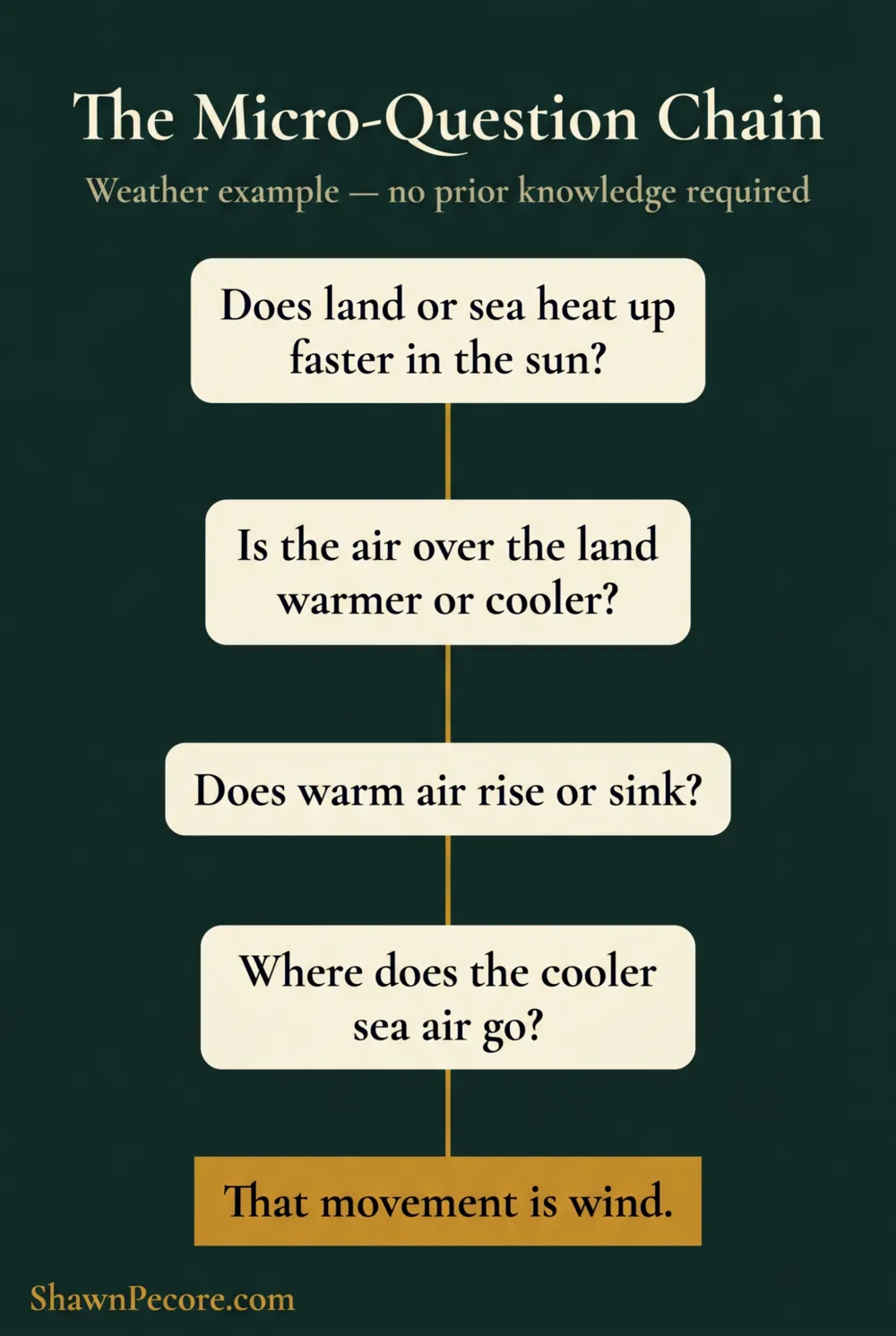
The micro-question sequence: each question uses only what the child produced in the previous step. Nothing is imported from outside their own reasoning.
Frequently Asked Questions
The Socratic method is a way of teaching through questions rather than answers. Instead of delivering a conclusion, the adult asks a sequence of questions that use the child's existing knowledge to guide them toward the conclusion themselves. The child does the reasoning. The adult provides the structure. Rob Reich at Stanford describes it as a concerted effort to explore the underlying beliefs that shape the student's views, not a lecture with questions attached.
Pace and tone do most of the work. Ask one question, then wait. Do not follow up immediately if the child is quiet. Keep questions short and grounded in what the child can already observe or already knows. Questions that feel like a test are questions the child cannot answer from their own observation or existing knowledge. If a question requires the child to already know something they do not know, it is not a Socratic question. It is a quiz.
Wait time is the deliberate pause after asking a child a question before speaking again. A 2024 systematic review published in PMC found the optimal wait time is 3 to 5 seconds. Most adults wait less than one second. Those missing seconds matter because the child is doing active cognitive work during them: searching for what they know, forming a response, deciding whether to commit to an answer. The result produced after a 4-second pause is consistently longer and more cognitively complex than what follows a half-second pause.
Read the frustration. If the child is tired, genuinely stuck, or has hit the edge of what they can reason through, give them something. The Socratic method is not withholding answers. It is sequencing them so the child's own reasoning does the connecting. A frustrated child who says "just tell me" usually needs either a piece of information they are missing or a break. Give it, explain it mechanistically, and return to the question-based approach another time.
Yes, with simpler question sequences and shorter wait times. The questions just need to stay within the circle of what the child can directly observe or already knows from experience. A four-year-old cannot answer a question about air pressure differentials, but they can answer "does the sun feel warm on your hand?" and "does the shadow feel the same?" Those two observations are the beginning of the same reasoning chain. The circle expands as the child's knowledge base grows.
Rosemary Russ, University of Wisconsin-Madison, student epistemologies in science education, 2024 (ResearchGate)
Rob Reich, Stanford Center for Teaching and Learning, Socratic method and epistemic exploration (Colorado State TILT)
Effects of inquiry-based approaches on higher-order thinking in science, a meta-analysis, ERIC, 2024 (ERIC)
The role of wait time during the questioning of children, a systematic review, PMC, 2024 (PMC)
Talker Research and Lightbridge Academy, parent survey on children's questions, 2024 (Lightbridge Academy)
Socratic methods in the classroom, encouraging critical thinking and problem solving through dialogue, ResearchGate, 2024 (ResearchGate)
Part of the series: The Question Every Curious Kid Asks That Textbooks Never Answer