Why "Because That's How the World Works" Isn't a Science Answer
Mechanistic reasoning for kids is not a specialist skill or an advanced curriculum objective. It is what children are already attempting when they keep asking "but why?" after you have answered the first question. The problem is not that children cannot handle the mechanism. It is that most adults stop explaining before they reach it.
A circular answer satisfies the question briefly. A mechanistic answer opens the next one.
What a Circular Answer Actually Does
A child points to the houseplant on the windowsill and asks why the stems are bending toward the glass. A parent answers: because plants need sunlight to grow. The child nods and moves on.
That answer is true. It also explains nothing at the causal level. It tells the child the purpose of the bending without telling them anything about the process that produces it. The mechanism, that a hormone called auxin redistributes to the shaded side of the stem and causes cells there to elongate faster than cells on the lit side, is entirely absent. The child who received the functional answer has a fact. The child who received the mechanism has the beginning of plant biology.
Circular answers, "that is just how it works," "because nature designed it that way," "because plants are like that," signal something specific to the child: the deep mechanics of the world are either unknowable or unimportant. Children pick up that signal even when they cannot articulate it. It is one driver of the quiet shutdown that turns a curious five-year-old into a passive science student by age ten.
The broader pattern behind that shutdown is covered in why kids stop asking questions. The circular answer is one mechanism among several. It is the most correctable one, because it only requires a different kind of explanation, not a different amount of time.
The same problem shows up in science class, compounded by the fact that textbooks default to functional answers at scale. That is part of what drives what the curriculum leaves out of a child's science education entirely.
Teleological vs Mechanistic: The Real Distinction
Two types of explanation dominate children's science content, and only one of them does the job children are actually asking for.
A teleological explanation describes the goal or purpose. Birds migrate to stay warm. Leaves change colour because the tree is preparing for winter. These answers are not wrong. They describe evolutionary function accurately. But they answer why at the purpose level and leave the how entirely untouched.
A mechanistic explanation describes the step-by-step process linking cause to effect. How the bird's pineal gland detects the shortening of daylight. How that detection triggers a hormonal shift that drives fat accumulation and restlessness. How magnetic field sensitivity in specialised cells guides the route. Each of those steps is a physical process with specific entities doing specific things. That is what a mechanism looks like.
David Hammer, Professor of Education and Physics at Tufts University, described in 2024 why model-based explanation matters for students: modeling is a social practice, a way of communicating, questioning, and refining scientific explanations. When adults model mechanistic thinking out loud, they are showing children what it looks like to actually explain something rather than summarise it.
Research from the Journal of the Learning Sciences in 2024 identified explanatory power as one of the two criteria children naturally use to evaluate the quality of an explanation. A child who has been taught to ask "does this explain how it happens, or just what happens?" has a tool that works across every scientific discipline they will ever encounter.
What the Research Says Children Can Handle
The assumed cognitive ceiling for children's science content is lower than the actual ceiling. Consistently and significantly lower.
A study first published online in the Journal of the Learning Sciences in 2024 asked 53 elementary pupils to explain how a blowfish puffs up. In their initial responses, 36 children (68%) offered mechanistic explanations. The researchers then used additional “how” questions with pupils who had initially offered non-mechanistic explanations. The 68% was not the success rate caused by that prompting.
Children including second-graders. 68% gave an initial mechanistic explanation in this study.
In my classroom, I see the equivalent at the high school level. When I give students the mechanistic explanation rather than the functional one, engagement goes up. Not because the content is more exciting but because the explanation actually answers the question the student was implicitly asking. A student who learns that ice melts because faster-moving air molecules transfer kinetic energy to slower-moving ice molecules, breaking the intermolecular bonds holding the crystal lattice together, has a model they can apply to other phase transitions. A student who learns that ice melts because it gets warm has a fact they can recall on a test.
The AIRS 2025 survey found that 99% of science teachers using high-quality materials require students to justify their thinking via models, and 90% have students develop their own scientific questions. Those practices build mechanistic reasoning directly. They are also almost entirely absent from the low-quality materials most elementary teachers are working with.
The Two Criteria Kids Use to Evaluate Explanations
Children are not passive recipients of science information. They evaluate what they are told against two standards, and they apply those standards whether or not anyone has named them.
The first is accuracy. Does this match what I can observe? A child who knows that heavy objects sometimes float and light objects sometimes sink has already rejected the simple version of density without being taught to. The explanation does not fit the evidence. They keep asking.
The second is explanatory power. Does this explain how it happens, or does it just tell me that it happens? A child who asks "but how does the plant know which direction the light is coming from?" after receiving the functional answer is applying the explanatory power criterion. They know the answer they received did not reach the mechanism. They are asking for it explicitly.
The Journal of the Learning Sciences study found that many children already construct mechanistic explanations and can evaluate explanations for how well they account for what happens. They stop accepting "because that's how it works" and start demanding causal chains. That is not a sign of a difficult child. It is a sign of a child who has started thinking like a scientist.
The effect sizes behind inquiry-based learning confirm the value of building this habit early. A 2024 meta-analysis published in the EURASIA Journal found a standardised mean difference of 2.27 for inquiry-based learning specifically in physics reasoning. Building the explanatory power criterion in an 8-year-old is not a small investment.
How to Shift From Why to How
The vocabulary shift is small. The cognitive shift it produces is not.
When a child asks why birds migrate, validate the teleological frame first: yes, the goal is to find warmer conditions with more food. Then push one level deeper: but how does the bird's body know it is time to leave? How does it navigate once it starts? Those two follow-up questions move the conversation from purpose to process without making the original answer wrong.
The same move works for any topic. Why do volcanoes erupt? The goal-level answer is that pressure builds until the rock cannot contain it. The mechanistic answer describes the specific conditions under which magma becomes less dense than the surrounding rock, how the buoyancy difference drives it upward through fractures in the crust, and what determines whether the eruption is explosive or effusive. A curious ten-year-old can follow every step of that explanation.
The practical rule is this: after giving any functional answer, ask yourself what the step-by-step physical process behind it looks like. If you know it, offer it. If you do not, say so and find out together. Both responses are more honest than stopping at the function. And both keep the child in the position of someone whose questions deserve a real answer.
For the conversation technique that turns this shift into a sustained investigation rather than a single exchange, the practical approach is in how to build that habit at home.
The MEYE Science Series applies this principle to every book in the series. Mechanism first. Function explained in service of the process, not as a substitute for it. See the full MEYE Science Series for current and upcoming titles.
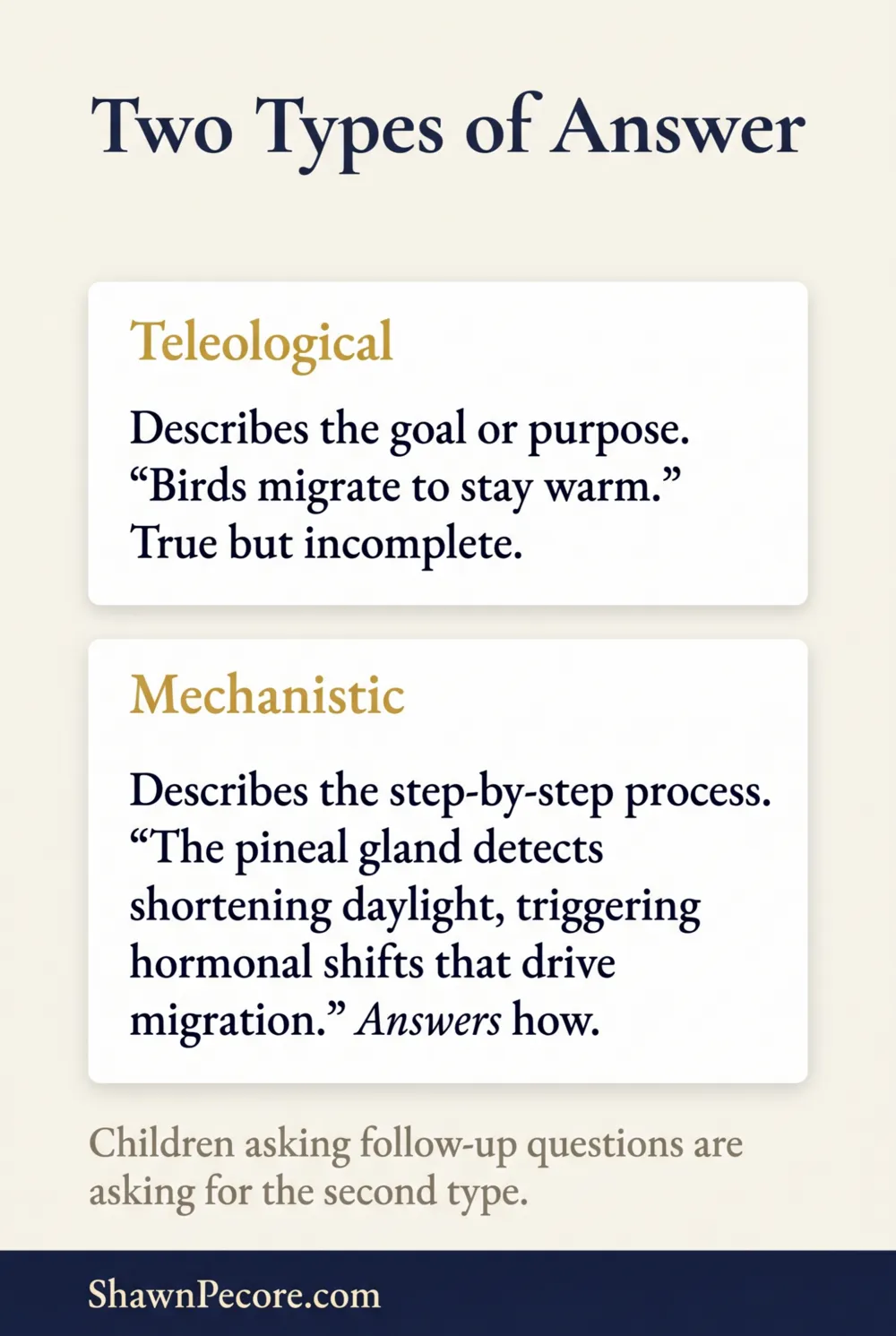
Two types of answer. One explains the purpose. One explains the process. Children asking persistent follow-up questions are asking for the second type.
Frequently Asked Questions
Mechanistic reasoning means explaining how something happens by describing the specific step-by-step process that produces it. Not what the outcome is, not what purpose it serves, but which things are involved, what they do, and how one action causes the next. When you explain that ice melts because faster-moving air molecules transfer energy to the slower-moving molecules in the ice, breaking the bonds that hold them in a fixed structure, that is mechanistic reasoning. When you say "because it gets warm," that is a functional summary. Both are true. Only one explains anything.
Partly because they were taught the same way. Science education has defaulted to functional answers for decades, so most adults learned the what without the how. Partly because the mechanism requires thinking through multiple steps, which is harder than retrieving a remembered fact. And partly because adults underestimate what children can follow. The mechanism is withheld not because it is too complex but because it is not expected to matter. Children notice the gap even when they cannot name it.
Earlier than most parents expect. Research published in the Journal of the Learning Sciences in 2024 found that when guided to ask "how" rather than "why," children construct mechanistic explanations successfully 68% of the time. The study involved elementary school children, including second-graders. The cognitive capacity is there before most formal science instruction attempts to build it. The constraint is not developmental. It is whether the adults in the child's life are offering mechanisms rather than functional summaries.
Say so, and then work through it together. "I know plants bend toward light but I'm not sure exactly how that happens at the level of the cells. Let's find out." That response is more scientifically honest than a confident functional answer, and it models the investigator stance that preserves a child's curiosity better than any complete explanation. If you do find the mechanism, explain it using the simplest physical terms available. The cell elongation example is entirely followable by a ten-year-old.
A teleological explanation describes the goal or purpose. Birds migrate to stay warm. Plants bend toward light because they need it. These are not wrong. They describe evolutionary function accurately. A mechanistic explanation describes the process that produces the outcome: how the bird's body detects declining daylight, how the hormone shift triggers migratory behaviour, how magnetic sensitivity guides the route. Children asking persistent follow-up questions are asking for the mechanism. Most answers they receive stop at the teleology.
Mechanistic reasoning in biology among elementary school children, Journal of the Learning Sciences, 2024 (Taylor and Francis)
David Hammer, Tufts University, modeling as social practice in science education, 2024 (ResearchGate)
American Instructional Resources Survey, RAND Corporation, 2025 (RAND Corporation)
Effects of inquiry-based approaches on higher-order thinking in science, EURASIA Journal of Mathematics, Science and Technology Education, 2024 (EURASIA Journal)
A systematic review of curiosity and wonder in natural science and early childhood education research, Educational Psychology Review, 2024 (Taylor and Francis)
Part of the series: The Question Every Curious Kid Asks That Textbooks Never Answer