The Question Every Curious Kid Asks That Textbooks Never Answer
Kids ask around 100 questions a day before school starts. Why do kids ask so many questions? Because that is how children build a working model of the world. Not motivation. Not personality. Mechanism. School does not kill curiosity. It stops paying it out, which turns out to be the same thing over time.
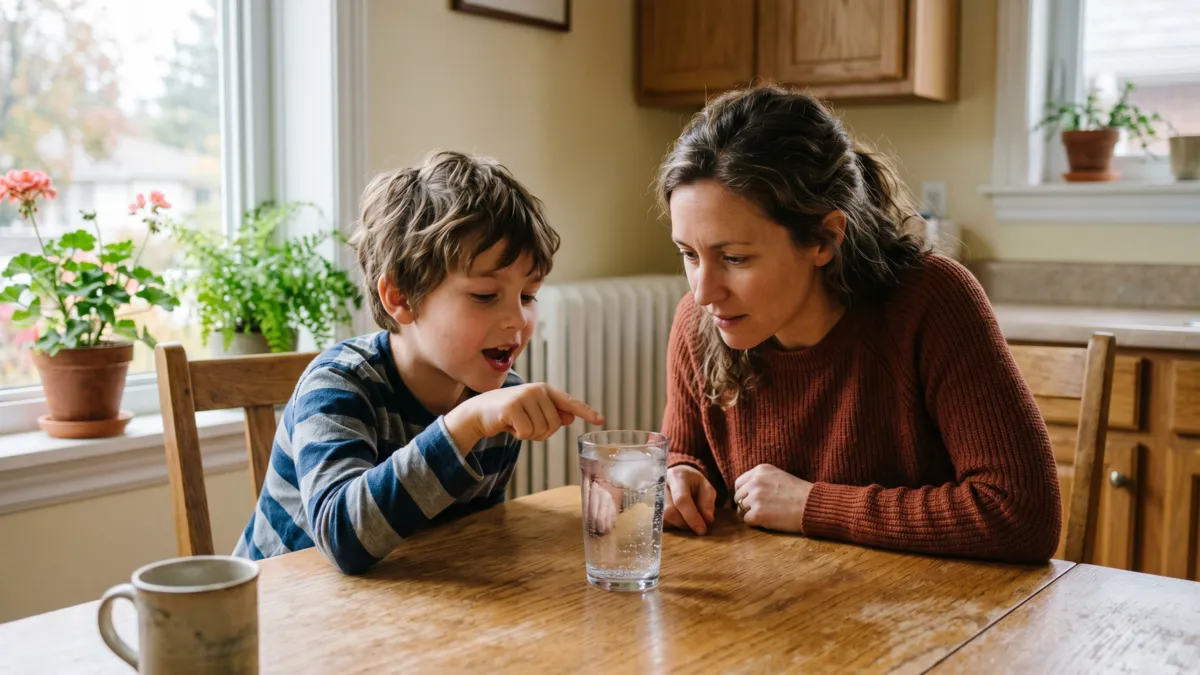
Children ask approximately 40,000 questions between ages two and five. The goal is keeping that engine running after school starts.
- Children ask approximately 40,000 questions between ages two and five, around 100 per day at peak. Research is consistent that the drop-off at school entry is driven by the school environment, not by developmental change.
- 81% of teenagers report genuine interest in science. Only 37% enjoy their actual science classes. The subject is not the problem.
- 35% of parents regularly find themselves with no answer to their child's daily questions. The instinct to Google and deliver the answer is understandable and counterproductive.
- There is a four-response framework that keeps a child's investigation alive. None of the four responses require the parent to know the answer.
- The MEYE Science Series is built on the same principle: give kids the actual mechanism, not the nearest comfortable approximation.
What Happens to a Child's Questions at School
Between ages two and five, children ask roughly 40,000 questions. Around 100 per day at peak.
I teach high school science. Every September I watch the same thing happen. Students come in, sit down, and wait. They copy notes. They ask about the test. Almost none of them ask about the phenomenon sitting right in front of them. That absence is not apathy. It took years to produce.
Harvard child psychologist Paul Harris has been tracking this for a long time. He calls it falling off a cliff. Children ask questions at an extraordinary rate until school entry, then the rate drops sharply and never really comes back. Not because they outgrew curiosity. Because they learned, fast, that curiosity is not what earns them anything in a classroom.
Harris calls the operating model product-driven efficiency. Get as much information to as many students as possible in the time available. Questions from students are expensive. They take the lesson somewhere unplanned. The system is not trying to punish curiosity. It just has no budget for it. So students stop spending it.
The NAEP numbers make the downstream effect visible. Only 14% of 13-year-olds read for fun daily. That is down 13 points since 2012. It is not a reading problem. It is a disengagement pattern that tracks the school years almost exactly.
The Question Textbooks Never Actually Answer
A child points at the houseplant on the windowsill. The stems are bending toward the glass. Why?
Because plants need sunlight to grow. That is the answer most books give. It is true. It also tells the child essentially nothing about what is actually happening.
What is happening: a hormone called auxin redistributes to the shaded side of the stem. That causes cells on the shaded side to elongate faster than cells on the lit side. The differential growth rate bends the stem toward the light. The plant is not leaning because it wants anything. It is responding to a chemical gradient. That is the mechanism.
The functional answer shuts the question down. The mechanistic answer opens at least three more. What is auxin. Why does it move toward shade. Does this happen in every plant species or only some. Those questions are the beginning of actual plant biology. Most children never reach them because the textbook stopped one level too early.
Not a reading-level problem. An assumption problem. Children's science content is written to a cognitive ceiling that research does not support. Work on mechanistic reasoning for kids shows second-graders constructing sophisticated causal explanations when someone bothers to ask them how rather than just telling them what. The ceiling is almost always the adult's, not the child's.
What 35% of Parents Have No Answer For
Talker Research put a number on it in 2024. 35% of parents regularly hit a wall when their child asks a daily question. No answer. The reflex is to grab a phone, find something credible-sounding, and hand it over.
That reflex closes the loop. The child gets the fact and moves on. Satisfaction, no traction.
What the research on curiosity shows consistently is that the co-investigator stance produces something different. The adult does not know. Says so. Invites the child into figuring it out. The child stays in the investigator role instead of becoming a passive recipient of retrieved data. That distinction sounds subtle. The long-term effect on a child's relationship with not-knowing is not subtle at all.
97% of parents in the same survey said they want their child to understand the reasoning behind things, not just the facts. The instinct is exactly right. The gap is between that instinct and what actually happens in the moment, which is almost always: phone, answer, done.
"I don't know, let's find out together" is not a feel-good parenting line. It is doing something precise. It signals that not knowing is a legitimate place to start. That the investigation belongs to both of them. That there is no test to pass here, just a question worth chasing.
Why Curriculum Doesn't Match What Kids Want to Know
81% of teenagers are highly interested in science. 37% enjoy their science class. That 44-point gap has been sitting there for years and nobody is pretending it does not exist.
The Next Generation Science Standards were written to fix it. Three-dimensional learning, phenomenon-based instruction, real-world problems students have to explain rather than just describe. The framework is sound. The materials are not there.
The 2025 American Instructional Resources Survey found high-quality science materials for elementary students are 13 times rarer than equivalent English or Math materials. Science teachers trying to run phenomenon-based inquiry are largely doing it without the tools. So they fall back on what exists. Worksheets. Vocabulary lists. The textbook sequence. Not because they want to. Because there is nothing else at the scale they need.
38% of science teachers report engaging students in a meaningful, logical learning sequence. That number should alarm anyone paying attention.
The downstream version of this lands on the parent at the kitchen table. The child spent the school day labelling a diagram. Now they are home with a worksheet asking them to label a different diagram. Understanding the science curriculum gaps behind this makes it easier to work around them rather than assume the child has lost interest in science. They have not lost interest in science. They are just tired of this version of it.
The Four Responses That Keep a Question Alive
Four responses. None of them require knowing the answer. All four keep the child in the investigator role rather than the audience.
"What do you think?" Sounds obvious. In practice most adults skip straight past it. Asking the child what they think before offering anything makes their existing model visible. That model is the starting point. A child who thinks ice melts because it gets tired of being cold is telling you exactly where their causal reasoning breaks down. You cannot fix what you cannot see.
"How could we find out?" This one shifts the whole frame. The child stops waiting for a conclusion and starts thinking about method. That shift is the structure of scientific inquiry compressed into five words. A six-year-old who says "we could put one ice cube in the sun and one in the shade" has just designed a controlled experiment. No textbook involved.
"What would happen if we changed this?" Observation becomes inquiry the moment you introduce a variable. The child watching ice melt is observing. The child asking what happens to the melt rate if the cube is smaller is doing science. This question teaches that distinction without ever naming it.
"I don't know. Let's find out together." The most powerful of the four. Also the hardest for adults to say without flinching. The adult who is supposed to know things does not know this thing and treats the gap as something worth chasing rather than covering. Children who see that modelled regularly learn that not-knowing is a starting position, not a failure. That lesson is worth more than most of what they will memorise this year.
These four are the practical entry point to Socratic questioning at home, a structured way to turn a child's question into a real investigation without a kit or a lesson plan.
Productive Uncertainty: The Science of Not Knowing
"Uncertainty is what motivates scientists to do the activities they do. We have to use that uncertainty as a fundamental resource for our children." Eve Manz, Associate Professor of Science Education at Boston University, said that in 2025. She calls it productive uncertainty. Not a vague encouragement to let kids struggle. A specific pedagogical principle: build not-knowing deliberately into a child's science experience so they engage with the practices of science rather than just absorbing the content.
Here is the counterintuitive part. A quick, accurate answer is one of the least useful things you can give a curious child. It discharges the question. The child is satisfied and moves on. The child who gets kept in the uncertainty long enough to form a hypothesis has somewhere to go with it.
A 2024 meta-analysis across 86 studies found an overall effect size of 0.893 (Hedges' g) on higher-order thinking from inquiry-based learning. That is large. The mechanism is not difficulty or novelty. It is keeping the student in the uncertainty long enough that they actually engage with it rather than waiting for it to be resolved.
In my own classroom: when a student asks something I cannot answer on the spot, I say so. Then I ask what they think the answer might be and why. What comes out of that is almost always more interesting than whatever I would have looked up and read back to them. The uncertainty is the engine. The comfortable adult who resolves it immediately is not being helpful. They are stalling the machine.
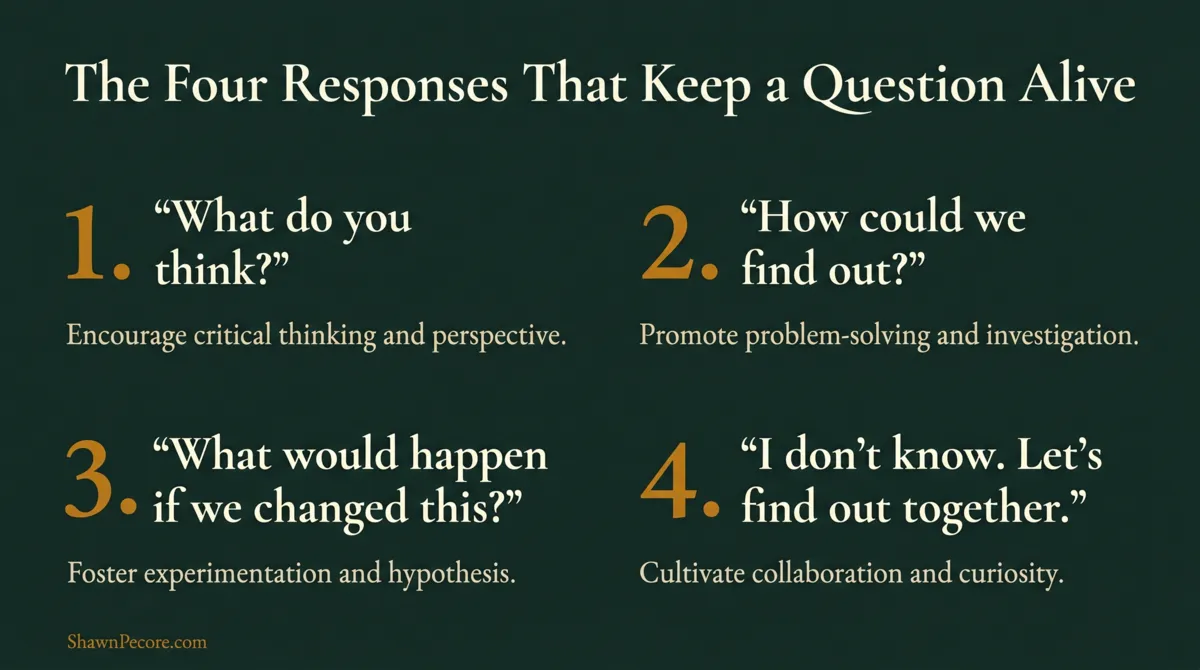
The four-response framework keeps a child's investigation open. None of the responses require the parent to know the answer.
What Mechanistic Reasoning Looks Like at Age 8
Mechanistic reasoning: explaining a phenomenon by describing the specific step-by-step process that produces it. Not what happens. Not the goal behind it. How. Which entities are involved, what they do, how one action causes the next.
Research published in the Journal of the Learning Sciences in 2024 found that when children are guided to ask "how" rather than "why," they construct mechanistic explanations successfully 68% of the time. Second-graders. Not a special cohort. Not a gifted programme. Ordinary second-graders given the right framing.
The ice cube. A child asks why it is melting. Teleological answer: because it needs to become water. Functional answer: because the room is warmer. Mechanistic answer: the molecules in the warmer air are moving faster than the molecules locked in the ice crystal. When they collide with the surface, energy transfers. That energy breaks the bonds holding the ice molecules in their fixed lattice. They start moving freely. That is liquid water. Molecules with enough kinetic energy to slide past each other.
A ten-year-old can follow every step of that. Most ten-year-olds have never been offered it. The barrier is not developmental. It is that nobody tried.
The two criteria children use to evaluate explanations, according to the same research, are explanatory power and accuracy. Does this explain how it happens, or just that it happens. Is it true. Those are the same criteria scientists use. Children arrive at them on their own. The question is whether the science they encounter bothers to meet those criteria or just clears a lower bar.
If this is the kind of science you want your child to engage with, the Shawn Pecore Substack is where I write it first. Free.
How the MEYE Science Series Is Built on This Principle
Every book in the MEYE Science Series starts from one assumption: children aged 8 to 12 can handle real science.
Not a simplified version. Not the mechanism swapped out for a metaphor. Not the interesting part removed because someone decided it was too much. The actual process, explained at the level a curious child can follow, which is almost always further than anyone gave them credit for.
The series is top-down and mechanistic. A book on plate tectonics opens with the ground moving right now, beneath the reader's feet, as it has for billions of years. Every mountain range on the planet, every ocean trench, every earthquake zone is a consequence of that motion. The mechanisms come first. The vocabulary comes later, in service of the process, not as a substitute for it.
Same principle as the four-response framework. Keep the child in the investigator role. Give them the actual mechanism. Let the questions come from understanding rather than from confusion. MEYE Plate Tectonics is coming soon. See the full MEYE Science Series for all current and upcoming titles.
Try It: What Kind of Answer Is This?
Five scenarios. A child asks a question and an adult answers it. For each one, decide: does this answer close the curiosity loop, or does it open the next question? Good for parent and child to do together.
Frequently Asked Questions
Asking questions is how children build a working model of the world. Between ages two and five, children ask approximately 40,000 questions in total, around 100 per day at peak. Each question is an attempt to fill a gap in their understanding of how things work. The behaviour is not attention-seeking. It is the mechanism of early learning operating exactly as it should. The problem is that formal schooling, optimised for delivering answers efficiently, does not know what to do with a child who wants to keep asking.
The drop begins at school entry, around age five or six. Harvard child psychologist Paul Harris describes it as falling off a cliff. The cause is not a natural developmental shift. Schools reward having the right answer, not formulating a good question. Under pressure to cover content efficiently and improve test scores, classrooms leave very little time for student-led inquiry. Children learn quickly that questions slow things down, and they stop offering them.
Do not Google the answer and deliver it. That closes the inquiry loop and trains the child to wait for information rather than pursue it. A more effective approach is to respond with one of four questions: What do you think? How could we find out? What would happen if we changed something? Or simply: I don't know, let's find out together. Each of those responses keeps the child in the investigator role. Children who are treated as co-investigators maintain their interest far longer than children who receive direct answers.
Mechanistic reasoning is the ability to explain a phenomenon by describing the step-by-step process that produces it, linking cause to effect at the level of specific entities and their actions. Research published in the Journal of the Learning Sciences in 2024 found that when children are guided to ask "how" rather than "why," they construct mechanistic explanations successfully 68% of the time. Second-graders can do this. Most science education simply does not ask them to.
Most children's science content is written to an assumed reading level rather than a cognitive level. The assumption is that a simpler answer is a safer answer. The result is content that tells children what happens but not how, and why at the goal level but not at the mechanism level. Children aged 8 to 12 can handle the mechanism. Most books do not attempt it.
A closing answer satisfies the question completely, delivers the fact, and ends the exchange. An opening answer validates the question, provides enough to move the thinking forward, and generates a next question naturally. The difference is not about how much information is given. It is about whether the child stays in the investigator role after the answer arrives. "Ice melts because it gets warm" closes the question. "What do you think happens to the water molecules when the temperature rises?" opens the next one.
Warren Berger, A More Beautiful Question, children's questioning rate data (amorebeautifulquestion.com)
Paul Harris, Harvard University, research on questioning decline at school entry (Harvard GSE)
Gallup, K-12 education satisfaction survey, 2025 (Gallup)
National Assessment of Educational Progress, 14% of 13-year-olds reading for fun daily, 2024 (nationsreportcard.gov)
Talker Research and Lightbridge Academy, parent survey on children's questions, 2024 (Lightbridge Academy)
American Instructional Resources Survey, RAND Corporation, 2025 (RAND Corporation)
EdWeek Research Center and Amgen Foundation, student science engagement survey, 2024 (Education Week)
Mechanistic reasoning in biology among elementary school children, Journal of the Learning Sciences, 2024 (Taylor and Francis)
Eve Manz, Boston University, productive uncertainty in science education, 2025 (BU Wheelock College)
Effects of inquiry-based approaches on students' higher-order thinking skills in science, a meta-analysis, ERIC, 2024 (ERIC)
Systematic review of wait time during questioning of children, PMC, 2024 (PMC)