Real Science Experiments vs Crafts: How to Tell the Difference
The defining feature of real science is not bubbling liquids, safety goggles, or an expensive kit from a toy store. It is falsifiability: the possibility that the result could be different from what was predicted. If an activity cannot produce a different outcome when the child changes something, it is a demonstration. Here is how to tell the difference, and what to do about it.
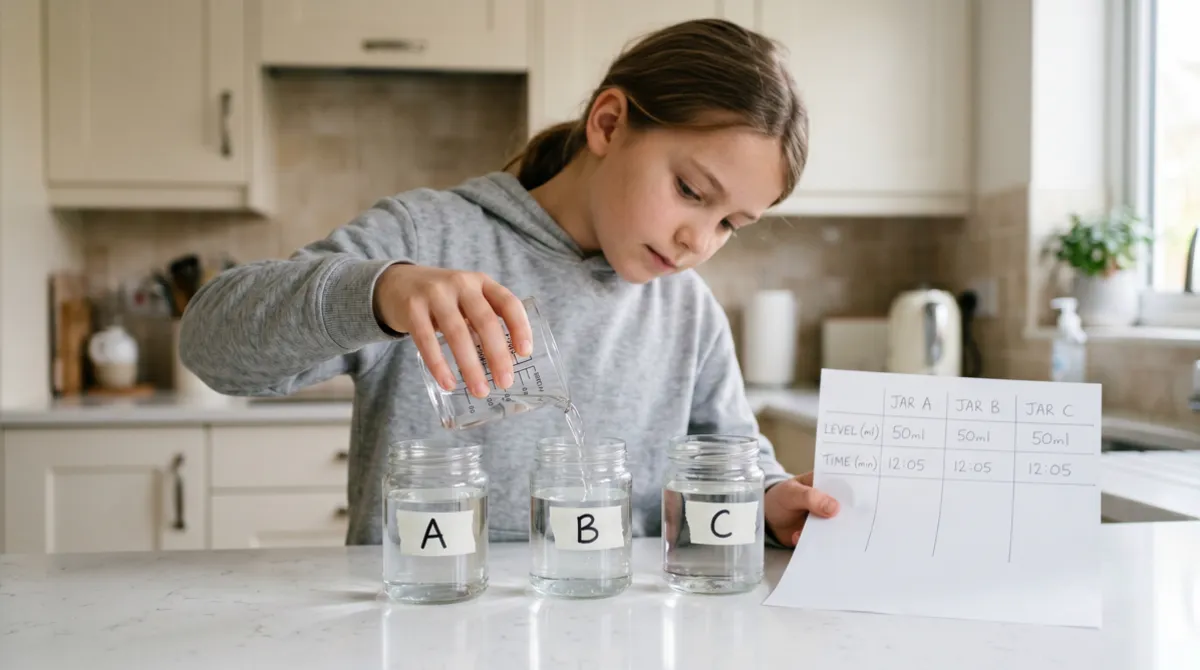
- If a science activity's outcome cannot change based on what the child does, it is a demonstration, not an experiment, regardless of how it is marketed
- The NAEP Science Framework defines science achievement through three dimensions: Disciplinary Concepts, Science and Engineering Practices, and Crosscutting Concepts. Most home activities cover only the first
- A 2025 study evaluated student scientific engagement across 6 levels. The majority of students in unstructured activity-based settings never moved past the early non-inquiry levels
- 65% of student posts in a targeted learning sequence were off-topic rather than demonstrating scientific thinking, despite high overall participation
- Real science requires a question, a prediction that could be wrong, a variable, and data. The absence of any one collapses the activity into something else
What Actually Defines Real Science
The scientific method is not a poster on a classroom wall. It is a specific way of asking questions so that the answers mean something.
The hallmark of real scientific inquiry is falsifiability. Philosopher Karl Popper established this as central to science: a scientific claim must be possible to test in a way that could prove it wrong. If no possible result would change your mind, you are not doing science. You are doing something else: ritual, craft, demonstration, storytelling.
Applied to a child's experiment: before the activity starts, the child commits to a prediction. The experiment is then designed so that the prediction could turn out to be wrong. If the result is guaranteed before the child begins, the activity is a demonstration. Interesting, potentially educational, but not an experiment.
Berkeley's Understanding Science project defines science as a process of testing ideas with evidence, where the evidence could in principle contradict the idea. That is the standard against which any activity should be evaluated: does this test a testable idea? Could the result be different from what we expect?
The Three-Dimension Test
The National Assessment Governing Board's 2028 NAEP Science Assessment Framework defines science achievement through three interconnected dimensions. Any activity can be evaluated against all three.
Disciplinary Concepts cover the established theories of physical, life, and earth sciences (the content). Most science activities touch this dimension. A baking soda volcano introduces the concept of chemical reactions.
Science and Engineering Practices cover the actual methods: asking questions, planning and carrying out investigations, analysing data, constructing explanations. Most home activities skip this dimension almost entirely. Following pre-set steps is not the same as planning an investigation.
Crosscutting Concepts cover the overarching tools for applying knowledge across domains: cause and effect, patterns, systems and system models, energy and matter. An activity that produces a visible reaction without asking the child to think about cause and effect is touching disciplinary content without developing the thinking tools that make science transferable.
Run through the three dimensions and ask honestly which ones are present. An activity that only operates in the first dimension is presenting science content, not practising scientific thinking.
The STEM Kit Problem
A parent buys a well-reviewed STEM kit. It contains pre-measured powders in plastic test tubes. The instructions: pour tube A into tube B and observe the neon slime that forms. The child follows the steps. Slime appears. Activity complete.
That was not different from following a recipe to bake a cake. Every step was prescribed. The outcome was certain. No question was asked and no prediction was made. Nothing in the activity required the child to think about what they were doing or why it worked.
This is not a criticism of every STEM kit. It is a description of most of them. A kit that provides materials and asks the child to design a test to answer a question is a completely different product. They exist and they are rarer, because the impressive moment in real science is not the reaction. It is the conclusion.
Before buying any science kit or beginning any home activity, ask one question: does this allow the child to change something and see a different result? If the instructions prescribe every step and the outcome is guaranteed, it is a demonstration kit. Buy it to show a reaction. Do not buy it expecting the child to do science.
A Practical Rubric
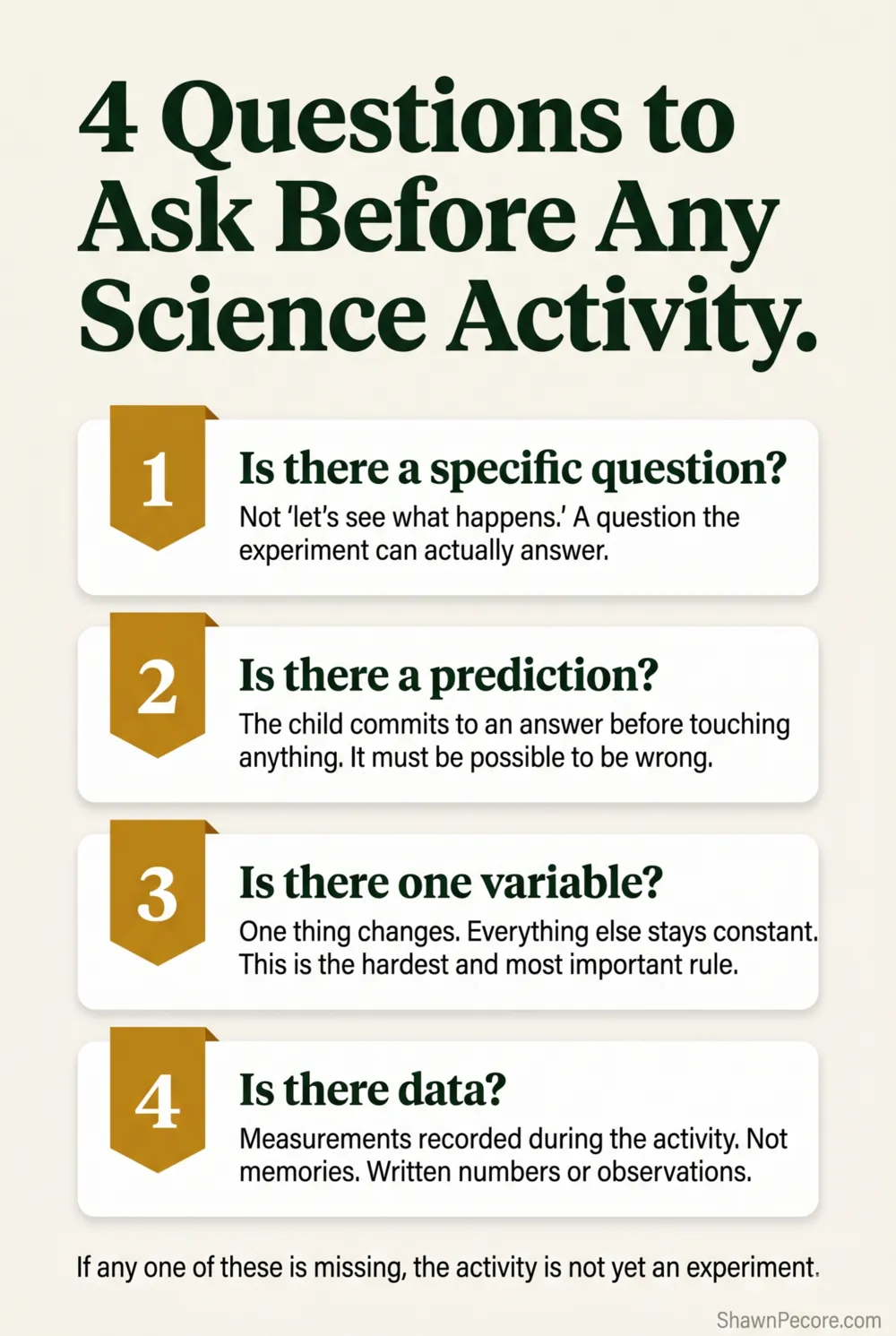
Here is a four-question rubric that takes thirty seconds to apply to any science activity:
Is there a question? A specific, answerable question that the activity is designed to address. Not "let's see what happens." A question with a measurable answer. "Does the temperature of the water affect how fast salt dissolves?" is a question. "Let's make salt water" is a task.
Is there a prediction? Before touching anything, the child commits to an answer. This is the hypothesis. It does not need to be correct. It needs to be specific enough that the result can confirm or contradict it. "I think warmer water will dissolve the salt faster" is a prediction. "Salt will probably dissolve" is not specific enough to test.
Is there a variable? One thing that changes. Everything else stays constant. If the child changes the temperature, the amount of salt, the container size, and the stirring method all at once, no conclusion is possible because any of those changes might have caused the result. One variable, all else equal. This is the hardest concept and the most important one.
Is there data? Measurements or observations recorded during the activity, not remembered afterward. A chart with numbers. A written description of what was observed at each stage. The data is what makes the conclusion possible. Without it, you have a memory of what happened, which is unreliable.
If the answer to all four is yes, the activity is a real experiment. If any one is absent, add it before starting. If the activity does not allow any of them to be present, it is a demonstration.
Turning Any Craft Into an Experiment
Almost any demonstration or craft can become a real experiment with one or two changes. The activity itself often does not need to change. The question and the approach do.
Baking soda and vinegar volcano: ask the child to predict which ratio of baking soda to vinegar produces the most carbon dioxide. Test three different ratios. Measure the volume of foam produced each time. Record and compare. Now it is an experiment in stoichiometry, at a level appropriate for an eight-year-old who has never heard that word yet.
Paper airplane: ask the child to predict which wing design flies farthest. Make three identical planes, change one feature on each (wing length, fold angle, number of folds). Test each three times. Average the distances. Record and conclude. Now it is aerodynamics.
Cornstarch slime: ask the child to predict how the ratio of cornstarch to water affects the texture. Make four batches with different ratios. Test each by pressing quickly versus pressing slowly. Record which ratios produced which behaviours. Now it is rheology (the study of how matter flows) and the child has collected data on non-Newtonian fluid behaviour.
The craft does not prevent the science. The absence of a question and a variable does.
This post is part of a series on science activities that actually teach. See my main post, The Problem With 'Making Science Fun', which covers the full argument, and a related post, Inquiry-Based Learning Without Rigor: Why It Fails, which addresses why good inquiry requires a foundation of direct instruction first.
Frequently Asked Questions
Ask: can the child change something and get a different result? If the answer is yes, and the activity is set up to use that possibility, you have the foundation of a real experiment. If the outcome is fully determined before the child starts, the activity is a demonstration, regardless of how scientific it looks or how it is marketed.
A demonstration shows you that something happens. An experiment tests why it happens, or tests what happens when you change something. The baking soda and vinegar reaction is a demonstration if the child follows fixed steps and watches. It becomes an experiment when the child asks a question, predicts an answer, tests different amounts, measures the results, and draws a conclusion.
It depends entirely on what the kit asks the child to do. Many STEM kits provide pre-measured materials and step-by-step instructions that produce a predetermined result. That is a demonstration kit, regardless of the price. Before purchasing, check whether the instructions allow for variation. If they prescribe every step and guarantee the outcome, the child will be performing a recipe.
Falsifiability means the prediction or hypothesis could turn out to be wrong. If an activity is designed so that the outcome is guaranteed regardless of what the child does, there is nothing to falsify. Children who work with falsifiable predictions learn that science is a process of finding out, not a process of confirming what the instructions already said.
Science relies on evidence, Understanding Science, UC Berkeley (Understanding Science) · Testing scientific ideas, Understanding Science, UC Berkeley (Understanding Science) · 2028 NAEP Science Assessment Framework, National Assessment Governing Board (NAGB) · Inquiring in the Science Classroom by PBL, Design-Based Research, MDPI, 2025 (MDPI) · Seeing Science Project, Transformative Experience, PMC, 2024/2025 (PMC) · CDC Program Evaluation Framework Action Guide, 2024 (CDC) · Science Education Should Be National Priority, National Academies (National Academies)
Back to: The Problem With 'Making Science Fun'