Science vs Engineering in Education: Why the Difference Matters for Kids
A parent buys a bridge-building kit. The child spends two hours testing designs, cheering when a bridge holds weight, and adjusting the structure when it fails. The parent posts a photo with the caption "our little scientist at work." The activity was genuinely good for the child. But it was not science. It was engineering. The difference matters more than most STEM content suggests.
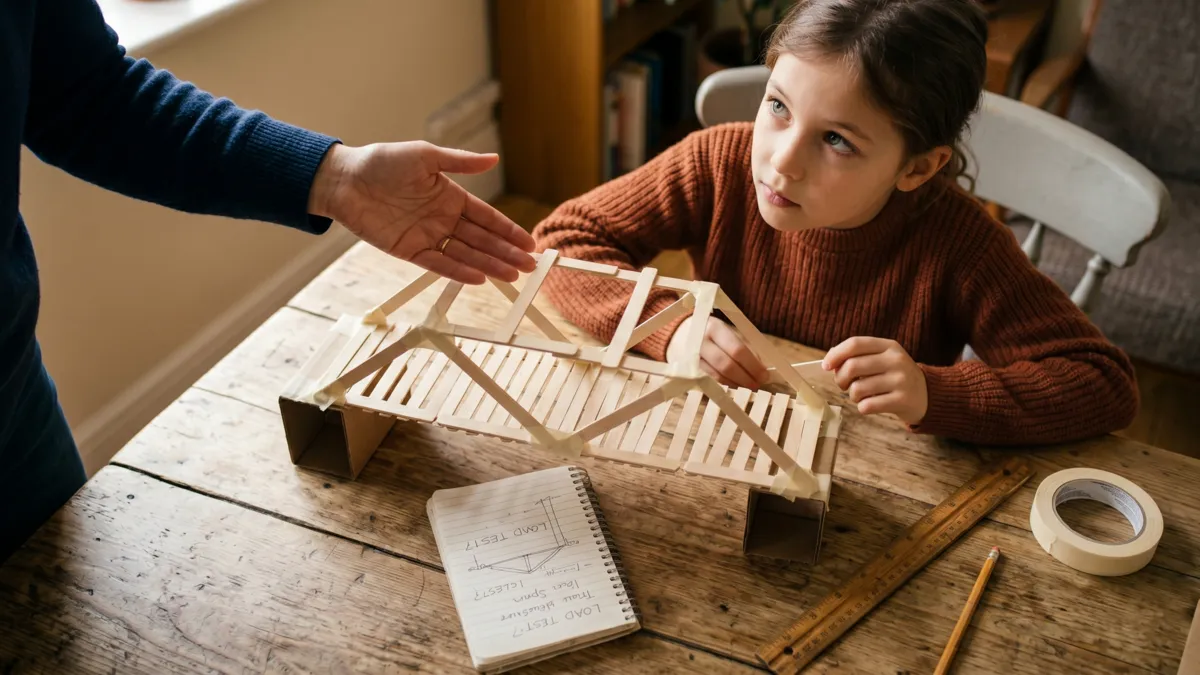
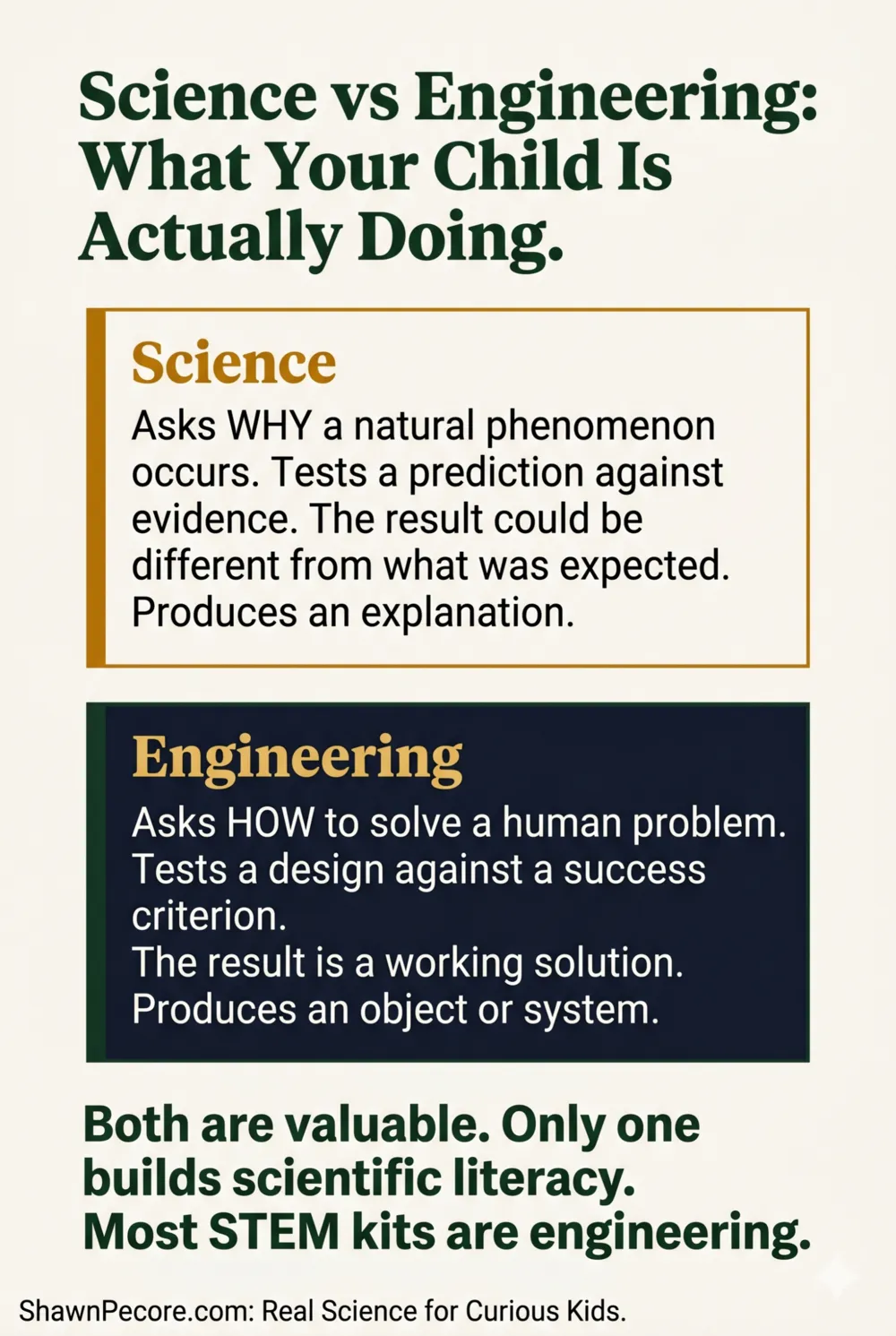
- Science asks "why does a natural phenomenon occur" and tests explanations. Engineering asks "how do I design a solution to a human problem." Both are valuable, but they are not the same thing
- At least 411,549 U.S. teaching positions were unfilled or under-certified as of 2025, meaning 1 in 8 positions nationally is compromised. Science instruction loses the most nuance when generalists fill specialist gaps (Learning Policy Institute, 2025)
- 90% of annual demand for new teachers is driven by attrition rather than retirement, meaning the crisis refills itself continuously (Edustaff, 2026)
- The Next Generation Science Standards define eight distinct practices. Engineering activities commonly cover only one or two of them
- A child who only does engineering activities never develops the habit of asking why a natural phenomenon occurs. That habit is the root of scientific literacy
The Bridge-Building Problem
Bridge-building kits are everywhere in STEM education, and for good reason. They produce visible results, require iterative thinking, and give children a clear success metric. A bridge that holds weight worked. A bridge that collapsed needs rethinking. That feedback loop is real and valuable.
The problem is what happens when bridge-building becomes the primary mode of "science" at home or in the classroom. The child learns to build things that work. They do not learn to ask why natural processes operate the way they do.
Aerospace Engineer Theodore Von Kármán described the distinction cleanly: "Scientists discover the world that exists. Engineers create the world that never was." A child designing a bridge is creating something that did not exist before. A child testing whether the angle of a ramp affects how far a ball rolls is asking a question about a world that already exists. Both are valuable. Only one is scientific inquiry.
The confusion between the two is understandable. Both fall under STEM. Both involve hands-on activity. Both require problem-solving. But conflating them means children often spend years doing engineering activities under the label of science and never build the questioning habit that science actually requires.
What Science Actually Is
Science is a method for asking questions about the natural world and testing the answers against evidence. The core move is: here is a claim about how something works, here is a test that could prove that claim wrong, and here is what the test showed.
The emphasis on what could prove it wrong is not a minor detail. It is the defining feature. An activity where the outcome is guaranteed before the child starts is not science. Science requires a question with a falsifiable answer: one where the evidence could come back against what was predicted. A child who predicts that heavier objects fall faster and then tests that prediction is doing science. The fact that they will probably be wrong (objects fall at the same rate regardless of mass, in the absence of air resistance) is precisely what makes it valuable. The failed prediction teaches them something real about how the world works.
Velma Itamura of the Science and Technology Advancement Center put it this way in 2024: "Imagine trying to learn how to swim just by reading a manual. The same goes for science. Real understanding comes from doing, not just memorising. The Science and Engineering Practices are the way students get in the pool."
The practices she is describing are the NGSS eight: asking questions, developing models, planning investigations, analysing data, using mathematics, constructing explanations, arguing from evidence, and communicating findings. A child who works through all eight on a single topic has done science. Most home activities reach one or two.
What Engineering Actually Is
Engineering applies scientific knowledge to solve practical problems. It starts with a constraint: make something that holds weight, transmits electricity, filters water, or travels a certain distance. The goal is a working solution, not an explanation.
A 2025 systematic review of K-12 STEM education described engineering practices as centred on "design-based tasks and challenges," prototyping, model building, and iterative improvement. The child tests the design, identifies what failed, changes something, and tests again. That is excellent cognitive work. It builds persistence, spatial reasoning, and the capacity to learn from failure.
It does not build the habit of asking why a natural phenomenon occurs. And that habit is what scientific literacy is.
Engineering activities also have a clear advantage for parents and teachers: they are easier to facilitate. The success criterion is obvious. The child either built something that works or they did not. Science inquiry is messier. A failed experiment is ambiguous without the analysis to understand what it means. That messiness is not a flaw. It is what real scientific investigation looks like. But it requires more from the person facilitating it.
Why the Staffing Crisis Makes This Worse
When a science classroom is staffed by a generalist covering a subject outside their training, the default is the easiest version of the subject. For earth science, that means rock identification worksheets. For physics, it means building activities with clear outcomes. For biology, it means labelling diagrams.
The Learning Policy Institute found that at least 411,549 U.S. teaching positions were unfilled or filled by under-certified educators as of 2025. One in eight positions nationally is compromised in some way. The cost of replacing a single teacher ranges from $12,000 to $25,000 per district, and 90% of the annual demand for new teachers is driven by attrition rather than growth. The pool refills itself with whoever is available.
The consequence for science instruction is that the distinction between scientific inquiry and engineering design gets lost in translation. Both are in the NGSS framework. Both require specialist understanding to teach well. When neither the teacher nor the available curriculum materials make the distinction clear, children spend their science time building things and calling it science.
This is not a failure of individual teachers. It is a structural consequence of a stretched system defaulting to what is feasible. The parent who understands the distinction and applies it at home is not supplementing the curriculum. They are covering a gap the formal system acknowledges it cannot close quickly.
The NGSS Eight Practices as a Parent Checklist
The Next Generation Science Standards define eight practices that appear in both science and engineering. Used as a quick checklist, they show immediately how much of the activity is science and how much is engineering.
Run through them for any activity the child is doing. Is the child asking a question about a natural phenomenon? Developing a model to explain something? Planning an investigation with a variable? Analysing data they collected? Using any mathematics? Building an explanation from evidence? Arguing for a conclusion? Communicating what they found?
A bridge-building kit usually covers "designing solutions" and perhaps "using mathematics." That is two out of eight. A well-run inquiry into how the angle of a ramp affects the distance a ball travels can cover all eight in a single afternoon.
The point of the checklist is not to score every activity. It is to notice when the activity is missing the asking-questions, planning-investigations, and arguing-from-evidence practices entirely. Those three are where scientific thinking lives. A child who never exercises them is developing only half of what STEM education claims to produce.
How to Run Both in the Same Afternoon
The good news is that science and engineering can coexist in a single session. The pivot between them is a question.
A child building a baking soda and vinegar volcano is doing an engineering activity: they are assembling a model to produce a specific effect. The pivot to science happens the moment the parent asks: "Why does real magma rise? Does the chemical composition of the magma change how explosively it erupts? How would you test that?" Those questions move the child from building to inquiring. The model stays on the table. The mode of thinking changes.
The same pivot works for any building activity. A child building a paper bridge can be asked: what do you think will happen if you change the thickness of the paper? Make a prediction before you test it. Change only that one thing. Record what each version held. Now explain what the pattern in your data means. That is science. The bridge is still there.
The NGSS checklist makes the pivot explicit. If the current activity is only covering one or two practices, adding the questions that bring in the others takes about two minutes and completely changes the cognitive demand of the afternoon.
This post is part of a series on real earth science education. The pillar post, What a Geologist Notices That Most Science Writers Miss, covers the full argument for top-down science education. The related cluster, Textbook Geology vs Real Fieldwork: What Your Child Is Missing, addresses the gap between classroom instruction and the kind of observation that makes geology real.
Frequently Asked Questions
Science asks why a natural phenomenon occurs and tests explanations against evidence. Engineering asks how to design a solution to a human problem. Both are valuable, but they require different thinking. Science produces explanations. Engineering produces objects or systems. A child who only does engineering activities never builds the questioning habit that scientific literacy requires.
No. A bridge-building kit is an engineering activity. The child is designing a solution to a specific problem: hold as much weight as possible without collapsing. To turn it into a science activity, the child needs to ask why certain designs hold more weight, form a prediction before testing, change one variable at a time, and record results. That is the pivot from engineering to scientific inquiry.
Partly because both fall under the STEM umbrella, which groups them in ways that blur the distinction. Partly because engineering activities are easier to facilitate at home and in classrooms: they have a clear endpoint, a visible success metric, and simple materials. Science inquiry is messier and harder to grade. The Learning Policy Institute found that 411,549 U.S. teaching positions were unfilled or under-certified as of 2025, meaning many science classes are taught by generalists not trained to maintain the distinction.
The Next Generation Science Standards define eight practices: asking questions and defining problems, developing and using models, planning and carrying out investigations, analysing and interpreting data, using mathematics and computational thinking, constructing explanations and designing solutions, engaging in argument from evidence, and obtaining, evaluating, and communicating information. Most commercial STEM kits cover only one or two. The practices involving asking questions, planning investigations, and arguing from evidence are the ones most often missing.
An overview of teacher shortages 2025, Learning Policy Institute (Learning Policy Institute) · Teacher shortages in 2025: what the data revealed, Edustaff, 2026 (Edustaff) · A systematic review of engineering practice in K-12 STEM studies, Taylor and Francis, 2025 (Taylor and Francis) · Why emphasising science and engineering practices supports better assessment outcomes, Vernier, 2024 (Vernier) · Dimension 1: Scientific and engineering practices, National Academies, K-12 Science Education Framework (National Academies) · The difference between science and engineering, Jay Daigle (Jay Daigle)
Back to: What a Geologist Notices That Most Science Writers Miss