What Kids Actually Want to Know vs What Science Class Teaches
In a 2016 US survey, 81% of teenagers expressed an interest in science, while 37% liked their science classes “a lot.” That difference raises questions about what helps students engage with science in school. It is a curriculum design problem, and the science curriculum gaps driving it are well documented and largely unaddressed.
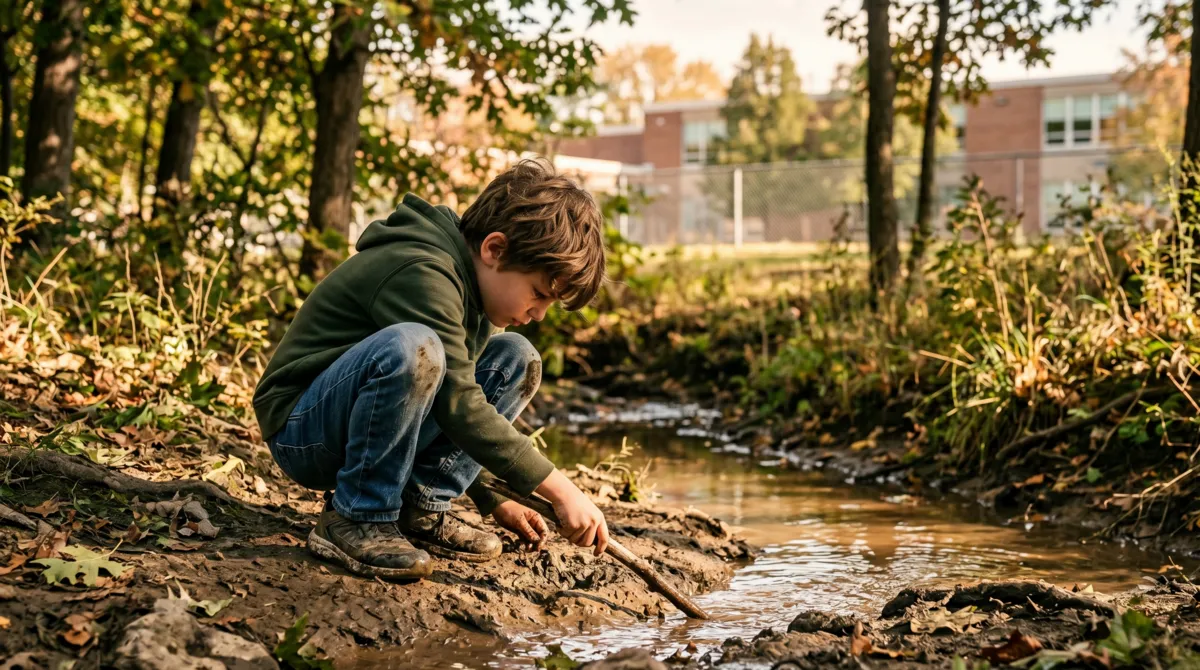
The science a child does in unstructured time and the science they encounter in class are often two completely different activities.
The 44-Point Gap
Every September I watch students walk into science class carrying genuine curiosity about how the world works. By November, a significant portion of them have shifted into compliance mode. They do the work. They are not doing science.
A 2016 survey commissioned by the Amgen Foundation and Change the Equation found that 81% of surveyed US teenagers expressed an interest in science, while 37% said they liked their science classes “a lot.” That is a 44-point difference between two differently worded responses in that survey, not a measure of how every science classroom performs today.
It is not the students. Only 38% of science teachers report engaging students in a meaningful, logical learning sequence, according to a 2024 PPIC educator survey. And just 33% of US 12th graders are academically prepared for college-level science or mathematics, per the NAEP Nation's Report Card. The preparation gap starts early and compounds.
The broader pattern behind all of this, including what happens to a child's questioning instinct before they ever reach high school, is covered in why kids stop asking questions. The curriculum gap is one driver. It is not the only one.
What the Curriculum Is Actually Doing
The Next Generation Science Standards were written specifically to fix this. The NGSS framework moves instruction away from memorisation and toward three-dimensional learning: scientific practices, crosscutting concepts, and disciplinary core ideas, all anchored to real phenomena that students have to explain. The intent is sound. The implementation is badly behind.
The 2025 American Instructional Resources Survey is the most comprehensive look at this problem available. It found that science teachers are 40 to 50 percentage points less likely to use high-quality instructional materials compared to their English and Math colleagues. High-quality science materials for elementary students are 13 times rarer than equivalent materials for English or Math.
The consequence is predictable. Teachers who want to run phenomenon-based inquiry have nothing to run it with. So they use what is available: worksheets, vocabulary lists, the textbook's sequence. Not because they prefer those tools, but because the alternative does not exist at the scale they need. The curriculum defaults to easily testable, lower-order tasks, and the child who was interested in science encounters a subject that looks nothing like what interested them.
The answers that fill the gap are often shallow and circular, which compounds the problem in a specific way covered in why circular answers don't hold up.
What Kids Are Actually Asking About
In unstructured time, children do science constantly. They test which rocks skip best on water. They dam up puddles to see how the flow changes. They take apart anything with a battery. None of it is assigned. None of it requires a worksheet.
Then they go home to a two-dimensional diagram asking them to label the parts of a plant cell. The same child who spent an hour observing water flow is now expected to find meaning in a vocabulary exercise with no observable phenomenon behind it.
High school science teachers see the downstream version of this every year. In a thread on r/ScienceTeachers, educators described incoming students who lack the ability to read and follow instructions and who give up immediately when an answer is not obvious. That is not a focus problem. It is a trained response. Years of curricula that never asked them to persist through uncertainty produced students who do not know how to.
TJ McKenna, a science education researcher at Boston University, put it plainly in 2025: science is theirs to discover. Not confined to textbooks. Waiting in every observable phenomenon. The gap between that framing and the worksheet on the kitchen table is not small.
Why Quality Science Materials Are So Rare
The National Association of State Boards of Education described what quality science materials actually require in a 2024 report: instruction focused on sense-making and problem-solving with true phenomena, not topics, concepts, or construction projects. Building knowledge and applying it as students practise related skills.
The baking soda and vinegar volcano fails that standard completely. The child assembles a model to produce a predetermined effect. No phenomenon is being explained. No prediction is being tested. No data is being collected. It is a construction project, and most parents and teachers treat it as science because it produces a satisfying result.
The materials that meet the NASBE standard do exist. Generation Genius, developed in partnership with the National Science Teachers Association, is one of the few resources at the elementary level that builds instruction around real phenomena rather than isolated vocabulary. It is not widely known outside of teacher communities, which is part of the problem.
When evaluating any supplemental science resource at home, one question does most of the work: does the child have to explain something they observed, or do they just build something that works? The first is science. The second might be valuable, but it is engineering at best and a craft project at worst.
What a Curriculum Gap Looks Like at Home
The gap shows up at the kitchen table as a child who cannot connect what they learned at school to anything they have actually observed. They know what photosynthesis is called. They cannot tell you what would happen to a plant if you covered its leaves with foil for a week and why.
Bridging that gap does not require a science kit or a lesson plan. It requires a different question. Not "what did you learn about photosynthesis?" but "what do you think the plant is doing right now that we cannot see?" The second question asks the child to apply their knowledge to an observable phenomenon. That is the shift from content delivery to scientific thinking, and it takes about thirty seconds.
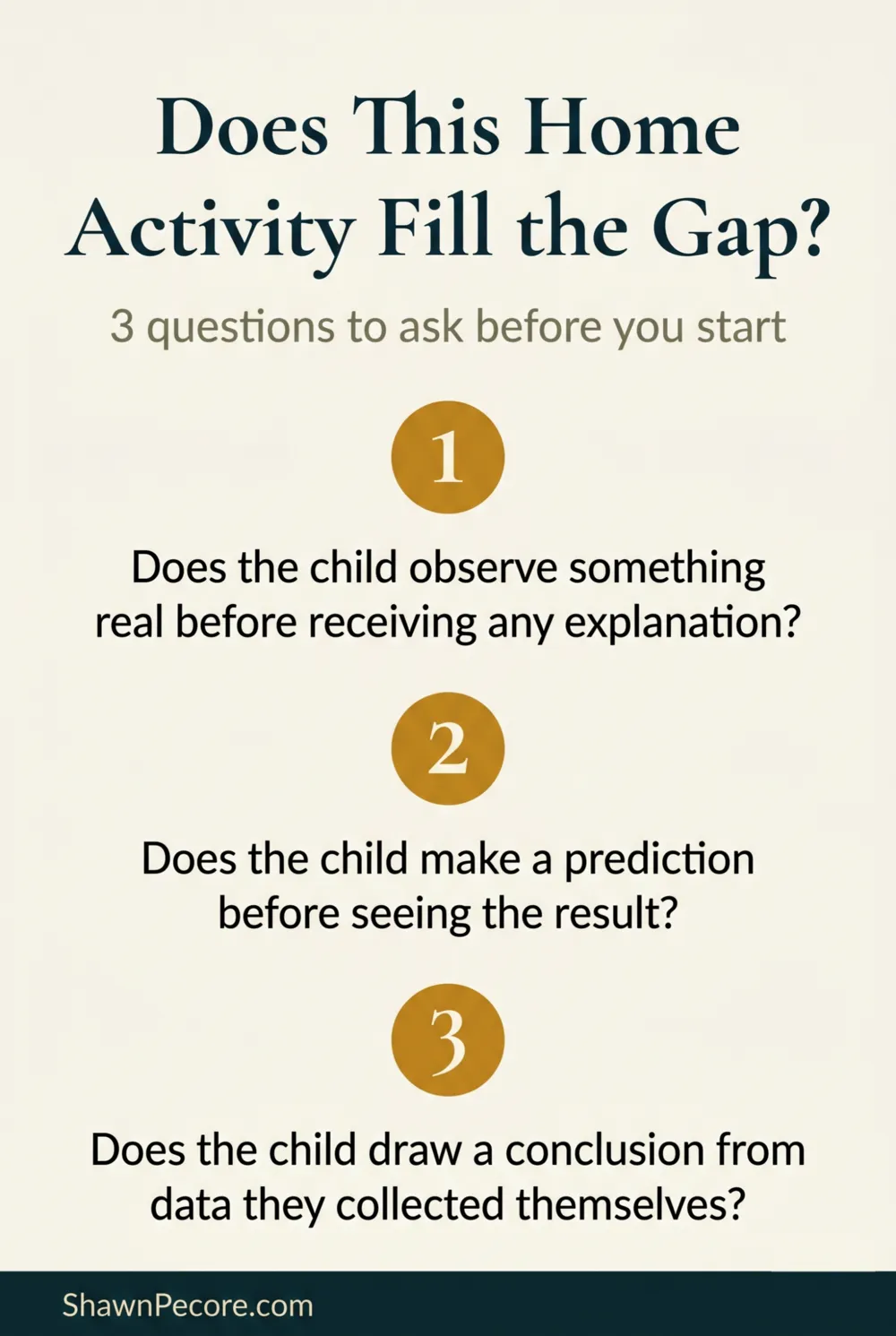
The phenomena-first test for any home activity runs like this. Does the child observe something real before receiving any explanation? Do they form a prediction before seeing the result? Do they draw a conclusion from data they collected themselves? Three yes answers means the activity is doing what science class often cannot. Zero yes answers means the activity is filling the same gap the curriculum left.
The MEYE Science Series is built on that same phenomena-first principle. Real mechanisms, observable predictions, no simplification that sacrifices accuracy. See the full MEYE Science Series for current and upcoming titles.
Try It: Curriculum or Curiosity?
Four home science activities. For each one, decide: does this fill a curriculum gap, or does it replicate the same problem? The distinction is not about effort or expense. It is about what the child is asked to do.
The 44-point gap between interest in science and enjoyment of science class is a curriculum design problem, not a student motivation problem.
Frequently Asked Questions
The biggest gap is between memorising science content and practising scientific thinking. Elementary curricula focus heavily on vocabulary and labelling. The Next Generation Science Standards call for students explaining real phenomena by observing, predicting, testing, and drawing conclusions. That shift is happening slowly. The 2025 American Instructional Resources Survey found that high-quality science materials for elementary students are 13 times rarer than equivalent materials for English or Math. Without the materials, teachers default to what is available, which is almost always the lower-order version of the subject.
Because the science they love outside school is messy, open-ended, and driven by their own questions. The science they encounter in class is tidy, pre-packaged, and driven by the textbook's sequence. A child who spent an afternoon testing which materials float is doing the same cognitive work as a scientist. A child labelling the parts of a plant cell is not. The 2016 Amgen Foundation and Change the Equation survey found 81% interested in science versus 37% who liked science class “a lot.” The subject is not the problem. The delivery is.
Ask three questions about the activity before starting. Does it require the child to observe something real rather than build something predetermined? Does the child make a prediction before seeing the result? Does the child draw a conclusion from data they collected themselves? Three yes answers means the activity is doing science. Zero yes answers means it is a construction project. The baking soda volcano fails all three. A ramp experiment testing whether angle changes how far a ball rolls passes all three and requires no kit.
Phenomenon-based learning starts with something observable and asks the student to explain it. Why does a puddle disappear on a sunny day? Why do some objects sink and others float when they weigh the same? The student observes, forms a hypothesis, tests it, and builds an explanation from the result. Regular science class often works in reverse: here is the vocabulary, here is the concept, here is a worksheet. Phenomenon-based learning builds scientific thinking. Most curricula deliver scientific content instead.
Science is a smaller portion of the instructional day at the elementary level, so the market for materials is smaller and publishers invest less. When the NGSS were adopted, demand for aligned materials outpaced supply almost immediately. The 2025 American Instructional Resources Survey found that teachers seeking high-quality science materials are 40 to 50 percentage points less likely to find them than teachers in English or Math. The shortfall is structural and has not been closed.
Amgen Foundation and Change the Equation, Students on STEM survey, 2016 (Amgen Foundation)
PPIC Educator Survey, science teacher instructional practices, 2024 (PPIC)
American Instructional Resources Survey, RAND Corporation, 2025 (RAND Corporation)
National Association of State Boards of Education, quality science materials report, 2024 (NASBE)
NAEP Nation's Report Card and NWEA, college science readiness data, 2024 (nationsreportcard.gov)
TJ McKenna, Boston University, science as discovery, 2025 (BU Wheelock College)
r/ScienceTeachers, community discussion on student persistence and problem-solving (Reddit)
Part of the series: The Question Every Curious Kid Asks That Textbooks Never Answer